Skin Cancer on the Nose: Why the Cancer Is Cleared First and the Repair Planned Second
✔ Medically reviewed by Dr. Ashutosh Shah - M.B., M.S., M.Ch., D.N.B., Board-Certified Plastic & Cosmetic Surgeon, Director of Elegance Clinic, Surat (22+ years’ experience).
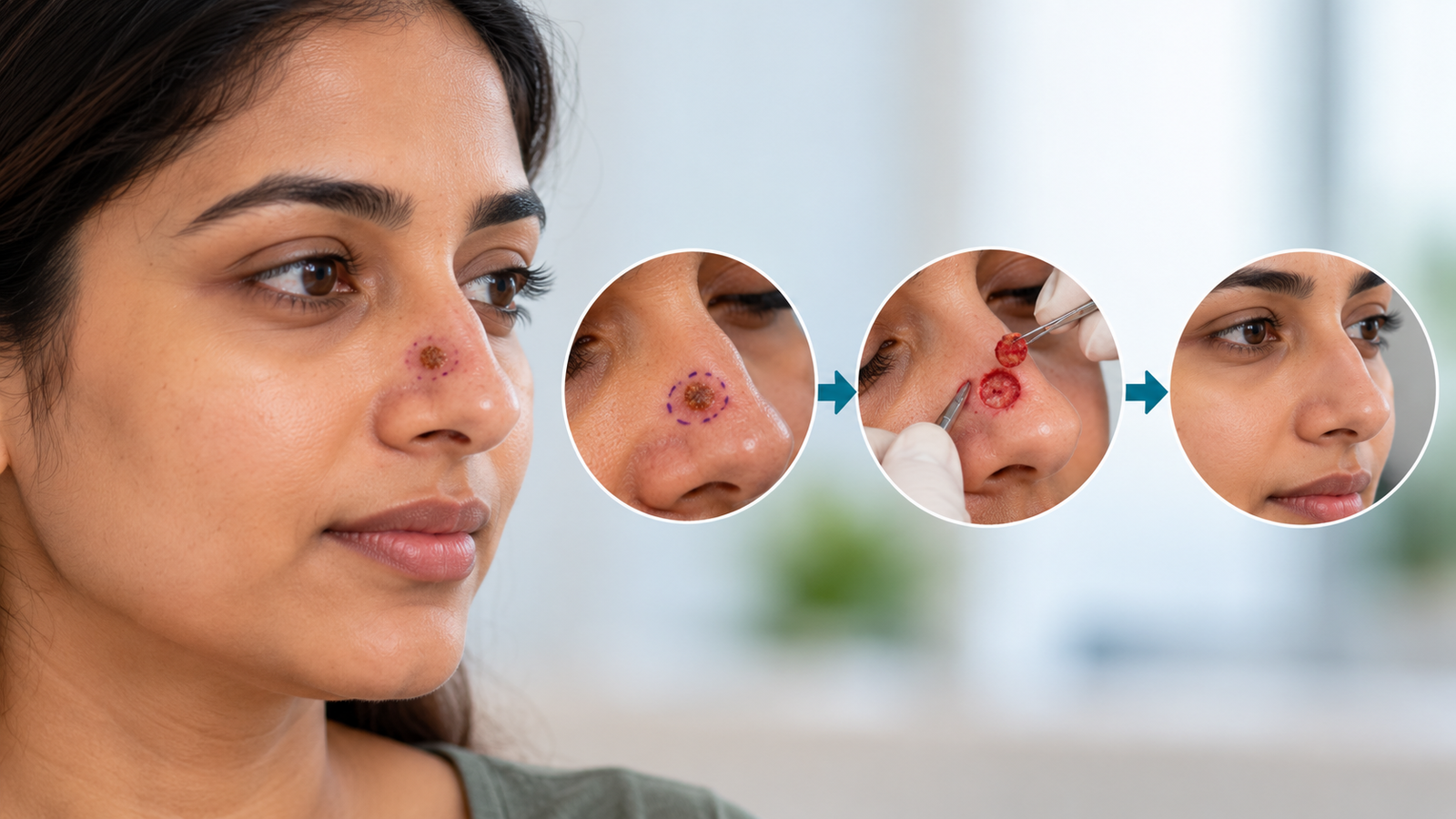
Basal cell carcinoma on the nose is treated by removing it with a margin of normal skin and confirming on histopathology that the edges are clear before the final repair. The defect is then closed by stitching, a skin graft or a local flap such as a bilobed, nasolabial or forehead flap, chosen by the size and part of the nose involved.
Nose reconstruction after skin cancer removal begins with one important priority: ensuring the cancer has been adequately removed. Basal cell carcinoma on the nose is usually treated with surgery and careful examination of the tissue margins. Once clearance is established, the surgeon selects a repair that preserves the nose's shape, breathing function and natural contours.
A diagnosis of skin cancer on the nose can be worrying, particularly because the nose is one of the most visible parts of the face.
Patients often have two concerns: whether the cancer will be completely removed and how their nose will look afterwards.
Fortunately, basal cell carcinoma (BCC) is usually treatable, especially when diagnosed early. However, its location can make treatment more complex because even a relatively small tumour may require careful reconstruction.
The treatment plan must balance cancer clearance, preservation of healthy tissue and reconstruction.
Published: 22 October 2026
Key Takeaways
-
Basal cell carcinoma is the most common type of skin cancer and frequently develops on sun-exposed facial skin.
-
The first priority is removing the cancer with appropriate margin assessment.
-
The nose is a high-risk anatomical location for BCC recurrence, making careful treatment planning important.
-
Mohs micrographic surgery or excision with appropriate histopathological assessment may be recommended.
-
Small defects may be closed directly, while larger defects may require skin grafts or local flaps.
-
Nasal tip, sidewall, bridge and nostril defects require different reconstructive approaches.
-
Large or complex defects may require a staged forehead flap.
-
Regular follow-up is important because additional skin cancers can develop later.
What Is Basal Cell Carcinoma on the Nose?
Basal cell carcinoma is a type of skin cancer that develops from cells within the skin's outer layer.
It commonly occurs on areas exposed to ultraviolet radiation, including the nose, forehead, cheeks and ears.
Although BCC rarely spreads to distant organs, it can gradually invade nearby skin, cartilage and other tissues if left untreated.
Common Signs of Nose Skin Cancer
Possible symptoms include:
-
A small shiny or pearly bump.
-
A pink or reddish growth.
-
A sore that repeatedly heals and reopens.
-
A spot that bleeds easily.
-
A scaly or crusted area.
-
A slowly enlarging lesion.
-
A scar-like patch without a clear injury.
Some lesions are subtle and may resemble harmless skin conditions.
A persistent or changing lesion should be examined by a qualified medical professional.
Why Is BCC on the Nose More Challenging?
The nose contains several important anatomical structures within a relatively small area.
These include thin skin, cartilage, nostril openings and distinct facial contours.
A tumour may extend beyond what is visible on the surface.
Removing it without adequate margin assessment increases the risk of leaving cancer cells behind.
At the same time, removing too much healthy tissue can make reconstruction more difficult.
This is why the cancer-removal plan and reconstructive plan should be coordinated.
Why Must Cancer Margins Be Confirmed Before the Nose Is Rebuilt?
A surgical margin is the border of tissue removed around a tumour.
When a pathologist examines the specimen, they assess whether cancer cells extend to the examined edges.
A negative or clear margin means no cancer cells are identified at the assessed tissue edge.
A positive margin means cancer cells are present at an examined edge and additional treatment may be necessary.
Why Margin Assessment Matters
Basal cell carcinoma can sometimes have microscopic extensions beyond the visible lesion.
These extensions may be especially important in recurrent, aggressive or poorly defined tumours.
If reconstruction is performed over an incompletely removed tumour, further surgery may become more complicated.
Therefore, the priority is adequate cancer clearance before committing to a definitive reconstructive plan.
Is Reconstruction Always Delayed?
No.
The timing depends on the cancer-removal method and how margins are assessed.
With Mohs micrographic surgery, tissue is examined in stages until the assessed margins are clear. Reconstruction can often take place during the same visit once clearance has been established.
With standard surgical excision, the specimen may require laboratory processing before the final pathology report is available.
Depending on the tumour's risk and the planned repair, the surgeon may perform immediate reconstruction or delay definitive closure until the pathology findings are known.
What Happens if the Margins Are Positive?
If cancer cells are found at a margin, further treatment may be recommended.
Options can include additional excision, margin-controlled surgery or another treatment selected by the treating team.
The next step depends on the tumour subtype, location, previous treatment and overall health.
For additional information, see the Basal cell carcinoma FAQs.
Who Removes the Cancer and Who Plans the Nasal Reconstruction?
Treatment may involve a dermatologist, dermatologic surgeon, plastic surgeon, head and neck surgeon or another appropriately trained specialist.
The exact team depends on the tumour's complexity and available expertise.
The Cancer-Removal Specialist
The clinician responsible for removing the tumour focuses on achieving appropriate cancer clearance.
This may involve:
-
Clinical examination.
-
Biopsy and diagnosis.
-
Assessment of tumour size and risk.
-
Selection of the excision method.
-
Histopathological margin evaluation.
-
Planning further treatment when needed.
The Reconstructive Surgeon
The reconstructive surgeon evaluates the defect left after cancer removal.
Important considerations include:
-
The size and depth of missing tissue.
-
The affected nasal subunit.
-
Skin thickness and colour.
-
Available surrounding tissue.
-
Cartilage support.
-
Nostril position.
-
Breathing function.
-
Expected scarring.
For complex cases, reconstruction may be discussed before cancer removal so the patient understands the possible repair options.
Patients can also review the Nose reconstruction after cancer FAQs.
Which Repair Suits the Nasal Tip, Sidewall, Nostril Rim or Bridge?
Nose reconstruction after skin cancer removal is not a single operation.
Different areas of the nose have different skin characteristics and structural requirements.
The surgeon selects a technique based on the final defect rather than the original visible tumour alone.
1. Nasal Tip Reconstruction
The nasal tip has thick, relatively less mobile skin and a rounded three-dimensional shape.
Small defects may sometimes be closed directly or allowed to heal naturally in carefully selected cases.
Other defects may require a bilobed flap, another local flap or a skin graft.
Larger defects may need a staged forehead flap.
2. Nasal Sidewall Reconstruction
The sidewall has relatively flexible tissue in some areas.
Small defects may be closed directly.
Medium defects may be suitable for local advancement or rotation flaps.
Larger defects may require cheek-based or forehead tissue.
3. Nostril Rim Reconstruction
The nostril rim is especially important because it helps maintain the shape of the nostril opening.
Poorly planned reconstruction can cause notching, asymmetry or narrowing.
Depending on the defect, reconstruction may require skin coverage, structural cartilage support and sometimes internal lining replacement.
4. Nasal Bridge Reconstruction
The nasal bridge has different skin characteristics from the tip.
Small defects may be closed directly or repaired with a graft.
Larger defects may require local flaps or more extensive reconstruction.
Nasal Reconstruction Options by Area
| Nasal area | Small defect | Medium defect | Large or full-thickness defect | Typical stages |
|---|---|---|---|---|
| Nasal tip | Direct closure or selected skin graft | Bilobed or other local flap | Forehead flap, sometimes with cartilage support | Usually 1; forehead flap commonly 2–3 |
| Nasal sidewall | Direct closure or skin graft | Advancement or rotation flap | Larger cheek-based or forehead flap | Usually 1; complex repairs may need multiple stages |
| Nostril rim | Carefully selected direct closure or local repair | Nasolabial flap or composite reconstruction | Lining, cartilage support and external skin reconstruction | 1–3 or more depending on complexity |
| Nasal bridge | Direct closure or skin graft | Local advancement or rotation flap | Larger local or forehead flap | Usually 1; complex repairs may be staged |
These are general reconstructive possibilities, not fixed size-based rules. The final technique depends on defect depth, tissue quality, cartilage involvement and surgeon assessment.
What Is Nose Flap Surgery?
A flap is a piece of tissue moved from a nearby or distant area while maintaining or surgically restoring its blood supply.
Unlike a skin graft, a local flap brings tissue with an existing blood supply.
This can be useful when the wound requires additional thickness, contour or coverage over important structures.
Bilobed Flap
A bilobed flap uses two connected sections of nearby skin.
It is commonly considered for selected small to medium defects of the lower nose.
The surgeon designs the flap to redistribute tissue movement and close the wound.
Nasolabial Flap
A nasolabial flap uses skin from the fold between the nose and cheek.
It can be useful for selected defects involving the side of the nose or nostril region.
Some nasolabial flap techniques require a second procedure to divide or refine the tissue.
Forehead Flap
A forehead flap transfers skin from the forehead to reconstruct a larger nasal defect.
It is particularly useful when a substantial amount of nasal skin has been removed.
The transferred tissue may initially remain connected to the forehead through a temporary tissue bridge that supplies blood.
The bridge is divided during a later operation after the transferred tissue has developed adequate circulation.
When Is a Forehead Flap Needed, and Why Is It Done in Stages?
A forehead flap may be recommended when the nasal defect is too large or complex for a simpler local repair.
It may be considered for:
-
Large nasal tip defects.
-
Extensive skin loss involving several nasal subunits.
-
Defects requiring substantial external skin replacement.
-
Complex reconstruction after recurrent cancer.
-
Selected full-thickness nasal defects.
Stage 1: Transfer and Initial Reconstruction
The surgeon transfers forehead skin to the nasal defect.
Additional cartilage support or lining reconstruction may be required.
The flap remains connected to its original blood supply through a temporary pedicle.
Stage 2: Pedicle Division
After the transferred tissue establishes sufficient circulation, the connecting pedicle can be divided.
This is commonly performed after approximately 2–4 weeks, although the timing depends on the flap design, tissue condition and surgical plan.
Stage 3: Refinement When Necessary
Some patients require an additional procedure to improve contour, thickness or symmetry.
Not every forehead flap needs three operations.
The number of stages depends on the complexity of reconstruction.
Will a Forehead Flap Leave Scars?
Yes.
There will usually be scars on the nose and forehead.
Surgeons attempt to position incisions along natural facial boundaries where possible.
Scars generally mature over several months, but they do not disappear completely.
The aim is to restore suitable coverage, support, function and an acceptable appearance.
Will the Nose Look Normal After Skin Cancer Reconstruction?
Patients considering nose reconstruction after cancer often worry about permanent changes in appearance.
The final result depends on the size and depth of the defect, the affected nasal structures and the reconstructive technique.
What Changes Can Patients Expect?
Possible changes include:
-
Visible incision lines.
-
Temporary swelling.
-
Redness.
-
Differences in skin colour.
-
Changes in skin thickness.
-
Mild asymmetry.
-
Altered sensation.
Some patients may need revision procedures after healing.
How Long Does the Nose Take to Heal?
Initial wound healing often occurs over several weeks.
However, swelling and scar maturation can continue for many months.
Complex reconstructions may take longer because they involve several operations.
Patients should understand that complete restoration of the original nasal appearance cannot be guaranteed.
For related questions, visit the Nasal reconstruction FAQs.
Can Laser or Cream Replace Surgery for Nasal Basal Cell Carcinoma?
Not every basal cell carcinoma requires the same treatment.
Certain superficial, low-risk BCCs may be treated with prescribed topical therapies or other nonsurgical approaches in selected circumstances.
However, the nose is considered a high-risk anatomical site.
Surgery with appropriate margin assessment is generally preferred for many nasal BCCs because it provides tissue for pathological evaluation and helps establish whether the tumour has been adequately removed.
Laser treatment does not routinely provide the same comprehensive margin assessment as margin-controlled surgery.
A suspicious lesion should not be treated cosmetically without an appropriate diagnosis.
Some patients may also benefit from information about Precancerous skin lesions, although precancerous lesions and confirmed basal cell carcinoma are different conditions and may require different treatments.
Skin Cancer Surgeon Near City Light Surat: When Should You Seek Consultation?
A persistent sore, bleeding spot or slowly growing lesion on the nose deserves medical evaluation.
Dr. Ashutosh Shah, Plastic and Reconstructive Surgeon at Elegance Clinic, can discuss nasal reconstruction after skin cancer removal, including how defect size, tissue availability and nasal function influence repair planning.
An assessment may include:
-
Reviewing the biopsy or histopathology report.
-
Examining the lesion or post-excision defect.
-
Discussing the planned cancer-clearance approach.
-
Assessing nasal shape and breathing function.
-
Explaining suitable reconstructive techniques.
-
Discussing scars, recovery and possible staged procedures.
For patients seeking a nose cancer reconstruction doctor, it is important to ask how cancer clearance will be confirmed, whether another specialist is involved and when definitive reconstruction is planned.
How Are Patients Followed Up After Basal Cell Carcinoma Removal?
Treatment does not end when the wound heals.
Patients who have had basal cell carcinoma are at increased risk of developing another BCC or other skin cancers.
Regular skin examinations are therefore important.
What Happens During Follow-Up?
The treating clinician may:
-
Examine the surgical scar.
-
Check for signs of recurrence.
-
Assess other sun-exposed skin.
-
Review any new or changing lesions.
-
Recommend ongoing skin protection.
Follow-up frequency depends on tumour risk, treatment history and individual circumstances.
Can Basal Cell Carcinoma Return?
Yes.
Although many BCCs are successfully treated, recurrence remains possible.
Risk can be higher with aggressive tumour subtypes, recurrent tumours or inadequate clearance.
Patients should report new bleeding, persistent sores, growing bumps or unexplained changes around the surgical scar.
How Can You Reduce Future Skin Cancer Risk?
Helpful precautions include:
-
Using broad-spectrum sunscreen.
-
Wearing protective clothing and hats.
-
Avoiding unnecessary intense sun exposure.
-
Monitoring the skin for new or changing lesions.
-
Attending recommended follow-up examinations.
Sun protection reduces ultraviolet exposure but cannot eliminate all future skin cancer risk.
Conclusion
Nose reconstruction after skin cancer removal should begin with a clear cancer-treatment plan.
For basal cell carcinoma on the nose, appropriate excision and margin assessment are essential before selecting or completing definitive reconstruction.
Once the tumour has been adequately treated, the surgeon can choose between direct closure, skin grafting, local flaps and more complex staged procedures.
The nasal tip, sidewall, bridge and nostril rim each require different considerations because their skin, shape and structural support vary.
The aim is not only to cover the wound but also to preserve breathing function, maintain nasal support and achieve the best feasible appearance.
Successful nasal reconstruction combines appropriate cancer clearance, careful surgical planning and long-term follow-up.
Frequently Asked Questions
Is Basal Cell Carcinoma on the Nose Dangerous?
Can Laser or Cream Treat Nasal Basal Cell Carcinoma Instead of Surgery?
Will the Nose Look Normal After a Flap?
How Long Does a Forehead Flap Stay Attached?
Is Mohs Surgery Available in Gujarat?
Can Basal Cell Carcinoma Come Back After Removal?
About the Author