
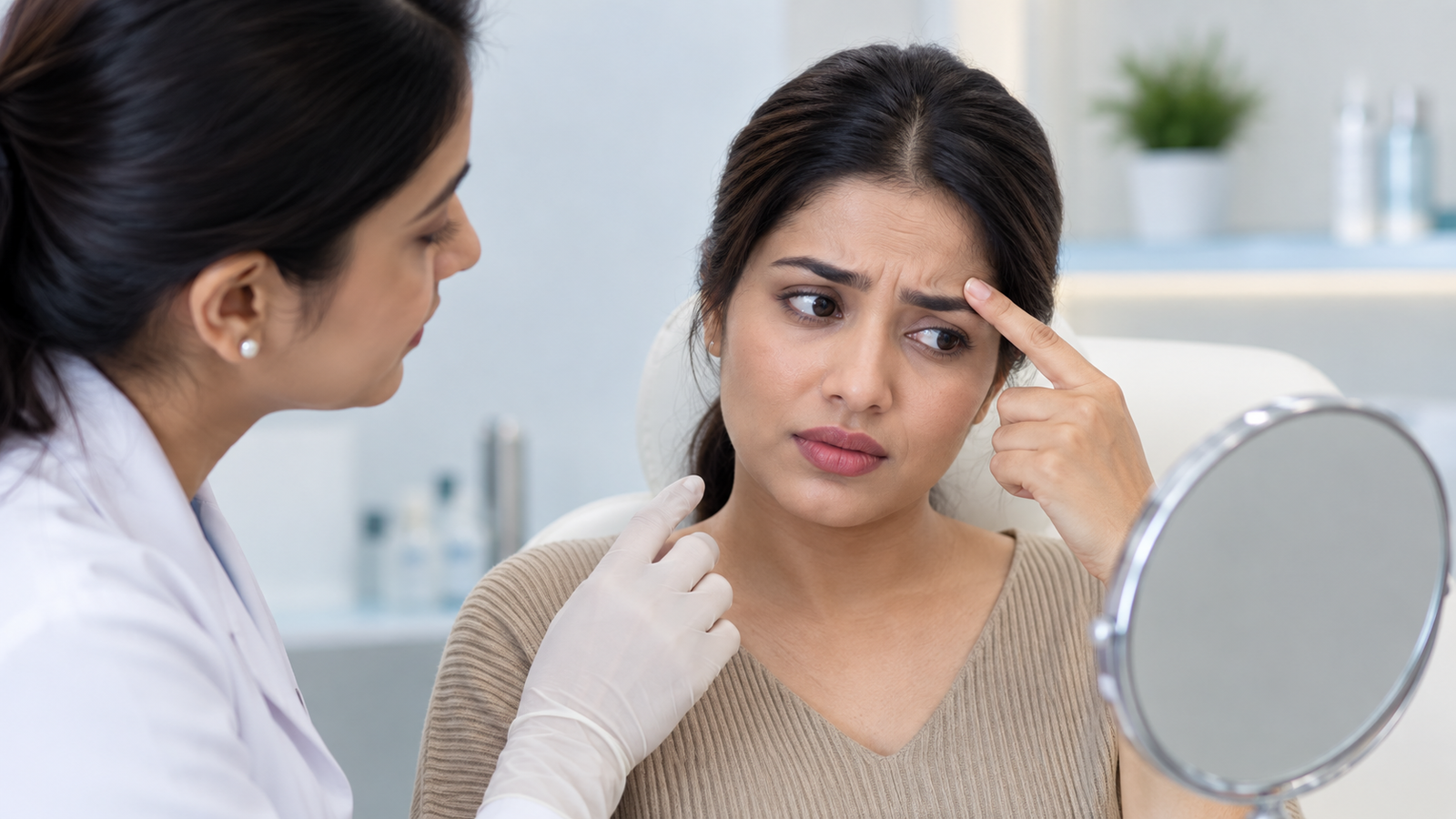
Botox Done Elsewhere Looks Wrong: What Can Be Corrected Now and What Must Wait
✔ Medically reviewed by Dr. Ashutosh Shah - M.B., M.S., M.Ch., D.N.B., Board-Certified Plastic & Cosmetic Surgeon, Director of Elegance Clinic, Surat (22+ years’ experience).
Bad Botox results can sometimes be improved, but not every problem has an immediate correction. If you are wondering how to correct bad botox results, the first step is to identify whether the problem is uneven eyebrows, eyelid droop, excessive muscle relaxation or another imbalance. Some asymmetries can be adjusted, while others mainly need time to settle.
Botox does not produce exactly the same response in every muscle or on both sides of the face. The final appearance can be influenced by the original facial asymmetry, muscle strength, dose, injection depth and placement.
It is also important not to judge the result too early. Botox takes time to develop its effect, so a result that looks slightly uneven initially may change as the treatment settles.
What Are the Three Most Common Bad Botox Results?
Most unwanted Botox results fall into three common patterns.
1. Uneven Eyebrows
One eyebrow may sit higher than the other, or one side may develop a more noticeable arch.
Natural facial asymmetry is common, but Botox can make it more obvious when the muscles on each side respond differently. Differences in dose or injection placement can also contribute.
Mild eyebrow asymmetry is one of the problems that can sometimes be improved with a carefully planned corrective dose.
2. Drooping Eyelid or Heavy Brow
A patient may notice that one upper eyelid appears lower or that an eyebrow feels unusually heavy after treatment.
These are not necessarily the same problem.
A true eyelid droop involves the upper eyelid, while excessive relaxation of the forehead can lower the eyebrow and make the eye appear smaller. Examination is needed to distinguish between them.
3. An Over-Treated or Unnatural Appearance
Too much reduction in muscle activity can make the forehead look excessively still or make the eyebrows feel heavy.
Once a muscle has been over-relaxed, adding more Botox does not reverse the original effect. In many cases, improvement occurs gradually as muscle activity returns.
For more information about how Botox works and where it is used, see Botox uses and benefits.
How to Correct Bad Botox Results Safely
Understanding how to correct bad botox results starts with identifying exactly which muscles have been affected.
Correction does not always mean injecting more Botox.
Depending on the problem, management may involve:
- Waiting for the initial treatment to settle
- Adding a small corrective dose to a carefully selected muscle
- Monitoring an eyelid droop while the Botox effect decreases
- Using prescribed eye drops in selected cases
- Avoiding further injections when muscles are already over-relaxed
- Planning a different dose or injection pattern at the next treatment
The safest option depends on the timing of the original treatment and the type of unwanted result.
Patients seeking assessment can learn more about Botox and fillers at Elegance Clinic.
Bad Botox Correction Table
| Problem | Can It Be Corrected Now? | How It May Be Managed | Expected Settling Time |
|---|---|---|---|
| One eyebrow higher than the other | Sometimes | Small corrective dose after muscle assessment | Depends on response and timing |
| Uneven forehead movement | Sometimes | Observation or selective balancing | Often improves as treatment settles |
| Heavy or low eyebrow | Often needs time | Avoid further weakening until assessed | Gradual improvement as Botox wears off |
| Drooping upper eyelid | Usually needs time | Observation; selected prescription eye drops may help temporarily | Often improves gradually over weeks |
| Over-treated or frozen forehead | Usually not immediately | Allow muscle activity to return | Gradual improvement as Botox wears off |
| Mild early asymmetry | Often wait initially | Reassess once the initial treatment has settled | May improve without further treatment |
Which Problems Can Be Balanced With a Small Corrective Dose?
An uneven eyebrow can sometimes be corrected by treating the side that still has stronger muscle activity.
For example, if one eyebrow remains noticeably higher because a specific muscle is still pulling more strongly, a clinician may consider a small amount of additional Botox in that muscle.
However, more Botox is not automatically better.
Before adding another dose, the doctor should assess:
- Which muscles remain active
- Which muscles are already weakened
- Whether the problem involves the eyebrow or eyelid
- The patient's natural facial asymmetry
- How long ago Botox was injected
- Where the original injections were placed, if known
- Whether the full treatment effect has developed
Injecting too early or into the wrong muscle can increase rather than correct the imbalance.
Why Must an Eyelid Droop Mostly Be Waited Out?
A drooping eyelid after Botox may occur when Botox affects a muscle involved in lifting the upper eyelid.
Unlike an uneven eyebrow caused by remaining muscle activity, a weakened eyelid-lifting muscle cannot simply be strengthened with another Botox injection.
There is also no routine antidote that immediately switches off Botox after it has taken effect.
For this reason, a Botox-related eyelid droop generally improves as the effect gradually wears off.
Can Eye Drops Help?
Certain prescription eye drops may temporarily stimulate another eyelid muscle and slightly improve eyelid position in selected patients.
However, eye drops do not reverse Botox.
They should only be used after a clinician confirms that the problem is actually an eyelid droop and that the medication is suitable.
Patients with significant or unusual eye symptoms should have them medically assessed rather than assuming Botox is the cause.
For concerns involving eyebrow position, see Sagging brow correction.
What Went Wrong Technically: Dose, Depth or Placement?
Several factors can contribute to an unwanted Botox result.
Dose
The amount of Botox needs to match the strength and function of the targeted muscle.
Too much treatment may excessively reduce movement, while too little on one side can leave stronger muscle activity and visible asymmetry.
Injection Placement
Botox affects the muscles around the injection area.
Small differences in placement can therefore change how the forehead and eyebrows move after treatment.
Understanding facial anatomy is particularly important around the forehead, brow and eye area.
Injection Depth
Different facial muscles lie at different depths.
Injection technique therefore needs to be adapted to the particular muscle and treatment area rather than using exactly the same depth everywhere.
Natural Facial Asymmetry
Most faces are not perfectly symmetrical before Botox.
One eyebrow may naturally sit higher, or one side of the forehead may move more strongly.
If these differences are not identified before treatment, they can become more noticeable afterwards.
Pre-treatment photographs and examination of facial movement can help document these differences.
How Is a Corrective Assessment Done?
A corrective assessment should begin with examination, not another injection.
The doctor may first ask:
- When was the Botox performed?
- Which facial areas were treated?
- Which Botox product was used?
- How many units were injected, if known?
- When did the problem become noticeable?
- Has it improved or worsened?
- Have you had Botox previously?
- Do you have photographs from before treatment?
The face should then be assessed both at rest and during movement.
The patient may be asked to raise the eyebrows, frown, smile or perform other facial movements. This allows the clinician to see which muscles remain active and which have already been weakened.
Timing Matters
If Botox was performed very recently, the final result may not yet be apparent.
Trying to correct the result too early may introduce another imbalance before the original treatment has finished developing.
If appropriate, the doctor may therefore recommend waiting and reassessing before deciding whether an additional dose is needed.
For other lower-face concerns, see Treatment for drooping mouth corners.
When Should You Wait Instead of Adding More Botox?
Waiting is often safer when:
- The original Botox was performed recently
- The full effect has not developed
- The forehead already looks over-treated
- An eyebrow has become too low
- A true eyelid droop is present
- The asymmetry is mild
- Additional weakening could worsen the result
Botox is temporary. Its effect gradually reduces and muscle movement returns.
This means some unwanted results improve without additional treatment.
A corrective consultation should therefore answer two separate questions: Can this problem actually be corrected now, and would another injection make the overall result better or worse?
How Long Until Bad Botox Wears Off?
There is no single settling time that applies to everyone.
The duration depends on factors such as the dose, muscle treated, individual response and severity of the unwanted effect.
A minor asymmetry may improve as the initial Botox settles. Problems caused by excessive muscle weakening generally need more time because improvement depends on muscle activity gradually returning.
Patients should therefore be cautious about promises that an unwanted Botox result can always be corrected immediately.
Conclusion
Knowing how to correct bad botox results means recognising that different problems require different approaches.
An uneven eyebrow may sometimes be balanced with a small corrective dose, while an over-treated forehead, heavy brow or drooping eyelid after Botox may primarily need time for muscle activity to recover.
Dose, depth, placement, natural facial asymmetry and the timing of the original treatment should all be considered before further injections are given.
The aim of corrective assessment is therefore not simply to add more Botox. It is to determine whether a targeted adjustment is appropriate now or whether waiting will produce the safer and more natural result.
Frequently Asked Questions
Can Extra Units Fix an Uneven Eyebrow After Botox?
How Long Does a Drooping Eyelid From Botox Last?
Is There an Antidote That Reverses Botox?
Why Does One Side Settle Faster Than the Other?
Should the Next Session Be Delayed After a Bad Result?
Do Eye Drops Help a Botox-Related Eyelid Droop?
About the Author