
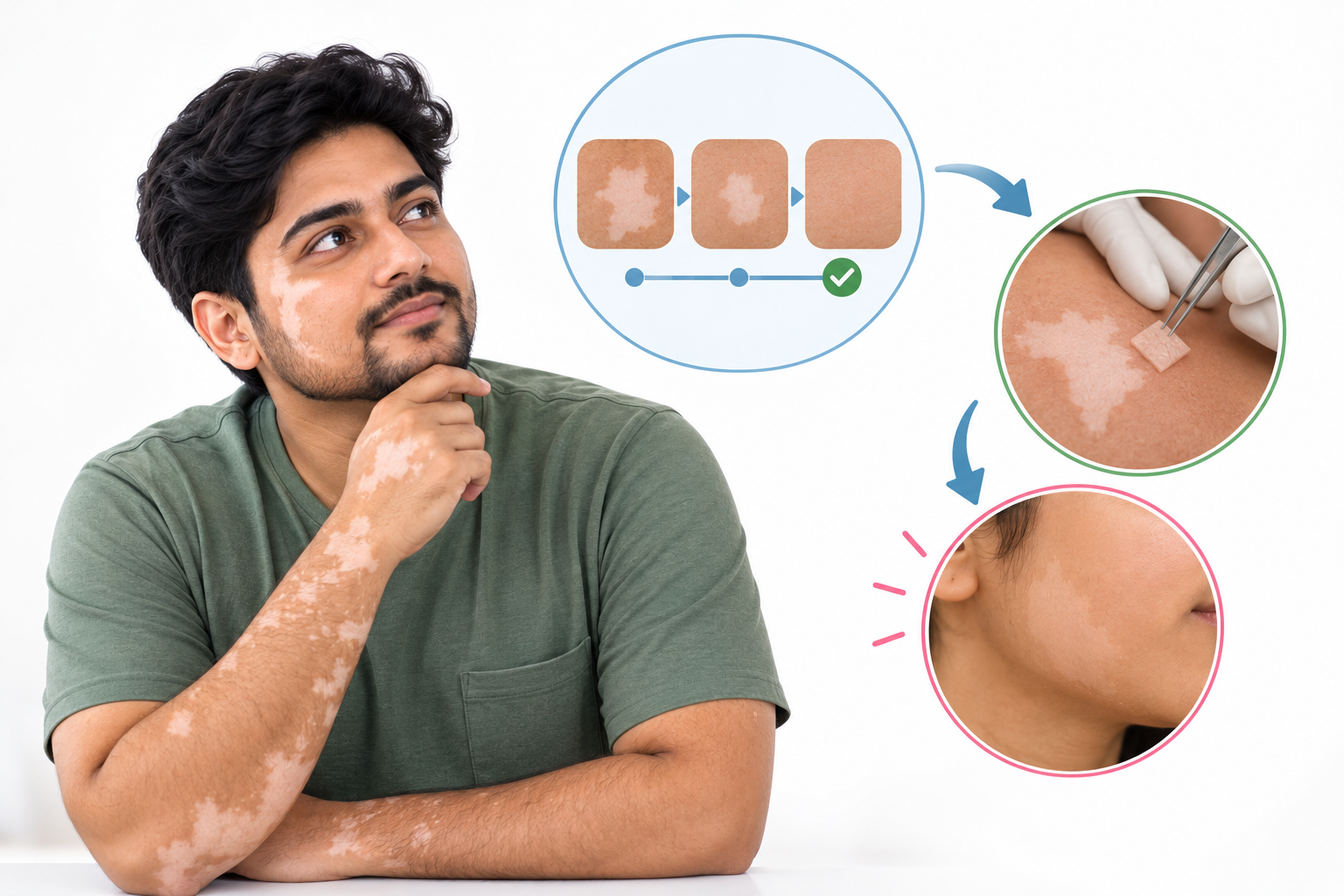
Who Is Actually a Candidate for Vitiligo Surgery? The Stability Rule Explained
✔ Medically reviewed by Dr. Ashutosh Shah - M.B., M.S., M.Ch., D.N.B., Board-Certified Plastic & Cosmetic Surgeon, Director of Elegance Clinic, Surat (22+ years’ experience).
When deciding who is a candidate for vitiligo surgery, stability is one of the most important factors. Surgery is generally considered only when patches have remained stable for an appropriate period, without meaningful new lesions or enlargement. The site, size, previous treatment response and, in selected cases, a test graft also help determine whether surgery is suitable.
Vitiligo surgery is therefore not simply a treatment for any white patch that has failed to regain colour. The first question is whether the condition is stable enough for transplanted pigment-producing cells or grafts to have a reasonable opportunity to survive and produce repigmentation.
What Does Stable Vitiligo Mean and How Is Stability Measured?
Vitiligo stability before surgery means more than simply noticing that one patch looks unchanged.
The clinician looks at the overall behaviour of the condition over time.
Important points include whether:
- existing patches have increased in size;
- new patches have appeared;
- previously pigmented areas have lost additional colour;
- lesions have appeared after skin injury or friction; and
- the condition appears clinically inactive.
Photographs taken at different times can be particularly useful because they allow the surgeon to compare the borders and dimensions of individual patches.
A detailed history is also important. Patients should tell the doctor about new spots even when they appeared somewhere away from the area being considered for surgery.
The aim is to determine whether the disease process is sufficiently inactive before attempting surgical repigmentation.
Patients can learn more about available procedures on the Vitiligo surgery at Elegance Clinic page.
What Is the Minimum Stable Period Before Any Grafting?
There is no single stability period that should be applied to every patient without clinical assessment.
In practice, surgeons generally want evidence that vitiligo has remained stable for a meaningful period before considering grafting or melanocyte-transfer procedures.
The assessment should look beyond one patch.
If the patch being considered has remained unchanged but new vitiligo has appeared elsewhere, the disease may not be considered sufficiently stable for surgery.
This is why vitiligo stability before surgery should be assessed from the overall pattern of disease rather than from one photograph or one area alone.
A longer period of stability can give the treating team greater confidence that the condition is inactive, but duration alone does not guarantee a successful result.
Site, previous treatment, skin behaviour and the type of vitiligo also influence the decision.
Who Is a Candidate for Vitiligo Surgery?
So, who is a candidate for vitiligo surgery?
A suitable candidate is generally someone whose vitiligo is clinically stable and whose remaining patches have not responded adequately to appropriate non-surgical treatment.
The assessment may consider:
- stability of the condition;
- location of the patch;
- size of the treatment area;
- age and general health;
- previous medical treatment;
- previous phototherapy where relevant;
- tendency to develop lesions after skin injury;
- availability of a suitable donor area; and
- expectations about colour matching and repigmentation.
Surgery is not necessarily the next step simply because creams have not produced rapid results.
At Elegance Clinic, Dr. Ashutosh Shah can assess the pattern and stability of the vitiligo before determining whether a surgical repigmentation procedure should be considered.
What Does Melanocyte Transfer Eligibility Depend On?
Melanocyte transfer eligibility depends strongly on whether the vitiligo is stable.
Melanocytes are the cells responsible for producing pigment. In suitable surgical techniques, pigment-producing cells obtained from a donor area are prepared and transferred to the depigmented treatment area.
However, transferring melanocytes into skin where vitiligo remains active may not produce a predictable long-term result.
The clinician therefore assesses both the recipient area and the behaviour of the condition before recommending the procedure.
The size and location of the patch also matter because different sites may respond differently.
Patients interested in facial treatment can read more about Vitiligo surgery for the face.
Which Body Sites Respond Well and Which Do Not?
Treatment site can influence the outcome of vitiligo surgery.
Some areas of the body may repigment more predictably than others, while areas such as the lips, fingertips and certain bony or acral sites can be more challenging.
This does not automatically mean treatment is impossible in difficult areas.
Instead, expectations need to be adjusted according to the site, type of vitiligo, size of the patch and selected surgical technique.
The surgeon also evaluates whether the recipient skin is healthy enough for the proposed procedure.
Scarring, repeated trauma, active inflammation or other local skin problems may affect planning.
The important point is that melanocyte transfer eligibility cannot be determined only by looking at the total size of the white patch.
Location matters too.
Why Is a Test Graft Done Before a Large Procedure?
A test graft may be recommended in selected patients before treating a larger area.
The purpose is to see how a small area responds before committing to a more extensive procedure.
A successful test area can provide useful information about:
- pigment uptake;
- repigmentation;
- colour development;
- healing;
- donor-site behaviour; and
- whether the condition appears stable after controlled skin injury.
A test graft does not guarantee that every larger treatment area will behave identically, but it can provide additional information for surgical planning.
This is particularly useful when the clinician wants further evidence about vitiligo stability before surgery or the likely response of a particular treatment site.
Vitiligo Surgery Eligibility Checklist
| Factor | What Is Assessed | Go / Consider Surgery | No-Go / Reassess |
|---|---|---|---|
| Stability period | New or enlarging patches | Stable disease | Active or changing disease |
| Treatment site | Location of white patches | Suitable treatment site | Difficult site requiring cautious expectations |
| Size | Extent of area requiring treatment | Practical treatment area | Very extensive area may need another strategy |
| Previous treatment | Response to medical treatment | Persistent stable patch despite treatment | Adequate medical treatment not yet completed |
| Skin condition | Health of recipient and donor skin | Healthy treatment areas | Active infection/inflammation or other problems |
| Test graft | Pigment and healing response | Supportive response | Poor response requiring reassessment |
| Expectations | Understanding of likely outcome | Realistic expectations | Expectation of guaranteed perfect colour matching |
This checklist is a guide to assessment rather than a substitute for an examination.
Which Patients Should Stay on Medical Treatment Instead?
Understanding when vitiligo surgery should not be done is as important as knowing who may benefit.
Surgery may not be the appropriate next step when vitiligo is actively spreading or when new patches continue to appear.
A patient may also be advised to continue medical management if non-surgical treatment has not yet been adequately tried.
Treatment can include medicines and other dermatologist-directed approaches depending on the individual condition.
Information about non-surgical management is available under Vitiligo cream treatment.
Surgery should also be reconsidered when the treatment area is unsuitable, expectations are unrealistic or the patient's skin response suggests that surgical trauma could create additional problems.
The objective is not to operate as soon as possible. It is to choose surgery when the disease and treatment area provide an appropriate setting for repigmentation.
How Is the Surgical Plan Made at Elegance Clinic?
At Elegance Clinic, Dr. Ashutosh Shah evaluates the vitiligo pattern, treatment history, stability and location of the patches before discussing surgical options.
The consultation may include reviewing previous photographs and treatments, examining potential donor and recipient areas, and determining whether further medical treatment or observation is needed before surgery.
If surgery is appropriate, the technique is selected according to the individual patch and treatment goals.
The consultation should also cover realistic expectations.
Vitiligo surgery aims to restore pigmentation in selected stable areas, but an exact colour match cannot be guaranteed in every case.
Patients with skin changes following trauma or other conditions may also find the overview of Skin surgery options after injury useful when exploring reconstructive skin procedures.
Why Previous Treatment Matters
A surgical consultation should include a complete history of previous vitiligo treatment.
Tell the surgeon about creams, tablets, phototherapy or previous surgical procedures and how the patches responded.
This information helps determine whether the remaining depigmented area represents stable disease that has not responded adequately to non-surgical treatment.
Patients should also bring older photographs when available. Images taken several months apart can help demonstrate whether a patch has changed.
The decision about who is a candidate for vitiligo surgery should therefore be based on disease behaviour, treatment history and examination rather than on the appearance of one patch during a single visit.
Conclusion
Determining who is a candidate for vitiligo surgery requires more than checking whether a white patch is present. Stability, location, size, previous treatment, skin behaviour and sometimes the response to a test graft all contribute to the decision.
The most important principle is that surgery is generally considered for appropriately selected, stable vitiligo rather than actively spreading disease.
At Elegance Clinic, Dr. Ashutosh Shah can assess vitiligo stability before surgery, treatment history and the affected site before deciding whether melanocyte transfer or another surgical approach should be considered.
A careful eligibility assessment helps determine not only whether surgery can be performed, but whether it is the appropriate next step for that particular patient.
Frequently Asked Questions
How Long Must Vitiligo Be Stable Before Surgery?
Do Lips and Fingertips Respond to Grafting?
Is a Test Graft Done Before the Main Procedure?
Can Surgery Be Done While on Oral Medicines?
Will the Transplanted Colour Match Exactly?
Can Vitiligo Spread After Surgery?
About the Author