
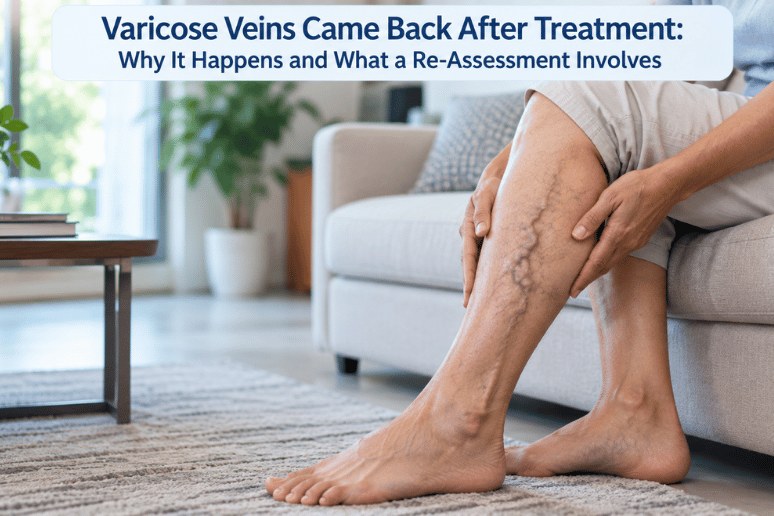
Varicose Veins Came Back After Treatment: Why It Happens and What a Re-Assessment Involves
✔ Medically reviewed by Dr. Ashutosh Shah - M.B., M.S., M.Ch., D.N.B., Board-Certified Plastic & Cosmetic Surgeon, Director of Elegance Clinic, Surat (22+ years’ experience).
If your varicose veins came back after treatment, the cause may be reopening of a treated vein, persistent reflux, an untreated tributary or perforator, or new reflux developing in another vein. A repeat duplex Doppler helps identify the current source so further treatment can be planned according to the present vein pattern rather than simply repeating the first procedure.
Recurrence does not always mean that the original laser treatment or surgery failed. Varicose veins are related to abnormal venous blood flow, and the pattern can change with time.
Some patients notice the same veins returning, while others develop visible veins in a different part of the leg. Symptoms such as aching, heaviness, swelling, itching or skin changes may also return.
The important question is therefore not simply, “Why have my veins come back?” It is where the abnormal blood flow is coming from now.
At Elegance Clinic, Dr. Ashutosh Shah can assess the previous treatment history, current symptoms and present venous pattern before discussing whether further treatment may be appropriate.
What Are the Common Reasons Veins Recur?
There are several possible recurrent varicose veins causes. The exact reason can only be determined after clinical assessment and, when appropriate, duplex Doppler mapping.
Possible causes include:
- Reopening of a previously treated vein
- Persistent reflux in a vein that was not fully treated
- Residual tributary veins
- Incompetent perforator veins
- Development of reflux in another superficial vein
- Progression of underlying venous disease
- New collateral veins becoming enlarged
- A different source of reflux developing over time
A visible recurrent vein does not tell the surgeon where the problem begins.
For example, a bulging surface vein may be connected to a larger refluxing superficial vein. In another patient, the main previously treated vein may remain closed while a different tributary has become enlarged.
These situations may look similar from outside but require different treatment plans.
Does Laser Treatment Always Fail When Veins Return?
No.
A previously laser-treated vein may remain successfully closed while another vein develops abnormal reflux. Alternatively, part of a treated vein may reopen.
This distinction is important when patients search for why laser vein treatment fails. The presence of a new visible vein alone cannot confirm that the original laser procedure failed.
A repeat Doppler can help determine whether the original treated pathway remains closed.
Patients can learn more about available approaches through varicose and vascular surgery.
Can Recurrent Veins Cause Symptoms Again?
Yes. Recurrent varicose veins may again be associated with:
- Aching
- Heaviness
- Swelling
- Itching
- Night cramps
- Local discomfort
- Visible bulging veins
- Skin pigmentation or other skin changes
However, not every patient with recurrent visible veins develops significant symptoms.
Leg pain and swelling can also have causes unrelated to varicose veins, so symptoms should be assessed rather than automatically attributed to venous disease.
What Must a Proper Duplex Doppler Map Cover?
A duplex Doppler scan combines ultrasound imaging with blood-flow assessment.
When varicose veins have already been treated, the purpose of the scan is not simply to confirm that veins are visible again. It should help identify the source and pathway of the current abnormal flow.
A repeat Doppler after vein surgery or laser treatment may assess:
- Deep veins
- Superficial veins
- Previously treated vein segments
- Major superficial vein pathways
- Tributary veins
- Perforator veins
- Areas of reflux
- Areas of obstruction when clinically relevant
- Relationship between visible veins and their feeding source
Why Does the Previous Treatment Matter?
The anatomy after treatment may be different from the anatomy before the first procedure.
The scan should therefore establish questions such as:
- Is the previously treated vein still closed?
- Has part of the treated vein reopened?
- Is another superficial vein now refluxing?
- Is a tributary responsible for the visible veins?
- Is a relevant perforator contributing?
- Is there another pathway feeding the recurrence?
This information helps avoid treating only what can be seen on the skin.
Why Is Vein Mapping Important Before Re-Treatment?
Visible varicose veins are often the end result of abnormal pressure elsewhere in the venous system.
Treating a surface vein without identifying its source may not address the complete problem.
A useful way to think about Doppler mapping is that it creates a map of the current venous pathway. Once the source is identified, the doctor can decide which vein, if any, requires treatment.
Patients who want to understand the available methods can read how varicose veins are treated.
Recurrence-Cause Table
| Pattern on Doppler | Likely explanation | Possible re-treatment approach |
|---|---|---|
| Persistent reflux in a previously treated pathway | Residual or persistent abnormal flow | Treatment based on the current anatomy |
| Recanalised vein | Previously treated segment has reopened | Further endovenous or another appropriate treatment may be considered |
| Residual tributary | Surface tributary remains enlarged | Targeted treatment may be considered |
| Relevant incompetent perforator | Abnormal flow through a perforating vein | Selected perforator-focused treatment may be considered |
| New reflux in another superficial vein | Venous disease has developed through another pathway | Treatment directed at the newly identified reflux source |
| Local surface veins without major axial reflux | Residual or newly enlarged superficial veins | Injection or another localized treatment may be considered |
The table is a general guide rather than a treatment prescription. The appropriate approach depends on symptoms, examination, Doppler findings and previous treatment.
Which Perforator and Tributary Veins Are Missed First Time?
Varicose veins form part of a venous network. A recurrent vein may therefore arise from a tributary or perforator rather than from the same main vein treated previously.
Tributary Veins
Tributaries are smaller veins connected to larger superficial veins.
When a main refluxing vein is treated, some tributaries may become less prominent. Others can remain visible or become more noticeable later.
A residual tributary does not necessarily mean the main treatment failed. The important question is whether the tributary is isolated or is still receiving abnormal flow from another refluxing pathway.
Perforator Veins
Perforator veins connect the superficial venous system with deeper veins.
Some perforators can become incompetent and contribute to abnormal superficial venous pressure.
However, the presence of a perforator on ultrasound does not automatically mean it needs treatment.
Its significance depends on:
- Location
- Direction of blood flow
- Associated reflux
- Visible vein pattern
- Symptoms
- Skin changes
- Overall Doppler findings
Why Can These Veins Matter After Previous Treatment?
If varicose veins came back after treatment, the current source may differ from the original source.
This is why simply repeating laser treatment on the same area without new mapping may not address the actual problem.
The treatment should be based on the present venous anatomy.
How Is a Re-Assessment Done After Treatment Elsewhere?
When a patient has already undergone laser treatment, injections or surgery at another centre, the reassessment begins with understanding what was previously done and what has changed since then.
If available, bring:
- Previous Doppler reports
- Date of the first treatment
- Operative or procedure notes
- Discharge summary
- Details of veins treated
- Previous photographs
- Information about complications
- Details of compression therapy
- Any subsequent treatment records
Do not worry if you do not have every document. A fresh examination and Doppler assessment can still provide useful information about your current condition.
Clinical Examination
The doctor may examine:
- Visible varicose veins
- Distribution of recurrent veins
- Leg swelling
- Tender areas
- Skin pigmentation
- Other skin changes
- Previous scars
- Healed or active ulcers
You should also explain when the veins returned and whether symptoms have changed.
Important symptoms include:
- Aching
- Heaviness
- Swelling
- Itching
- Night cramps
- Local pain
- Skin discoloration
- Previous or current ulcers
Patients with persistent wounds can also read about chronic leg ulcer treatment in Surat.
Repeat Duplex Doppler
The Doppler examination should help answer the central question:
What is feeding the recurrent veins now?
This may show that:
- The original treated vein remains closed
- A treated segment has reopened
- Another vein has developed reflux
- A tributary remains active
- A relevant perforator is contributing
- The visible veins are relatively localized
Once this is known, further treatment can be planned according to the actual source.
How Soon Can Veins Recur?
There is no single recurrence timeline.
Some residual veins may remain noticeable relatively early after treatment. Other patients may develop new reflux or new varicose veins months or years later.
The timing alone does not establish why the veins returned.
This is another reason why a new Doppler assessment can be more useful than assuming that the original procedure has failed.
Which Recurrent Patterns Need Surgery and Which Need Injection Only?
There is no single treatment for every recurrent varicose vein.
The treatment method should match the anatomy identified during examination and Doppler mapping.
When Injection Treatment May Be Considered
Selected localized superficial recurrent veins may be suitable for injection-based treatment when there is no major underlying reflux pathway requiring another approach.
The decision depends on:
- Vein size
- Vein location
- Source of reflux
- Previous treatment
- Symptoms
- Doppler findings
When the Underlying Reflux Source Also Needs Treatment
If a significant refluxing vein is feeding the visible recurrent veins, treating only the surface branches may not address the source.
The underlying abnormal pathway may also need treatment.
This could involve an endovenous procedure or another approach depending on the anatomy.
Patients can read more about laser treatment for varicose veins.
When Is Another Procedure Considered?
Further treatment may be considered when the patient has:
- Persistent symptomatic reflux
- Recanalisation of a previously treated vein
- Another significant refluxing superficial vein
- Relevant tributary disease
- Selected perforator-related disease
- Persistent symptomatic varicosities
- Venous skin changes or complications requiring assessment
The exact procedure should be chosen only after identifying the current source.
The useful question is therefore not:
“Should I have laser, injection or surgery?”
Instead, ask:
“Which vein is causing the recurrence, and which treatment is appropriate for that vein?”
What Result Can Be Expected After Re-Treatment?
Re-treatment aims to address the abnormal vein pattern identified during reassessment.
Depending on the patient's condition, treatment may help reduce visible varicosities or symptoms associated with venous reflux.
However, treating current abnormal veins does not guarantee that another vein will never become varicose in the future.
Venous disease can progress over time.
Patients should therefore understand that re-treatment is directed at the present problem rather than providing a lifetime guarantee against every future varicose vein.
Planning Treatment After Varicose Veins Return
When varicose veins came back after treatment, a fresh assessment is generally more useful than automatically repeating the original procedure.
At Elegance Clinic, Dr. Ashutosh Shah can review previous treatment, current symptoms, clinical findings and relevant duplex Doppler results before discussing whether additional treatment may be appropriate.
The assessment should establish:
- Which veins are abnormal now?
- Is the previously treated vein still closed?
- Where is the current reflux coming from?
- Are tributaries or perforators contributing?
- Does the recurrent pattern require treatment?
- Which treatment matches the current anatomy?
This approach helps ensure that the treatment plan addresses the current venous problem rather than relying only on what was done previously.
Conclusion
If your varicose veins came back after treatment, it does not automatically mean that the original procedure failed. Recurrence may result from reopening of a treated vein, persistent reflux, residual tributaries, relevant perforators or new reflux developing in another venous pathway.
A repeat duplex Doppler can map the current pattern and determine where abnormal blood flow is coming from.
Treatment can then be matched to the finding. Some localized recurrent veins may be suitable for injection-based treatment, while other patterns may require treatment of an underlying refluxing vein.
The key is to reassess the venous system first rather than automatically repeating the previous treatment.
Frequently Asked Questions
Does laser treatment for varicose veins ever fail?
Do I need a repeat Doppler scan before re-treatment?
Can recurrent varicose veins be treated without surgery?
How soon after first treatment can varicose veins recur?
Are recurrent varicose veins more painful?
How long must compression stockings be worn?
About the Author