
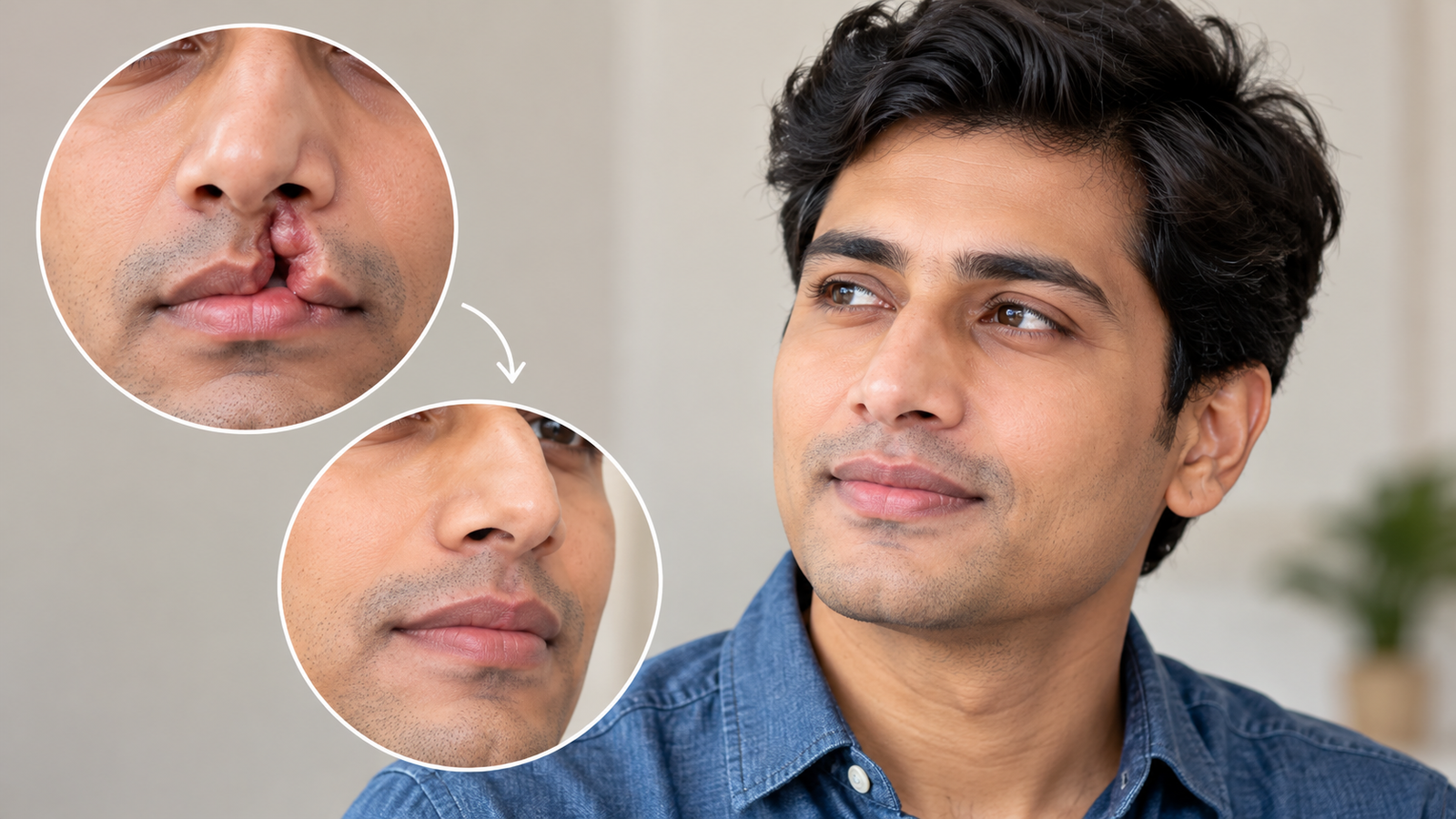
Cleft Lip Nose in Adults: Is It Too Late to Correct the Nose and Lip Scar?
✔ Medically reviewed by Dr. Ashutosh Shah - M.B., M.S., M.Ch., D.N.B., Board-Certified Plastic & Cosmetic Surgeon, Director of Elegance Clinic, Surat (22+ years’ experience).
It is not too late. The definitive cleft lip nose correction is usually done after facial growth is complete, around 16 to 18 years, so adults are ideal candidates. The surgeon supports the slumped nostril with cartilage from the septum, ear or rib, straightens the tip and septum to improve breathing, and can revise the lip scar in the same sitting.
Many adults who underwent cleft lip repair during childhood still notice differences in their nose or upper lip. One nostril may appear flatter, the nasal tip may lean to one side, or the previously repaired lip may have a visible scar or notch.
Cleft lip nose deformity correction can address these concerns even when the original cleft repair took place many years ago.
Adult treatment focuses on improving nasal structure, breathing and facial balance rather than simply changing the external appearance.
Dr. Ashutosh Shah, a plastic and reconstructive surgeon associated with Elegance Clinic, can assess the existing nasal deformity, previous cleft repair and individual treatment goals to discuss suitable reconstructive options.
Key Takeaways
-
Adults can undergo cleft lip nose deformity correction after childhood cleft repair.
-
Definitive cleft rhinoplasty is generally planned after facial growth is complete.
-
Surgery may improve flattened nostrils, nasal tip asymmetry and breathing difficulties.
-
Cartilage grafts from the septum, ear or rib may provide additional nasal support.
-
Lip scar revision and cleft nose repair can sometimes be combined.
-
Complete facial symmetry cannot be guaranteed.
-
Final nasal shape may take 12 months or longer to settle after complex reconstruction.
Why Does the Nose Still Look Different After Childhood Cleft Repair?
A cleft lip affects more than the upper lip. It can also influence the development and position of nasal cartilage, the nostril base and surrounding soft tissues.
Even after successful childhood cleft repair, differences in nasal structure may remain or become more noticeable as the face grows.
Common concerns include:
-
A flattened or widened nostril on the cleft side.
-
A nasal tip that appears tilted or asymmetrical.
-
A short or displaced columella.
-
A deviated nasal septum.
-
Unequal nostril openings.
-
Difficulty breathing through one side of the nose.
-
A visible upper-lip scar or notch.
The severity varies from person to person.
Patients with unilateral cleft lip may have greater asymmetry on one side, while bilateral cleft lip can produce different structural changes affecting both nostrils and the central nasal support.
Why Can Childhood Surgery Leave Some Nasal Asymmetry?
Early cleft surgery primarily aims to restore lip continuity and support normal feeding, growth and function.
The surgeon may also improve the nasal shape during childhood, but definitive structural correction is often delayed until facial growth is substantially complete.
Scar tissue from earlier operations can also influence the position of the nose and lip.
As a result, adults may seek cleft lip nose surgery to address remaining deformity or breathing problems.
Why Is the Main Nose Correction Delayed Until Growth Is Complete?
Definitive cleft rhinoplasty is generally planned after skeletal maturity because the nose and surrounding facial structures continue developing during childhood and adolescence.
Operating extensively on growing nasal structures may affect subsequent growth or require additional correction later.
For many patients, facial growth is substantially complete during the later teenage years, although the exact timing varies.
What Is the Best Age for Cleft Nose Repair?
Definitive correction is commonly considered around the later teenage years, often approximately 16–18 years or later, depending on individual growth and development.
The decision should not rely on age alone.
A surgeon may consider:
-
Whether facial growth is complete.
-
The severity of the nasal deformity.
-
Previous cleft operations.
-
Nasal breathing problems.
-
Available cartilage for reconstruction.
-
The patient's treatment goals.
The American Cleft Palate-Craniofacial Association's parameters of care support coordinated, individualised cleft management, with definitive nasal correction generally considered after facial growth.
Is Cleft Nose Surgery Possible at 30 or 40?
Yes. There is no fixed upper age limit for adult cleft rhinoplasty.
Adults in their 20s, 30s, 40s or later may be suitable candidates if their health and nasal anatomy support surgery.
The procedure may be more complex in patients with substantial scar tissue or multiple previous operations, but adulthood itself is not a reason to avoid evaluation.
For further information, read the Cleft nose FAQs.
Which Cartilage Is Used, and Why Does Rib Cartilage Sometimes Matter?
Cartilage grafting is an important part of many adult cleft nose operations.
A cleft-related nose may have insufficient support, asymmetrical lower lateral cartilages or a deviated septum.
Simply reshaping the surface may not provide lasting correction if the underlying framework remains weak.
The surgeon may use cartilage grafts to support the nasal tip, improve nostril shape, straighten selected structures or reinforce the nasal framework.
Septal Cartilage
Septal cartilage comes from the partition inside the nose.
It can provide relatively straight cartilage for structural grafts when enough usable tissue remains.
However, previous surgery or congenital differences may limit the available amount.
Ear Cartilage
Ear cartilage is naturally curved and can be useful for selected nasal tip or nostril reconstruction techniques.
It is commonly obtained from the conchal region of the ear.
The donor site generally retains its overall external shape when cartilage is harvested appropriately.
Rib Cartilage
Rib cartilage may be considered when the reconstruction requires a larger amount of strong structural support.
This can be important in complex adult cleft nose deformity correction, particularly when previous operations have reduced the available septal cartilage.
Rib cartilage can help reconstruct or strengthen the nasal framework, but harvesting it creates an additional surgical site.
Potential considerations include chest discomfort, donor-site scarring and graft-related complications.
How Does the Surgeon Choose the Cartilage Source?
The decision depends on the deformity, previous operations and amount of support required.
Not every patient needs rib cartilage.
Some patients may require only limited cartilage grafting, while others need extensive reconstruction.
Learn more about Rhinoplasty and nasal reconstruction.
Common Adult Cleft Nose Problems and Their Treatment Options
The following table explains how different features may be addressed during reconstructive surgery.
| Common adult cleft nose feature | What may correct it | Possible cartilage source | Can it be combined with lip revision? |
|---|---|---|---|
| Flattened nostril | Nostril repositioning and structural support | Septum, ear or rib | Sometimes |
| Short columella | Columellar lengthening and support | Septum or rib | Sometimes |
| Deviated septum | Septoplasty and structural correction | Septal cartilage, sometimes additional grafts | Yes, when appropriate |
| Asymmetric nasal tip | Tip repositioning and cartilage grafting | Septum, ear or rib | Sometimes |
| Lip notch or visible scar | Scar revision and lip contour correction | Usually no cartilage needed | Yes, in selected cases |
The exact procedure depends on clinical examination and the patient's previous cleft treatment.
Can Cleft Lip Nose Surgery Improve Breathing?
Yes. Some adults with a repaired cleft lip have nasal obstruction because of a deviated septum, narrow nasal passage, nasal valve weakness or altered cartilage support.
These problems may affect airflow on the cleft side.
A surgeon should assess breathing alongside the external nasal appearance.
Why Is Breathing Difficult on the Cleft Side?
Possible causes include:
-
Septal deviation.
-
Narrowing of the nasal valve.
-
Asymmetrical nostril structure.
-
Scar-related narrowing.
-
Weak nasal sidewall support.
-
Other internal nasal conditions.
Depending on the findings, surgery may involve septal correction, structural grafting or other techniques to improve airflow.
However, breathing improvement varies, and not every obstruction is caused by the cleft deformity alone.
Patients can review the Septoplasty FAQs to understand how septal problems are assessed and treated.
Can the Lip Scar and Nose Be Corrected Together?
Yes. In selected patients, the surgeon may combine cleft nose repair with upper-lip scar revision.
Adults who underwent cleft lip surgery in adults or childhood cleft repair may have residual concerns involving both the nose and upper lip.
A visible lip scar, notch or uneven lip contour may affect facial balance.
Correcting both areas during one operation can sometimes reduce the need for separate procedures.
However, combined treatment is not suitable for everyone.
What Can Lip Scar Revision Improve?
Lip scar revision may address:
-
A wide or noticeable upper-lip scar.
-
Uneven lip contour.
-
A small notch along the vermilion border.
-
Scar-related pulling.
-
Asymmetry around the repaired cleft.
The goal is to improve contour and scar appearance, not to erase all evidence of previous surgery.
Patients researching cleft lip surgery scar adult concerns should understand that mature scars can often be improved, but complete scar removal is not possible.
When Are Separate Operations Better?
A staged approach may be recommended when the nasal reconstruction is complex, substantial tissue rearrangement is necessary or the surgeon wants to assess healing before revising the lip.
The treatment plan should consider the patient's anatomy, previous operations and expected recovery.
Cleft Lip Nose Correction in Surat: What Happens During an Adult Consultation?
An adult cleft rhinoplasty consultation begins with an assessment of the nose, upper lip and previous surgical history.
Dr. Ashutosh Shah at Elegance Clinic can discuss reconstructive concerns and evaluate whether the patient's goals may be addressed through nasal surgery, lip scar revision or a combined approach.
The assessment may include:
-
Reviewing previous cleft lip and palate operations.
-
Examining nostril symmetry and nasal tip position.
-
Checking septal deviation and nasal airflow.
-
Evaluating the strength of existing cartilage support.
-
Assessing the upper-lip scar and contour.
-
Discussing available graft sources and possible limitations.
Patients should bring previous surgical records, photographs and relevant investigations when available.
The surgeon can then explain whether additional tests, specialist assessment or staged treatment may be necessary.
For information about the surgeon's professional background, see Dr Ashutosh Shah's cleft and reconstructive training.
What Does Recovery and Swelling Look Like for Adults?
Recovery after adult cleft rhinoplasty depends on the complexity of the operation.
A limited revision may involve a different recovery course from extensive structural reconstruction using rib cartilage.
First Week
Patients may experience swelling, bruising, nasal congestion and discomfort.
A nasal splint may be used when indicated.
The surgeon provides instructions about wound care, sleeping position, medication and activity restrictions.
Weeks Two to Four
Visible swelling and bruising generally improve, although the nose may still feel firm or congested.
Patients may gradually resume routine activities according to the surgeon's advice.
Strenuous exercise and activities that risk nasal impact may need to be avoided for longer.
Months One to Three
The nasal shape becomes clearer as swelling reduces.
However, the nasal tip and areas with extensive grafting may remain swollen or firm.
Six to Twelve Months and Beyond
Subtle swelling can continue to improve for a year or longer, especially after complex or revision rhinoplasty.
Final contour changes may take additional time in patients with substantial scar tissue or extensive structural grafting.
When Should You Contact the Surgeon?
Seek prompt medical advice if you experience:
-
Increasing redness or swelling.
-
Fever or concerning wound discharge.
-
Severe or worsening pain.
-
Significant bleeding.
-
New breathing difficulty.
-
Sudden changes in skin colour around the operated area.
Follow-up appointments help the surgeon monitor healing and identify complications.
What Results Can Adults Expect From Cleft Lip Nose Deformity Correction?
The aim of surgery is to improve nasal balance, structural support and function.
Possible improvements include better nostril shape, a straighter nasal tip, stronger nasal support and reduced visible asymmetry.
Some patients may also experience improved breathing.
However, a cleft-related nose has unique anatomical differences and often contains scar tissue from previous procedures.
For this reason, cleft lip nose deformity correction cannot guarantee perfect symmetry.
A realistic surgical plan should explain which features are likely to improve, which differences may remain and whether additional surgery might be necessary.
Conclusion
It is not too late to consider cleft nose correction after childhood cleft lip repair.
Adults may seek treatment for flattened nostrils, nasal tip asymmetry, breathing difficulties or visible upper-lip scars.
Cleft lip nose deformity correction can involve structural rhinoplasty, cartilage grafting, septal correction and, in selected cases, lip scar revision during the same operation.
The best approach depends on the patient's anatomy, previous procedures, functional concerns and treatment goals.
A detailed consultation with an experienced reconstructive surgeon can help patients understand the available options, possible improvements, limitations and recovery process.
The goal is not perfect symmetry, but meaningful improvement in nasal structure, function and facial balance.
Frequently Asked Questions
Can Cleft Lip Nose Surgery Improve Breathing on the Cleft Side?
Will the Nose Look Exactly Symmetrical After Correction?
Can Cleft Nose Correction Be Done at 30 or 40?
Is Rib Cartilage Harvest Painful?
How Long Does Swelling Last After Cleft Rhinoplasty?
Can Fillers Correct a Cleft Nose Instead of Surgery?
About the Author