
Burn Contracture Release: When a Tight Burn Scar Needs Surgery and When Splints Come First
✔ Medically reviewed by Dr. Ashutosh Shah - M.B., M.S., M.Ch., D.N.B., Board-Certified Plastic & Cosmetic Surgeon, Director of Elegance Clinic, Surat (22+ years’ experience).
A burn contracture needs release surgery when a tight scar limits movement of the neck, armpit, elbow, hand or eyelid, or keeps pulling despite months of splinting and therapy. The surgeon cuts across the scar band and covers the opened gap with a skin graft or nearby flap, then splints and exercises the joint for months.
A healed burn is not always the end of burn treatment. As scar tissue matures, it can become thick, tight and less flexible. If that scar crosses a joint or mobile area, it may gradually restrict movement. This is called a burn contracture.
The purpose of burn contracture release surgery is not simply to remove an unattractive scar. It is primarily to restore movement, release tension and protect function. Surgery is only one part of treatment; splinting, exercises and physiotherapy remain important before and after an operation.
How Do You Know a Burn Scar Has Become a Contracture?
Not every burn scar is a contracture.
A scar may be dark, raised, itchy or visually prominent without restricting movement. A contracture develops when scar tightening starts pulling surrounding tissues and limits normal function.
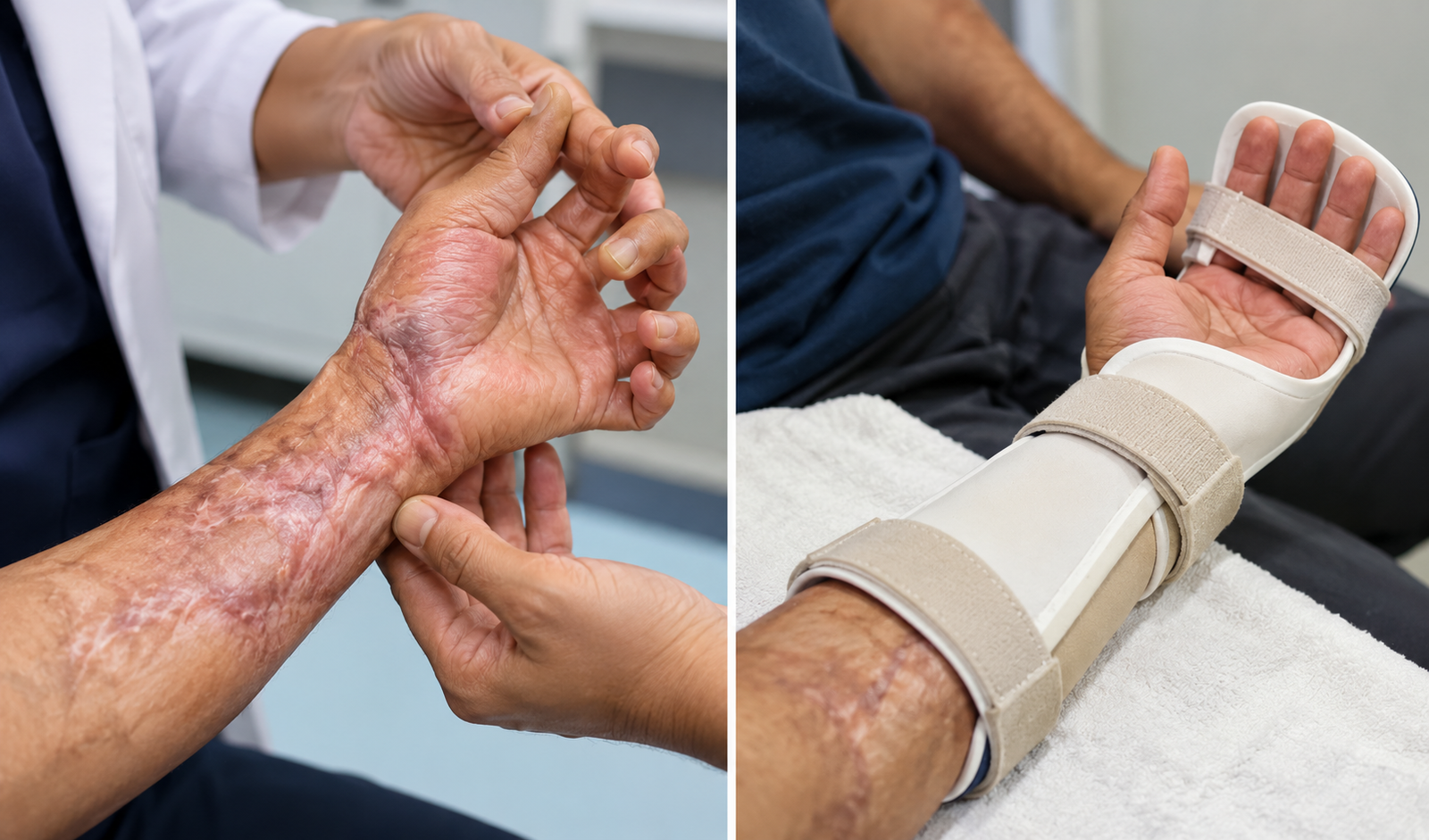
For example, a neck contracture may prevent a person from looking upward. An armpit contracture can make it difficult to raise the arm. A burn contracture hand may keep a finger bent or prevent the hand from opening normally.
Contractures around the eyelid can be particularly important because severe pulling may interfere with eyelid closure and expose the eye.
Signs a Burn Scar Needs a Surgeon
Consider specialist assessment when there is:
-
Loss of range of motion at a joint crossed by the scar.
-
Skin breakdown or repeated wounds over a tight scar band.
-
An eyelid that cannot close normally because of scar pulling.
-
A neck that cannot fully extend because of a tight band.
-
Increasing difficulty opening the hand or straightening fingers.
-
Difficulty lifting the arm because of an armpit contracture.
-
A child's normal movement or growth being affected by a scar.
A useful distinction is whether the scar is mainly a cosmetic concern or is actively restricting function. Once function is compromised, burn contracture treatment needs to address the mechanical tightness as well as the appearance of the scar.
When Should Splints, Pressure Garments and Physiotherapy Be Tried First?
Surgery is not automatically the first treatment for every tightening burn scar.
During scar maturation, rehabilitation may include stretching, positioning, splints, pressure therapy and physiotherapy depending on the location and nature of the burn.
Physiotherapy and Exercises
Movement helps preserve joint range and tissue flexibility.
A therapist may prescribe specific stretching and range-of-motion exercises rather than simply telling the patient to “keep moving.”
The exercise programme needs to target the direction in which the scar is tightening.
Splinting
A splint positions the affected area against the direction of contracture.
For example, a hand splint may hold fingers in a therapeutic position, while a neck splint may help maintain extension.
The type of splint and number of hours it is worn depend on the scar, joint and stage of rehabilitation.
Pressure Garments
Pressure garments may be used during burn-scar management in selected patients. They are intended to help manage problematic scars during maturation, but they cannot mechanically release an established severe contracture.
When Conservative Treatment Is Not Enough
Surgery becomes more relevant when:
-
A mature scar continues to restrict movement.
-
Adequate therapy and splinting fail to maintain useful range.
-
The contracture causes repeated skin breakdown.
-
Essential function is threatened.
-
Eyelid closure is affected.
-
The neck, hand or major joint cannot move adequately.
-
A growing child develops progressive restriction.
The decision is individual. Some contractures can be observed while rehabilitation continues; others need earlier surgical intervention because waiting risks further functional problems.
Burn Plastic Surgeon Near Udhna: Why Does the Wound Become Much Larger Than the Scar Once Released?
One of the most difficult parts of burn scar surgery near udhna for patients to understand is why a relatively narrow scar can produce a much larger wound after release.
The visible band is only the shortened surface tissue.
During burn contracture release surgery, the surgeon divides the tight scar until the affected body part can move toward its required position. As the contracted tissues separate, the true shortage of skin becomes apparent.
Think of a tight elastic band across a bent joint. While the joint remains bent, the band looks relatively short. When the joint is straightened, a much larger gap appears.
The same principle applies to contracture release.
Published surgical guidance on burn-scar contractures describes how a seemingly small contracture can create a substantially larger defect after complete release. The exact size cannot be predicted simply from the scar's surface dimensions.
That is why a surgeon planning the procedure must consider how the released defect will be covered before making the release.
A wound should not be inadequately released merely to make the resulting defect easier to close. The aim is to achieve sufficient functional release and then select appropriate reconstruction.
Skin Graft, Z-Plasty or Flap: How Is the Cover Chosen?
After releasing a contracture, the surgeon has to replace the missing length of skin.
The best method depends on the site, size and depth of the defect, surrounding scar quality, exposed structures and how much movement the reconstructed area must tolerate.
Z-Plasty
A Z-plasty rearranges nearby skin using triangular flaps.
Rather than adding skin from a distant donor area, it redirects and lengthens an existing scar.
Z-plasty may work well for selected linear contractures when enough healthy, mobile tissue remains around the scar.
It is not appropriate for every broad or severely scarred area.
Skin Graft
A skin graft transfers skin from another body area onto the released defect.
Grafting can cover a relatively large surface without requiring a bulky flap. The surgeon chooses the type of graft according to the wound and reconstructive goal.
A skin graft after burn also creates a donor site that needs healing.
Importantly, a graft does not eliminate the need for rehabilitation. Contracture can recur if the reconstructed area tightens during healing, especially across a mobile joint.
For more information about graft-based reconstruction, see Total excision and skin graft.
Flap Reconstruction
A flap transfers tissue while maintaining or surgically reconnecting its blood supply.
Flaps can be useful when the defect needs durable tissue, when important structures require coverage, or when grafting alone is unlikely to provide an appropriate functional result.
Depending on the site, nearby tissue may sometimes be rearranged into the released area.
Learn more about Excision and skin flap.
How the Methods Compare
| Reconstruction | Often considered when | Main advantage | Important limitation |
|---|---|---|---|
| Z-plasty | Selected linear contracture with suitable nearby tissue | Lengthens and redirects the scar using local tissue | Requires adequate surrounding mobile skin |
| Skin graft | Larger surface defect after complete release | Can cover a relatively broad defect | Needs donor site and careful rehabilitation |
| Flap | Deeper defect, important exposed structures or need for durable tissue | Brings vascularised tissue into the area | Usually a more involved reconstruction |
The surgeon does not choose between a graft and flap simply according to which procedure is smaller. The goal is to choose tissue that can tolerate the function required at that site.
You can also read about Skin surgery options after injury (Gujarati).
Burn Contracture Treatment by Site
Different body areas create different reconstructive challenges.
| Site | First-line therapy when appropriate | When surgery may be considered | Possible cover after release | Splint/rehabilitation |
|---|---|---|---|---|
| Neck | Stretching, positioning and splinting | Neck extension remains restricted or functional pulling persists | Graft, local tissue rearrangement or flap depending on defect | Long-term positioning and rehabilitation may be required |
| Armpit | Range-of-motion exercises and splinting | Arm elevation remains restricted | Z-plasty, graft or flap depending on pattern | Exercises and appropriate splinting |
| Elbow | Stretching and positioning | Flexion or extension remains significantly restricted | Graft or flap according to defect | Joint-specific therapy |
| Hand/fingers | Hand therapy and therapeutic splinting | Finger or hand function remains restricted | Graft, local rearrangement or flap | Structured hand therapy is essential |
| Eyelid | Specialist assessment; conservative measures only when appropriate | Eyelid closure or eye protection is compromised | Site-specific reconstructive technique | Individualised postoperative care |
The exact splint period cannot be determined from the body site alone. It depends on the reconstruction, wound healing, scar behaviour and therapist's assessment.
What Does the Splint and Exercise Plan Look Like After Release?
Surgery creates length. Rehabilitation helps preserve it.
That is why the operation should not be viewed as the final day of burn contracture treatment.
Immediately after reconstruction, the operated area may need protection while the graft, flap or incision begins healing.
Movement is then introduced according to the reconstruction and surgeon's instructions.
Some burn-contracture guidance describes beginning active motion around postoperative days 5–7 in appropriately healed or closed wounds. This is not a universal instruction. A fresh graft, complex flap or wound-healing problem may require a different schedule.
The rehabilitation plan can include:
Positioning: keeping the reconstructed area away from the direction in which it previously contracted.
Splinting: maintaining the achieved range for prescribed periods.
Range-of-motion exercises: progressively moving the joint through the safe range.
Scar management: introduced after adequate wound healing when appropriate.
Strengthening and functional exercises: added later according to recovery.
Why Splinting May Continue for Months
Scar tissue continues to remodel long after the surgical wound has closed.
During this period, tightening can recur.
A patient may therefore need splinting for weeks or months rather than only until the stitches are removed. Some splints may eventually be used mainly at night.
The exact schedule should be prescribed individually.
Clinic protocol placeholder: In our practice, [Dr. Ashutosh Shah's verified splint schedule by site and reconstruction should be inserted here before publication].
Can a Burn Contracture Come Back After Surgery?
Yes, recurrence is possible.
The risk depends on factors including:
-
The original burn severity.
-
The location of the contracture.
-
The reconstruction used.
-
Scar behaviour.
-
Growth in children.
-
Adherence to splinting and physiotherapy.
-
Repeated trauma or wound breakdown.
This is why successful burn contracture release surgery combines adequate surgical release with suitable coverage and structured rehabilitation.
Simply cutting the scar without planning the postoperative movement programme does not address the full problem.
What About Hair Loss in a Burn Scar?
Burns involving the scalp can permanently damage hair follicles.
Releasing a scalp contracture does not automatically restore those follicles.
Once the scar is stable and reconstruction is complete, selected patients may later be assessed for options to improve hair-bearing areas.
Hair transplantation is a separate stage and depends on scar thickness, blood supply and the condition of the surrounding scalp.
Read more about Hair transplant into scars.
Key Takeaways
A tight burn scar becomes a contracture when it starts restricting normal movement or function.
Splints, stretching, positioning and physiotherapy can be important first-line components of treatment, particularly while scars are evolving. However, an established contracture that significantly limits the neck, armpit, elbow, hand or eyelid may require surgical release.
During burn contracture release surgery, the visible scar can open into a much larger defect once the shortened tissues are fully released. The surgeon must therefore plan how to cover that defect with a Z-plasty, skin graft or flap.
A graft may cover a broad released area, while a flap can provide vascularised tissue for selected deeper or more demanding defects. No single method is best for every contracture.
Most importantly, surgery and rehabilitation work together. Splinting and exercises may continue for months because scar tissue can tighten again while it matures.
The goal is not simply a better-looking scar. It is to release the pull, restore useful movement and preserve that movement during healing.
Frequently Asked Questions
How long after a burn can contracture surgery be done?
Can a child's burn contracture be released before growth is complete?
Will the contracture come back after surgery?
Is burn contracture surgery done under general anaesthesia?
How long must the splint be worn after release?
Can hair grow back on a released burn scar on the scalp?
About the Author