
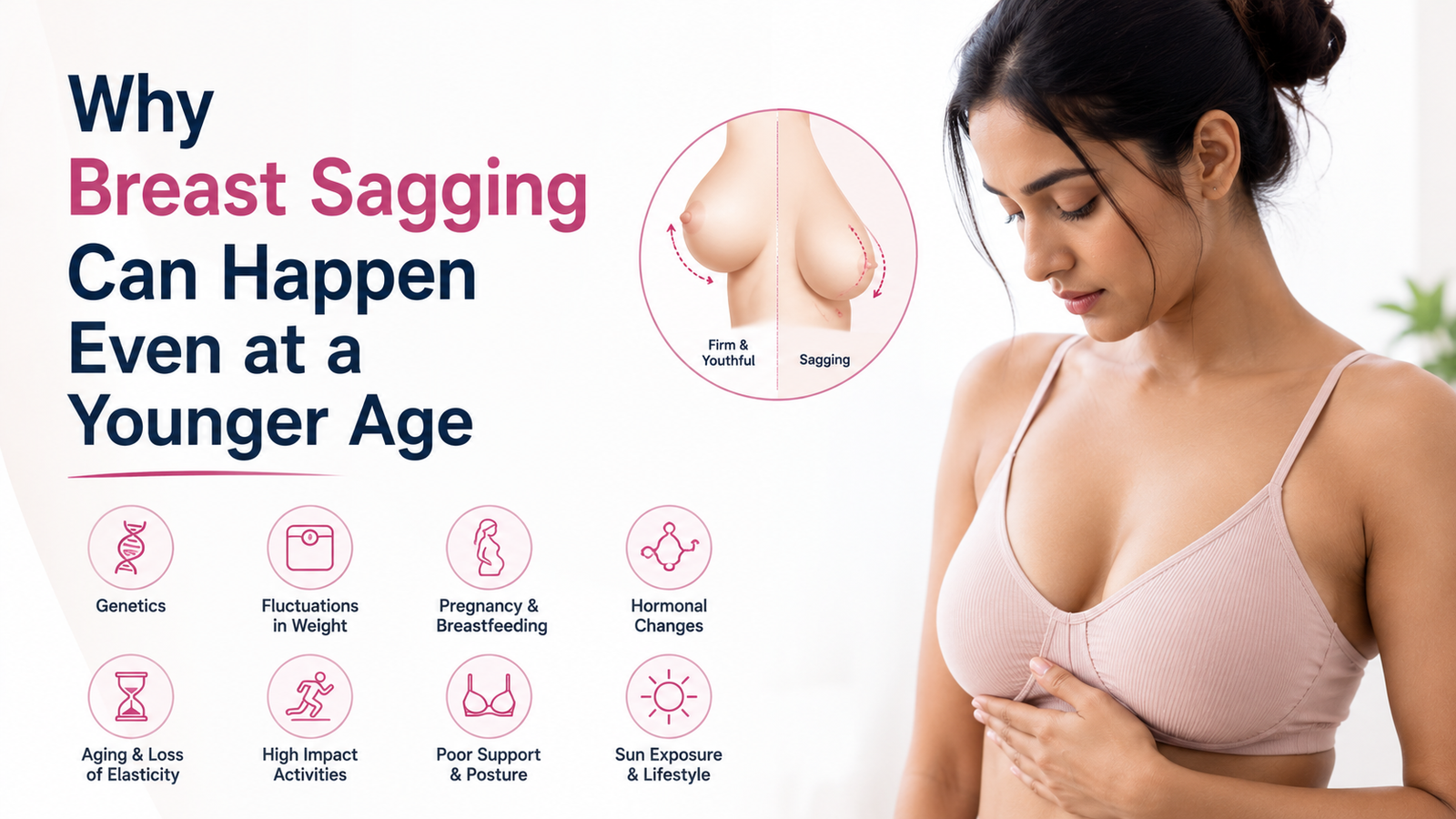
Why Breast Sagging Can Happen Even at a Younger Age
✔ Medically reviewed by Dr. Ashutosh Shah - M.B., M.S., M.Ch., D.N.B., Board-Certified Plastic & Cosmetic Surgeon, Director of Elegance Clinic, Surat (22+ years’ experience).
Many people associate breast sagging with ageing, pregnancy or breastfeeding. But here is something that is less commonly understood: breast sagging can occur at a younger age too.
Age is only one factor affecting breast position. Genetics, breast size, skin elasticity, changes in body weight, pregnancy and the natural effects of gravity can all influence how the breasts look over time. The American Society of Plastic Surgeons notes that women of different ages may consider a breast lift when factors such as genetics, weight fluctuations or pregnancy affect breast shape.
For women concerned about early changes in breast position, understanding why breast sagging happens and when correction may be appropriate can be more useful than simply focusing on age.
Can Breasts Sag at a Young Age?
Yes. Breast sagging can occur in younger women, and it does not necessarily mean that something is wrong.
Breast tissue is influenced by skin elasticity, connective tissues, breast volume and genetics. Some women naturally have softer or more elastic skin, while others may have breast characteristics that make changes in position more noticeable earlier.
Breast sagging, medically referred to as breast ptosis, generally describes a downward change in breast tissue and/or nipple position.
It can happen even when a woman:
- Has never been pregnant
- Has never breastfed
- Is relatively young
- Has not experienced major weight loss
- Has naturally smaller breasts
- Maintains a generally healthy lifestyle
So, young age alone does not rule out breast sagging.
7 Reasons Breasts May Sag Earlier Than Expected
Instead of assuming that sagging is simply an age-related issue, it helps to look at the factors that influence breast shape.
1. Genetics Can Play a Major Role
Some women naturally have skin with greater elasticity, while others may have more stretch-prone skin.
Breast shape, tissue distribution and inherited skin characteristics can therefore influence how early changes in breast position become visible.
This is one reason two women of the same age can have completely different breast shapes.
2. Larger or Heavier Breasts May Place More Stress on Supporting Tissues
Breast weight can influence how the breast changes over time.
Heavier breasts may place greater downward stress on the skin and supporting tissues, potentially contributing to changes in breast position. The ASPS also notes that larger, heavier breasts can be more prone to recurrent sagging after a lift.
This does not mean that having larger breasts automatically causes sagging, but breast volume can be one factor considered during an assessment.
3. Weight Fluctuations Can Change Breast Shape
Repeated weight gain and weight loss can stretch the skin surrounding the breasts.
When breast volume changes, the skin may not always return completely to its previous degree of tightness. Significant weight changes can therefore contribute to a flatter, elongated or less firm breast appearance.
For this reason, maintaining a relatively stable weight is often an important consideration before elective breast surgery.
4. Pregnancy Can Affect Breast Position
Pregnancy can cause substantial changes in breast volume.
As breasts become fuller and heavier during pregnancy, the supporting tissues and skin can stretch. After pregnancy, breast volume may decrease again, potentially leaving the breasts with a different shape or position. This can happen regardless of whether a woman breastfeeds.
Importantly, this means breast changes after pregnancy are not necessarily caused by breastfeeding alone.
5. Breastfeeding Is Not the Only Explanation
A common misconception is that breastfeeding itself is responsible for breast sagging.
In reality, pregnancy-related breast enlargement, changes in breast volume, weight changes, ageing and other individual factors can all contribute.
So, a young woman who has never breastfed can still experience breast ptosis.
6. Natural Loss of Skin Elasticity
Skin elasticity varies from person to person.
Over time, the skin's ability to stretch and recoil changes. Gravity also continuously affects breast tissues and supporting structures. These processes can begin influencing breast shape before obvious signs of ageing appear elsewhere on the body.
7. The Starting Shape of the Breasts Matters
Not every breast naturally sits high on the chest.
Some women naturally have a lower breast position, a longer breast shape or downward-pointing nipples. This may become more noticeable with changes in volume or skin elasticity.
Therefore, a breast that looks lower does not automatically mean it has developed severe ptosis. An in-person assessment is needed to understand the actual degree of sagging.
What Does Breast Sagging Actually Look Like?
Breast sagging can appear differently from one woman to another.
Some common signs include:
- The breasts appear lower on the chest.
- The nipples point downward.
- The nipple position appears lower compared with the breast fold.
- The breasts look flatter or more elongated.
- There is increased loose skin.
- The lower portion of the breast appears heavier.
- One breast sits lower than the other.
The position of the nipple relative to the breast crease is one of the factors plastic surgeons use when assessing breast ptosis.
However, online self-tests should not be used to diagnose the degree of breast ptosis. A qualified surgeon can assess breast tissue, skin quality, nipple position, breast volume and overall proportions.
Does Exercise Prevent Breast Sagging?
Exercise is valuable for overall health and can strengthen the chest muscles underneath the breasts.
However, exercise cannot directly tighten stretched breast skin or reposition sagging breast tissue.
This is because the breast itself is primarily composed of glandular and fatty tissue rather than muscle.
Therefore, exercises such as push-ups or chest presses may improve the underlying chest musculature but should not be presented as a surgical alternative for established breast ptosis.
Can a Breast Lift Correct Sagging Breasts?
For suitable patients, breast lift surgery, medically called mastopexy, is one established surgical approach for correcting breast sagging.
A breast lift raises the breasts by removing excess skin and reshaping the breast tissue. It can also reposition the nipple and areola when required.
The exact surgical approach depends on factors such as:
- Degree of breast sagging
- Skin elasticity
- Breast volume
- Nipple position
- Breast shape
- Amount of excess skin
- Desired outcome
- Whether additional volume or reduction is desired
A breast lift primarily changes breast position and shape. It does not necessarily make the breasts larger. If additional fullness is desired, augmentation may sometimes be discussed separately or in combination with a lift.
Is Breast Sagging Correction Suitable for Younger Women?
There is no single age at which every woman should consider breast sagging correction.
The more important questions are whether:
- Breast development is complete.
- The breast shape has remained relatively stable.
- Weight is reasonably stable.
- The patient is physically suitable for surgery.
- The concern is persistent and personally important.
- Future pregnancy plans have been considered.
If pregnancy is expected soon, postponing a breast lift may be recommended because pregnancy can stretch the breast tissues again and alter the surgical result. Mayo Clinic notes that women planning pregnancy may wish to wait before undergoing a breast lift.
Breast Sagging Correction in Surat: What Should You Discuss During Consultation?
If you are considering Breast Sagging Correction in Surat, the consultation should be about more than simply asking whether your breasts are “too saggy.”
A proper assessment can consider:
Breast position
Where the breast tissue and nipple sit relative to the breast fold.
Skin quality
Whether the skin has significant laxity or stretch.
Breast volume
Whether the breast has enough existing volume to achieve the desired contour after lifting.
Symmetry
Whether one breast naturally sits lower or differs in shape from the other.
Future plans
Pregnancy, breastfeeding and significant weight changes can influence long-term breast appearance.
Desired outcome
Some women primarily want elevation and reshaping, while others may also want changes in volume.
At Elegance Clinic in Surat, patients can discuss their individual concerns and available breast surgery options with Dr. Ashutosh Shah, rather than choosing a procedure based solely on age or an online comparison.
Breast Lift vs Breast Augmentation: They Are Not the Same
This distinction is important.
Breast augmentation primarily focuses on increasing breast volume.
Breast lift surgery primarily focuses on raising and reshaping breasts that have descended.
An implant can add volume, but augmentation alone does not necessarily correct significant breast drooping. Depending on the patient's anatomy and goals, a surgeon may recommend a lift alone or discuss a combination approach.
Simple way to understand it:
Want more volume? → Augmentation may be considered.
Want a higher breast position? → A lift may be considered.
Want both? → A combined approach may sometimes be appropriate.
The final decision should be made after an individual examination.
Does Breast Sagging Correction Change Breast Size?
A breast lift is primarily intended to change breast position and shape rather than significantly increase or decrease breast size.
However, removing excess skin and reshaping tissue can alter how the breasts fit inside a bra, so the apparent bra size may change even when the goal was not breast reduction.
If a patient wants smaller breasts, breast reduction can be combined with a lift. If more upper-breast fullness is desired, augmentation may be discussed.
What About Scars After Breast Sagging Correction?
Scarring is an important part of the discussion before breast lift surgery.
The incision pattern depends on the amount of correction required and the patient's anatomy. Possible incision patterns can include scars around the areola, vertically downward, and sometimes along the breast crease.
Scars generally soften and become less noticeable over time, but they do not disappear completely. Individual healing also varies.
A consultation should therefore include realistic discussion about both the expected breast shape and potential scarring.
Can Breast Sagging Return After Correction?
A breast lift can correct existing sagging, but it cannot stop the natural ageing process.
Future pregnancy, major weight fluctuations, skin elasticity and gravity can influence the breasts again. Larger, heavier breasts may also have a greater tendency toward recurrent sagging.
This is why maintaining a stable weight and discussing future pregnancy plans with your surgeon can be important when considering surgery.
Key Takeaways
- Breast sagging can happen at a younger age.
- Age is only one factor affecting breast position.
- Genetics, breast size, pregnancy, weight fluctuations, skin elasticity and gravity can contribute.
- Breastfeeding is not the only cause of breast sagging.
- Exercise can strengthen chest muscles but cannot surgically reposition sagging breast tissue.
- A breast lift, or mastopexy, can raise and reshape sagging breasts in appropriately selected patients.
- Breast augmentation and breast lift address different concerns.
- Future pregnancy and major weight changes can affect long-term results.
- An individual consultation is more reliable than online self-tests for determining the degree of breast ptosis.
Conclusion: When Should You Consider Breast Sagging Correction in Surat?
Breast sagging is not exclusively an age-related concern. Younger women can experience changes in breast position because of genetics, breast volume, weight fluctuations, pregnancy, skin elasticity and other individual factors.
If sagging is affecting your confidence or the way your clothes fit, Breast Sagging Correction in Surat may be worth discussing with a qualified cosmetic or plastic surgeon. A personalised assessment can determine whether a breast lift alone or another approach is more appropriate for your anatomy and goals.
Concerned about breast sagging at a younger age?
Book a consultation at Elegance Clinic, Surat, to discuss your breast shape, degree of sagging and suitable correction options with Dr. Ashutosh Shah. An individual evaluation can help you understand what approach may be appropriate for you.
Frequently Asked Questions
Can breasts sag at a young age?
What causes breast sagging in younger women?
Does breastfeeding cause breast sagging?
Can exercise fix sagging breasts?
Does a breast lift increase breast size?
Can breast sagging return after a breast lift?
About the Author