
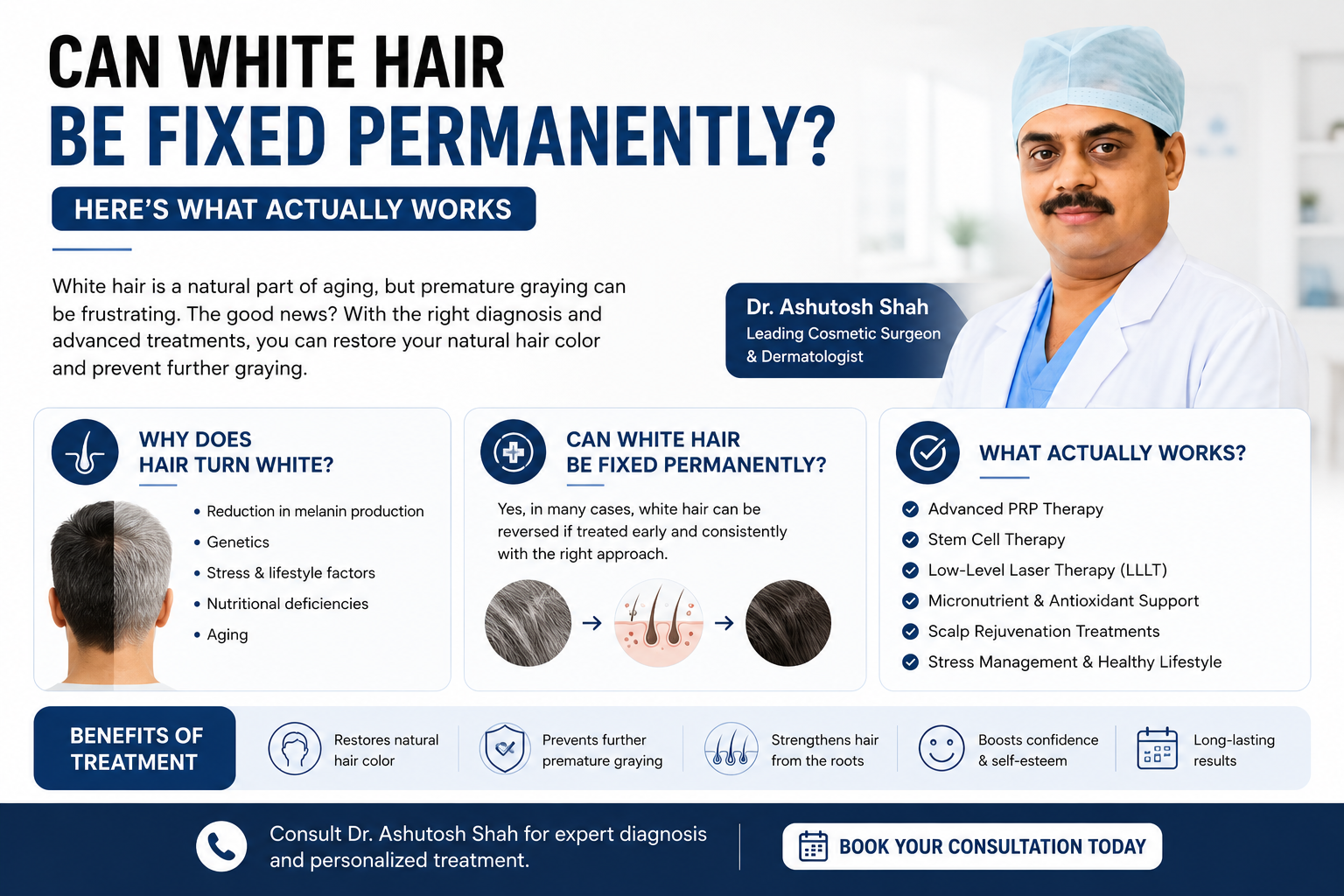
Can White Hair Be Fixed Permanently? Here’s What Actually Works
✔ Medically reviewed by Dr. Ashutosh Shah - M.B., M.S., M.Ch., D.N.B., Board-Certified Plastic & Cosmetic Surgeon, Director of Elegance Clinic, Surat (22+ years’ experience).
White hair is often associated with aging, but today, many people experience premature greying much earlier due to lifestyle, genetics, stress, nutritional deficiencies, and environmental factors. A common question patients ask is simple: Can white hair be fixed?
The answer depends on the underlying cause. While naturally grey or white hair caused by pigment loss may not always regain its original color, advanced aesthetic treatments can help restore hair density and improve appearance in people dealing with hair loss, along with white or grey hair.
At Elegance Clinic, Dr. Ashutosh Shah offers advanced hair restoration solutions, including Hair Transplant in White Hair, designed for patients experiencing baldness while already having grey or white hair.
This guide explains whether white hair can be fixed, what causes premature greying, and how Hair Transplant in White Hair works as an advanced hair restoration option.
Can White Hair Be Fixed?
White hair develops when the body gradually reduces or stops producing melanin, the pigment responsible for natural hair color.
In many cases:
- White hair caused by aging is usually permanent
- Premature white hair may be linked to nutritional or lifestyle factors
- Existing white hair may not naturally turn black again once pigment-producing cells stop functioning
However, when the concern is hair thinning, baldness, or visible hair loss along with white hair, cosmetic restoration treatments can improve hair coverage and overall appearance.
This is where Hair Transplant in White Hair becomes an effective option.
Why Does Hair Turn White?
Hair color depends on pigment-producing cells called melanocytes.
When these cells reduce pigment production, hair gradually turns grey or white.
Common causes include:
1. Natural Aging
The most common reason for white hair is age-related reduction in melanin production.
2. Genetics
Family history often influences when hair begins turning grey.
3. Stress
Long-term stress may contribute to premature greying in some individuals.
4. Vitamin Deficiency
Deficiency of nutrients such as:
- Vitamin B12
- Iron
- Copper
- Folic acid
may contribute to early greying.
5. Lifestyle Factors
Smoking, poor diet, lack of sleep, and environmental exposure may affect hair health.
6. Medical Conditions
Certain thyroid conditions or autoimmune issues may sometimes influence hair pigmentation.
Can White Hair Turn Black Again Naturally?
This is one of the most searched hair-related questions.
In most cases:
Naturally white hair caused by permanent pigment loss usually does not turn black again.
If early greying happens due to nutritional deficiencies or temporary health conditions, correcting the underlying cause may help slow further progression.
However, once the hair follicle permanently stops producing pigment, natural reversal becomes difficult.
What is Hair Transplant for White Hair?
Hair Transplant in White Hair is a specialized hair restoration procedure performed for individuals who already have grey or white donor hair but are experiencing hair loss or baldness.
The process focuses on transferring healthy hair follicles from one part of the scalp to thinning or bald areas.
The transplanted hair retains its natural characteristics, including existing white or grey color.
The purpose is not changing hair color — it is restoring hair density and natural hairline appearance.
Who Can Choose a Hair Transplant for White Hair?
This treatment may be suitable for people who:
- Have baldness or thinning hair
- Already have grey or white hair growth
- Want natural hair restoration despite hair color changes
- Have healthy donor hair available on the scalp
- Want permanent hair density improvement
A consultation helps determine eligibility.
At Elegance Clinic, Dr. Ashutosh Shah performs scalp analysis before recommending treatment.
How Hair Transplant in White Hair Works
The treatment follows a structured process.
Step 1 – Hair Evaluation
The scalp and donor hair area are examined carefully.
The doctor checks:
- Hair density
- Degree of baldness
- Donor hair availability
- Overall scalp health
Step 2 – Treatment Planning
The new hairline and required graft number are planned.
Step 3 – Hair Follicle Extraction
Healthy follicles are extracted from the donor area.
These follicles may naturally contain white or grey hair.
Step 4 – Implantation Process
Extracted follicles are implanted carefully into thinning or bald regions.
Special attention is given to angle, direction, and density.
Step 5 – Healing and Growth
The scalp gradually heals.
New transplanted hair begins growing naturally over time.
The transplanted hair maintains its original color.
Benefits of Hair Transplant in White Hair
Patients choose this procedure for long-term hair restoration.
Benefits include:
- Permanent hair restoration
- Natural hairline improvement
- Better scalp coverage
- Improved overall appearance
- Long-term solution for baldness
- Natural growth using your own hair follicles
Does Hair Transplant Change White Hair Color?
No. This is an important point patients should understand.
Hair transplant restores hair growth but does not change the color of white hair.
If donor hair is white or grey, transplanted hair will grow in the same natural color.
Hair coloring options can be considered separately after treatment if desired.
Can a Hair Transplant Be Done at an Older Age?
Yes.
Age alone usually does not prevent hair transplantation.
The main factors include:
- Healthy scalp condition
- Adequate donor hair
- Overall health suitability
Many older patients successfully undergo hair transplant procedures.
Why Choose Elegance Clinic for Hair Restoration?
Choosing an experienced specialist is important for natural-looking results.
Patients choose Elegance Clinic because of:
- Advanced hair restoration planning
- Modern hair transplant techniques
- Personalized scalp evaluation
- Focus on natural hairline design
- Patient-focused aesthetic care
- Safe clinical environment
Dr. Ashutosh Shah offers customized hair restoration treatments designed around individual hair conditions and long-term results.
Final Thoughts
Many people wonder whether white hair can be fixed permanently.
While reversing naturally white hair color is often difficult once pigment loss becomes permanent, modern hair restoration can still address hair thinning, baldness, and reduced hair density.
Hair Transplant in White Hair offers an effective long-term solution for patients who have white or grey hair but want to restore natural hair growth in bald areas.
At Elegance Clinic, Dr. Ashutosh Shah provides advanced consultation and customized hair restoration treatments focused on natural-looking, long-lasting results.
Frequently Asked Questions
Can white hair become black again permanently?
Can a hair transplant be done if the hair is already white?
Is a hair transplant permanent?
Can younger people with premature white hair seek treatment?
About the Author