
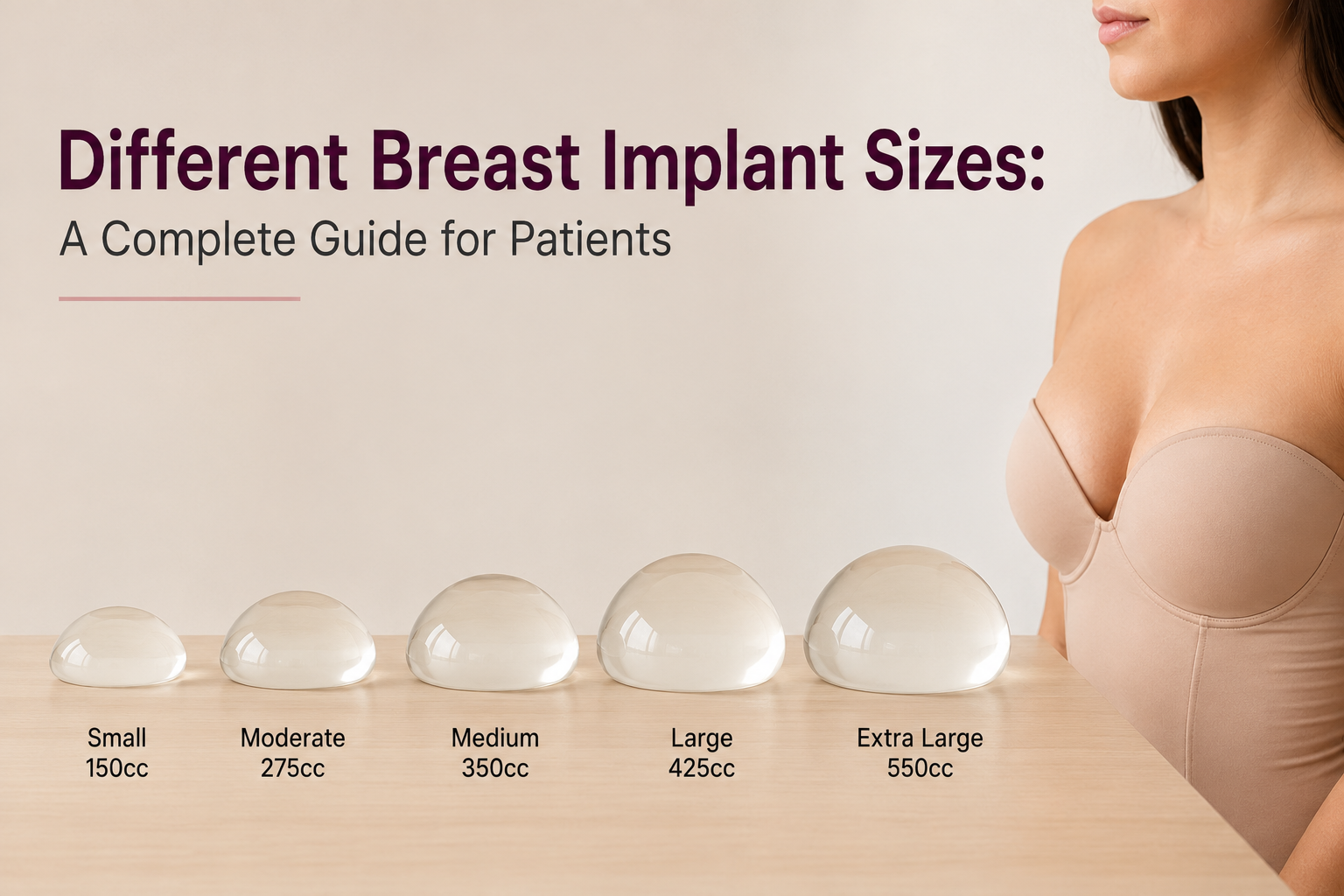
How a Plastic Surgeon Chooses Breast Implant Size: Chest Width, Skin Stretch and Tissue Cover
✔ Medically reviewed by Dr. Ashutosh Shah - M.B., M.S., M.Ch., D.N.B., Board-Certified Plastic & Cosmetic Surgeon, Director of Elegance Clinic, Surat (22+ years’ experience).
A plastic surgeon chooses breast implant size by measuring your breast base width, skin stretch, nipple-to-fold distance and soft-tissue thickness first, then selecting the volume that fits those limits. The cc number follows the measurements, not the other way round. An implant wider or heavier than the tissue can hold raises the risk of rippling, sagging and revision.
Choosing an implant is not simply a matter of deciding whether 250cc, 300cc or 350cc looks better. The same implant can produce different results in two patients because their chest dimensions, breast tissue, skin elasticity and existing breast shape differ.
If you are researching how to choose breast implant size, understanding these measurements will help you have a more useful consultation with your plastic surgeon.
Dr. Ashutosh Shah evaluates breast dimensions, tissue coverage and the patient's goals when discussing implant-based breast enhancement. The objective is to choose an implant that fits the anatomy while considering long-term tissue support, appearance and possible complications.
Why Is Implant Size Decided by Measurements Rather Than by CC?
Breast implant volume is measured in cubic centimetres (cc), but volume alone does not describe the implant's shape.
Two implants with similar volumes may have different widths and projections. Likewise, two patients receiving the same implant volume may have very different results.
For example, a patient with a narrow breast base may require an implant with a different width and profile from someone with a broader breast base.
The available skin and breast tissue also matter. An implant that is too wide may extend beyond the natural breast footprint. An implant that places excessive tension on the tissues may contribute to visible edges, implant displacement or progressive stretching.
This is why surgeons use a tissue-based approach rather than recommending different sizes breast implants solely according to height, weight or desired cup size.
The published High Five approach described by Tebbetts and Adams provides a framework for selecting implant dimensions and planning surgery according to the patient's tissues.
It considers how the breast's existing anatomy influences implant selection, pocket planning and the position of the inframammary fold.
The practical rule is simple: measure first, choose an anatomical range second, and discuss implant volume within that range.
For an overview of the procedure, see Breast augmentation.
Which Five Measurements Does the Surgeon Take at Consultation?
A consultation for implant sizing involves more than placing sample implants against the chest.
The surgeon examines the breast footprint, skin envelope, soft-tissue coverage and symmetry before recommending implant dimensions.
1. Breast Base Width
Breast base width is the horizontal width of the existing breast footprint.
It helps determine the implant diameter that can fit within the breast's natural boundaries.
Choosing an implant that is excessively wide for the patient's anatomy may increase the risk of visible lateral fullness or unwanted displacement.
2. Skin Stretch
The surgeon assesses how much the breast skin can stretch and accommodate additional volume.
Skin that stretches easily behaves differently from tight skin, particularly when the patient has very little existing breast tissue.
Excessive expansion may place unnecessary tension on the skin and supporting tissues.
3. Nipple-to-Fold Distance
This measurement runs from the nipple to the inframammary fold, the crease beneath the breast.
It helps the surgeon evaluate lower-pole dimensions and whether the existing fold position is appropriate for the planned implant.
The measurement is particularly important when considering how the implant will sit within the breast envelope.
4. Upper-Pole Pinch Thickness
The surgeon gently measures the thickness of skin and soft tissue covering the upper breast.
Thin tissue provides less natural coverage over an implant and may increase the likelihood of visible edges or rippling.
This measurement also contributes to decisions about implant placement.
5. Overall Breast and Chest Assessment
The surgeon evaluates chest-wall shape, breast symmetry, existing breast volume, skin quality and any degree of sagging.
These findings help determine whether an implant alone is likely to achieve the desired result or whether another procedure, such as a breast lift, should be discussed.
Breast Implant Measurement Table
| Measurement | What the surgeon evaluates | What it helps determine |
|---|---|---|
| Breast base width | Width of the natural breast footprint | Suitable implant width |
| Skin stretch | Capacity of the skin envelope to accommodate expansion | Reasonable volume and tissue tension |
| Nipple-to-fold distance | Lower breast dimensions and fold position | Implant positioning and lower-pole planning |
| Upper-pole pinch thickness | Thickness of tissue covering the upper breast | Coverage, visibility risk and pocket selection |
| Overall breast and chest assessment | Existing volume, symmetry, chest shape and sagging | Implant dimensions, profile and whether additional procedures are appropriate |
These measurements work together. No single measurement determines the final implant.
How Do Low, Moderate and High Profiles Change the Look at the Same Width?
Implant profile describes how far an implant projects forward relative to its base width.
Patients often focus on volume, but profile can influence the appearance of the upper breast, projection and overall proportions.
Low-Profile Implants
Low-profile implants generally have less forward projection relative to their width.
They may be considered when the patient's dimensions and aesthetic goals favour a broader, less projecting shape.
However, a low profile does not automatically guarantee a natural-looking result.
Moderate-Profile Implants
Moderate-profile implants provide an intermediate relationship between width and projection.
They may suit patients seeking a balance between breast width and forward fullness, provided the dimensions fit their anatomy.
High-Profile Implants
High-profile implants generally provide greater forward projection relative to their base width.
They may be considered when a narrower implant footprint is required or when additional projection is desired.
However, selecting a high-profile implant does not overcome limitations in skin stretch or soft-tissue support.
Implant Profile Comparison
| Profile | Relative projection at a similar base width | Important consideration |
|---|---|---|
| Low | Less | Must still fit the breast footprint and desired volume |
| Moderate | Intermediate | Often considered when balanced width and projection are appropriate |
| High | Greater | Tissue coverage and skin tension remain important |
Actual dimensions vary between manufacturers and implant models. Profile labels are not completely interchangeable across product ranges.
When researching breast implant profile low moderate high, compare the manufacturer's actual dimensions rather than relying on the profile name alone.
Learn more about the available Breast implants.
What Happens When the Implant Is Too Big for the Tissue?
A larger implant is not necessarily an unsafe implant. The concern arises when its dimensions or weight exceed what the patient's anatomy can reasonably accommodate.
Potential problems include the following.
Visible Implant Edges and Rippling
Patients with thin soft-tissue coverage may be more likely to notice implant edges or folds.
Rippling can become visible or palpable, particularly where tissue coverage is limited.
Excessive Skin Stretching
A large implant places additional weight and tension on the breast envelope.
Over time, this may contribute to tissue stretching and changes in breast position.
Implant Malposition
If the implant dimensions do not suit the breast footprint or the pocket is inadequately planned, the implant may shift into an undesirable position.
Possible changes include excessive lateral displacement or downward movement.
Bottoming Out
Bottoming out occurs when the implant descends too far relative to the breast fold, creating excessive lower-pole fullness and an altered nipple position.
Tissue quality, implant weight and surgical pocket factors may contribute.
Need for Revision Surgery
Some patients require later surgery because of implant malposition, changes in breast tissue, capsular contracture, rupture or dissatisfaction with the result.
Implants are not lifetime devices, and additional surgery may be necessary in the future.
If implant-related problems develop, Breast implant removal and replacement may be considered after clinical assessment.
The objective of tissue-based sizing is to reduce avoidable mismatch between the implant and the breast, not to promise that complications will never occur.
Breast Augmentation in Vadodara: How Do Sizers and Photos Help You Choose Within a Safe Range?
Once the surgeon has assessed the measurements, patients can discuss the appearance they would prefer within the proposed implant range.
This is where trial sizers, reference photographs and visual planning can be useful.
Implant Sizers
External sizers can help patients compare approximate breast volume under clothing.
They are useful for discussing preferences, but they cannot reproduce exactly how an implant will look after surgery.
The final result also depends on implant profile, placement, existing tissue and postoperative healing.
Reference Photographs
Patients may bring photographs showing the general shape or proportions they prefer.
The surgeon can use these examples to understand the patient's goals while explaining which features may or may not be achievable with their anatomy.
Photographs of other patients should not be treated as guarantees.
Three-Dimensional Imaging
Some practices use three-dimensional imaging to support planning and communication.
Such simulations can help illustrate possible proportions, but they remain estimates rather than promises of an exact result.
What Should You Ask During Sizing?
Before choosing an implant, ask:
-
What is my measured breast base width?
-
How much soft-tissue coverage do I have?
-
What implant widths and profiles fit my anatomy?
-
Would my preferred volume place excessive tension on the tissues?
-
How might the result change with weight fluctuation or ageing?
-
What are the possible long-term complications?
-
Would an implant alone address my concerns, or should a lift be discussed?
The purpose of sizing is to find a reasonable balance between the patient's preferences and anatomical limitations.
Can Implant Size Alone Guarantee Natural-Looking Breast Surgery?
No. Natural looking breast surgery depends on more than the implant volume.
Factors include the patient's starting breast shape, the selected implant dimensions, soft-tissue coverage, surgical pocket, skin quality and healing.
A smaller implant is not automatically natural-looking, just as a larger implant is not automatically unnatural.
The important question is whether the implant fits the breast and produces proportions that the patient finds acceptable without unnecessarily overloading the tissues.
Patients should also understand that cup size is not a reliable surgical measurement. Bra sizing varies between manufacturers, and an exact postoperative cup size cannot be guaranteed.
For additional patient questions, read the Breast augmentation FAQs.
Key Takeaways
-
How to choose breast implant size begins with anatomical measurements, not a preferred cc number.
-
Breast base width helps establish implant diameter, while skin stretch and nipple-to-fold distance guide volume and positioning.
-
Upper-pole tissue thickness helps assess implant coverage and visibility risks.
-
Low, moderate and high implant profiles describe different relationships between width and projection.
-
An implant that is too large for the available tissues may increase the risk of rippling, stretching, malposition and revision.
-
External sizers and reference photographs can help communicate preferences but cannot guarantee the final result.
-
The safest planning approach balances the patient's desired appearance with the dimensions and support of their breast tissues.
The central principle is that implant volume should follow the patient's measurements—not determine them.
Frequently Asked Questions
What Is the Most Common Breast Implant Size in India?
Can I Choose a Bigger Size Than the Surgeon Recommends?
Does Implant Size Change After Breastfeeding or Weight Change?
Are Larger Implants More Likely to Need Revision?
Is the Implant Placed Above or Below the Muscle Based on Size?
How Do I Choose Implant Size After Mastectomy?
About the Author