
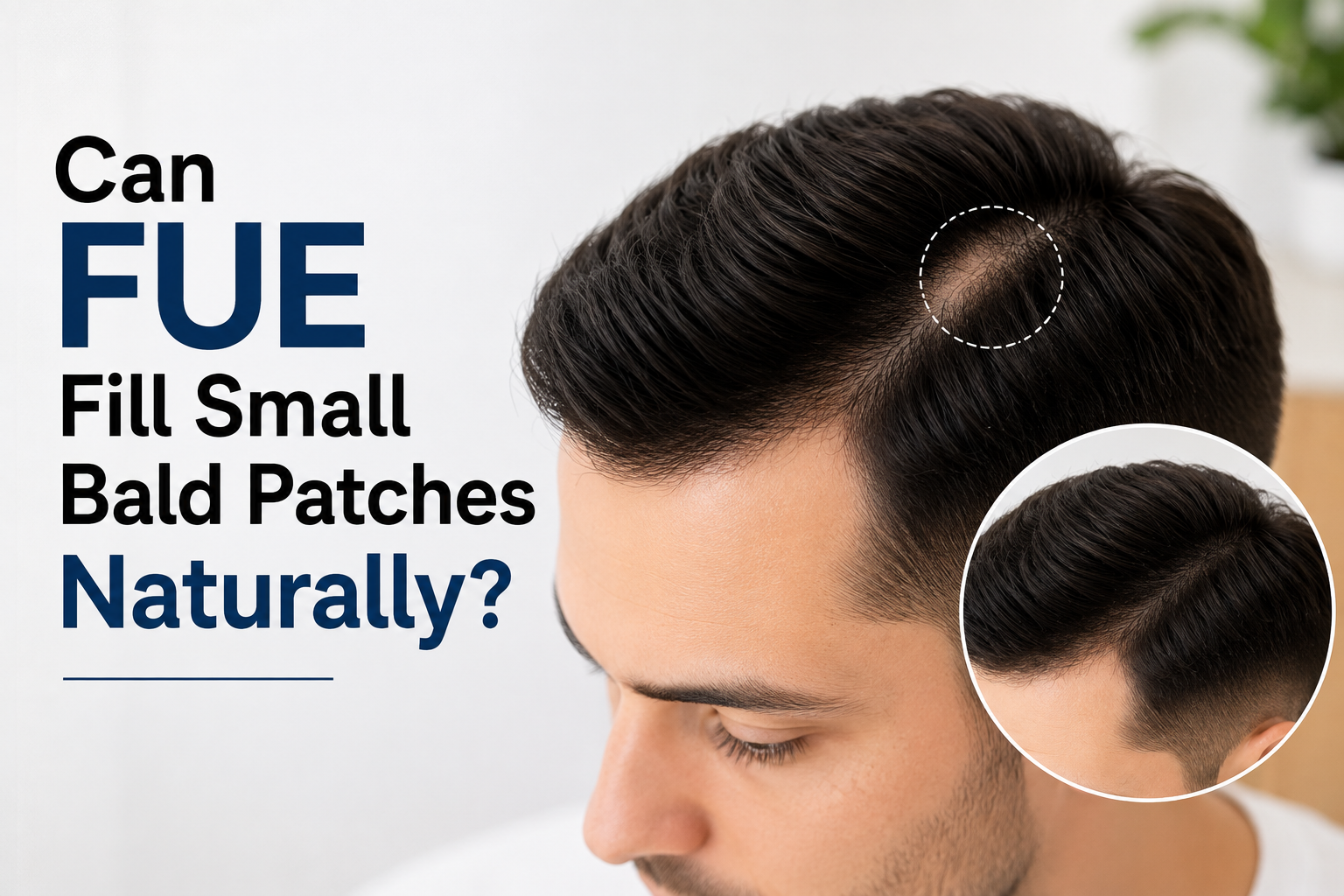
Can FUE Fill Small Bald Patches Naturally?
✔ Medically reviewed by Dr. Ashutosh Shah - M.B., M.S., M.Ch., D.N.B., Board-Certified Plastic & Cosmetic Surgeon, Director of Elegance Clinic, Surat (22+ years’ experience).
Small bald patches can be surprisingly noticeable, especially when they appear around the hairline, temples, crown, beard, or other visible areas. Many people assume that hair transplantation is only for extensive baldness, but Follicular Unit Extraction (FUE) can also be considered for selected areas of localized or patchy hair loss.
FUE involves removing individual follicular units from a donor area and carefully placing them into areas where hair density has reduced. Because the grafts are transplanted one by one, the procedure can be planned around the shape, direction, and density of the existing hair.
For people looking for FUE for patchy baldness in Surat, the important question is not simply whether FUE works it is whether the bald patch has a suitable cause, adequate donor hair, and realistic potential for improvement.
What Makes FUE Different for Small Bald Patches?
Unlike techniques that remove a strip of scalp, FUE extracts individual follicular units using small punches.
This allows the surgeon to:
- Target specific bald or thinning areas
- Place individual grafts between existing hairs
- Follow the natural direction of surrounding hair
- Avoid a linear donor-area scar
- Design the treatment around a relatively small area
The goal is not simply to “fill a hole.” The grafts need to blend with existing hair so the treated area looks as natural as possible.
Can FUE Actually Fill a Small Bald Spot?
Yes, FUE may be suitable for some small bald patches, particularly when the area has stable hair loss and the surrounding donor hair is healthy.
However, not every bald patch should immediately be treated with a hair transplant.
The cause of the hair loss matters.
Patchy hair loss may occur because of:
- Pattern hair loss
- Previous injury or scarring
- Certain hairstyles or repeated traction
- Previous surgery
- Localized follicle damage
- Some forms of alopecia
A proper examination can help determine whether transplantation is appropriate or whether another treatment should be considered first.
Why Individual Grafts Can Look More Natural
Natural hair does not grow as a solid block. Follicles emerge in individual units, with differences in direction, angle, and density.
During FUE, individual follicular units can be positioned strategically to imitate the surrounding growth pattern.
For example, if a small patch is located near the frontal hairline, graft placement may need to account for:
Hairline design → follicle angle → growth direction → density → transition into existing hair
This planning becomes particularly important when treating small patches because the transplanted area sits directly next to your existing hair.
Is FUE Better Than a Full Hair Transplant for Small Areas?
Not necessarily. The treatment should be based on the size and cause of the hair loss, donor availability, and the patient's overall hair-loss pattern.
A person with a small stable bald patch may require relatively few grafts. Someone with progressive thinning throughout the scalp may need a broader treatment strategy.
A consultation with a qualified hair-transplant surgeon can help determine:
- Whether FUE is appropriate
- Approximately how many grafts may be needed
- Whether the donor area is sufficient
- Whether existing hair is likely to continue thinning
- What level of density can realistically be achieved
What Happens During FUE for Patchy Baldness?
The process is generally planned in several stages.
1. Scalp assessment
The doctor examines the bald patch, surrounding hair and donor area.
2. Treatment planning
The target area and desired density are mapped according to your natural hair pattern.
3. Donor preparation
Suitable follicular units are selected from the donor region.
4. Individual follicle extraction
Follicular units are carefully extracted one at a time.
5. Graft preparation
The harvested grafts are examined and prepared for placement.
6. Recipient-site creation
Small sites are created in the bald area while considering the natural direction and angle of hair growth.
7. Graft placement
The follicles are positioned carefully to create a natural transition with the existing hair.
What About Recovery?
After FUE, some temporary redness, swelling, sensitivity, or scabbing can occur around the treated areas. Recovery varies depending on the number of grafts, treatment area and individual healing.
The transplanted hairs also do not necessarily grow immediately. The follicles go through a healing and growth cycle, so final hair growth takes time.
Your surgeon will provide specific aftercare instructions regarding scalp washing, physical activity, medications and follow-up.
Will the Result Look Natural?
Natural-looking results depend on more than simply transplanting hair.
Important factors include:
- Correct diagnosis
- Donor-hair quality
- Graft selection
- Hairline or patch design
- Placement angle
- Existing hair density
- Surgeon experience
- Appropriate aftercare
For a small bald patch, precision is especially important because the transplanted area can be compared closely with the surrounding natural hair.
When Should You Consider a Consultation?
Consider a professional evaluation if you notice:
-
A clearly defined bald patch
- Gradually increasing hair loss
- Thinning around a previously stable area
- Hair loss after an injury or procedure
- A receding hairline with localized gaps
- A patch that has remained stable but affects your appearance
Sudden or rapidly developing patchy hair loss should be medically evaluated before considering transplantation, because the underlying cause may need treatment first.
FUE for Patchy Baldness in Surat
If you are looking for FUE for patchy baldness in Surat, treatment planning should begin with understanding why the patch developed and whether the follicles are permanently affected.
At Elegance Clinic, Dr. Ashutosh Shah can evaluate the pattern of hair loss, donor area and suitability for FUE before recommending an appropriate hair-restoration approach.
The objective is to restore the affected area while maintaining a natural relationship between the transplanted and existing hair.
Why Choose a Personalized FUE Approach?
A small bald patch does not necessarily require an extensive transplant. A personalized approach can help focus treatment on the areas that actually need additional coverage while preserving the available donor hair for the future.
This is particularly important for people with early or localized hair loss.
Conclusion
Can FUE fill small bald patches naturally? Yes, in appropriately selected patients. FUE uses individual follicular units to target localized hair loss and can be planned to match the direction, angle and density of surrounding hair.
However, the cause of patchy baldness should be assessed before transplantation. If you are considering FUE hair transplant for patchy baldness in Surat, a consultation with Dr. Ashutosh Shah at Elegance Clinic can help determine whether FUE is suitable for your specific pattern of hair loss.
Thinking about treating a small bald patch? Consult Elegance Clinic for an individualized assessment and learn whether FUE could be an appropriate option for you.
Frequently Asked Questions
Can FUE treat small bald patches?
Is FUE suitable for patchy baldness in Surat?
Can FUE make a bald patch look natural?
How many grafts are needed for a small bald patch?
Does FUE leave a linear scar?
Can sudden patchy hair loss be treated with FUE?
About the Author