
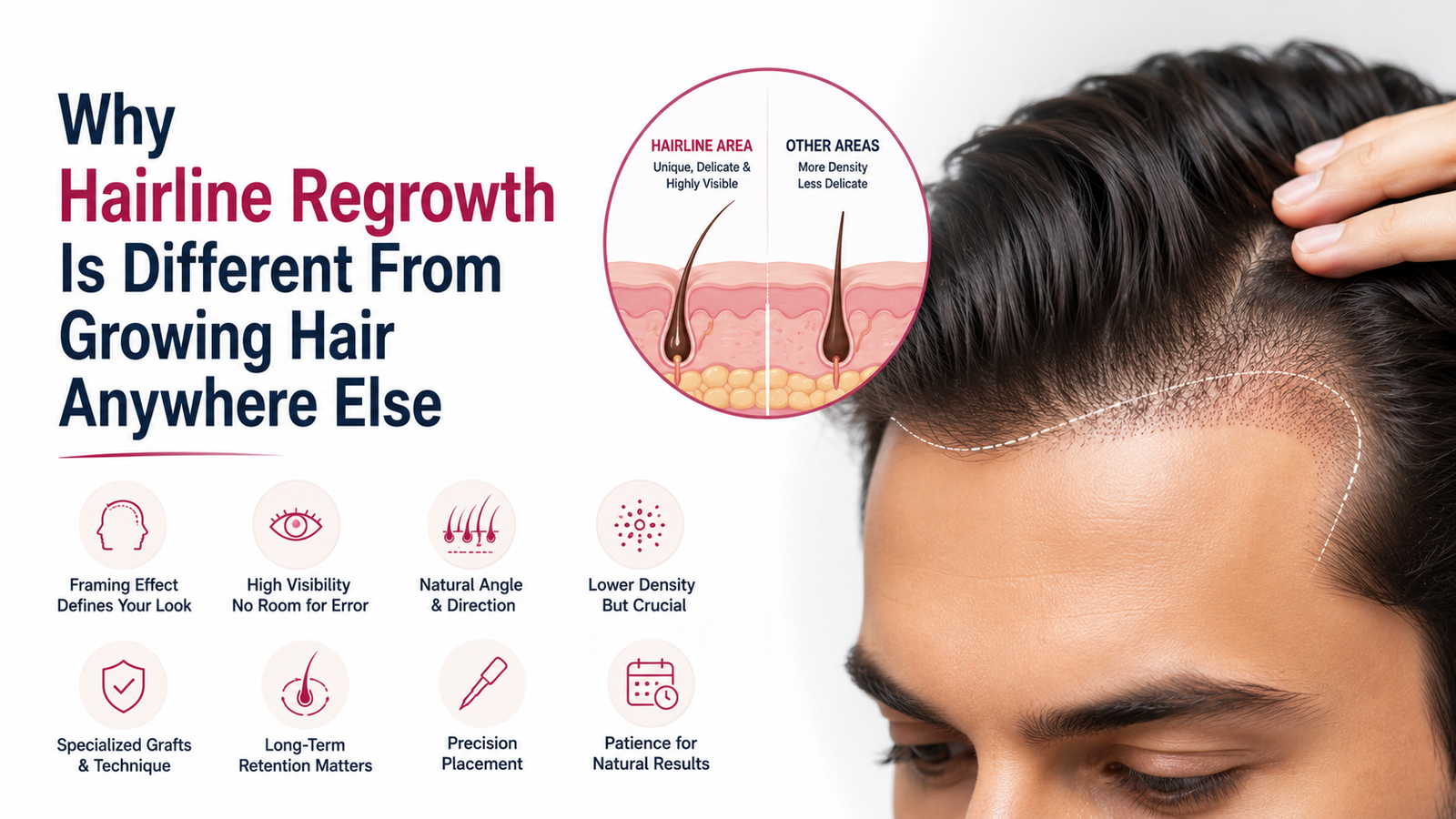
Why Hairline Regrowth Is Different From Growing Hair Anywhere Else
✔ Medically reviewed by Dr. Ashutosh Shah - M.B., M.S., M.Ch., D.N.B., Board-Certified Plastic & Cosmetic Surgeon, Director of Elegance Clinic, Surat (22+ years’ experience).
A receding hairline can be frustrating because the hair at the front of the scalp does not always respond in the same way as hair in other areas. Even when the remaining scalp hair appears healthy, the hairline may continue becoming thinner, weaker, or more uneven.
This raises an important question: Why is hairline regrowth so difficult, and what is an effective hairline growth solution in Surat?
The answer depends on what is causing the hairline to recede, whether the follicles are still capable of producing hair, the extent of follicle miniaturisation, and the amount and quality of available donor hair.
Why Does the Hairline Behave Differently?
Hair follicles are not identical across the scalp. The frontal hairline has its own pattern of growth, density, direction, and sensitivity to hormonal influences.
With progressive hair loss, follicles may gradually become smaller. This process, known as miniaturisation, can cause each new hair to become finer and less noticeable.
Over time, a person may notice:
- A higher forehead
- Receding temples
- Fine, weak hairs around the front
- Uneven hairline density
- More scalp visibility
- A change in the overall facial appearance
The important point is that not every receding hairline means the follicles are permanently lost. Some follicles may still produce finer hairs, while others may have progressed to a stage where restoration requires a different approach.
Hair Growth and Hairline Restoration Are Not the Same Thing
One of the most overlooked aspects of hair restoration is that growing more hair does not automatically mean recreating a natural hairline.
The frontal hairline has to blend gradually with the existing hair. Simply increasing density at the front can sometimes create an unnatural appearance.
A successful restoration plan therefore considers:
Hairline position → facial proportions → follicle characteristics → hair direction → density → future hair loss
This is why hairline restoration requires more than simply asking how to make hair grow faster.
What Can Cause Hairline Hair Loss?
Several factors may contribute to a receding or thinning hairline.
1. Genetic Hair Loss
Androgenetic alopecia is one of the most common reasons for progressive hairline recession. Genetic sensitivity to certain hormones can gradually cause follicles to miniaturise.
2. Age-Related Changes
The hairline naturally changes with age. However, significant recession or rapid thinning may indicate a more progressive pattern of hair loss.
3. Hormonal Factors
Hormonal changes can influence the hair-growth cycle and may contribute to thinning in genetically susceptible individuals.
4. Traction and Repeated Pulling
Constant tension from tightly pulled hairstyles can place stress on the follicles. Prolonged traction may eventually lead to permanent hair loss in affected areas.
5. Scalp or Skin Conditions
Certain inflammatory or dermatological conditions can affect follicles and may require medical assessment before considering hair restoration.
6. Poor Hair and Scalp Health
Nutritional deficiencies, illness, stress, and other factors can contribute to temporary shedding. Identifying the underlying cause is important before choosing a long-term restoration strategy.
Can a Hairline Grow Back Naturally?
Sometimes, but it depends on the condition of the follicles.
If the follicles are temporarily affected or still functioning, addressing the underlying cause may improve hair growth.
However, when follicles have undergone significant miniaturisation or have been permanently lost, simply using oils, shampoos, or general hair-growth products may not recreate the original hairline.
This distinction is important when searching for a hairline growth solution in Surat. The right approach should be based on an individual scalp and hair assessment rather than a one-size-fits-all treatment.
Why Hairline Design Matters in Restoration
A hairline is not naturally a perfectly straight line.
A natural-looking frontal hairline usually contains subtle variations in:
- Height
- Shape
- Density
- Hair direction
- Individual follicular-unit placement
The transition zone is particularly important. If the front is made excessively dense or placed too uniformly, it may look artificial.
During hairline creation, the goal is therefore not simply to "fill an empty area." It is to create a transition that works with the person's facial proportions and existing hair.
What Is a Hairline Growth Solution?
A hairline growth solution refers to an approach selected according to the reason for hairline thinning or recession.
Depending on the diagnosis, options may include:
- Medical hair-loss management
- Treatment of underlying scalp conditions
- Monitoring early-stage thinning
- Regenerative or supportive treatments where appropriate
- Hair transplantation for suitable candidates
- Hairline reconstruction or refinement
The best option cannot be determined from the hairline alone. A consultation can help evaluate the donor area, existing follicles, hair-loss pattern and long-term expectations.
When Is Hair Transplant Considered for the Hairline?
Hair transplantation may be considered when hairline follicles have been permanently lost and sufficient healthy donor follicles are available.
During transplantation, follicles from a donor area are moved to areas affected by hair loss. For the frontal hairline, the placement needs to account for the angle, direction and distribution of the follicles.
However, a hair transplant is not automatically the right solution for every person with a receding hairline.
Age, pattern of hair loss, donor supply, existing hair density and the likelihood of future recession all matter.
Why Starting With an Assessment Is Important
One common mistake is choosing a treatment before understanding the reason behind the hairline change.
A proper evaluation can help answer questions such as:
- Are the follicles still active?
- Is the recession progressing?
- Is the hairline genetically receding?
- Is there miniaturisation?
- Is the donor area sufficient?
- Could another scalp condition be contributing?
- Would medical management be appropriate?
- Is hair transplantation likely to provide a suitable result?
This diagnostic step helps make the treatment plan more realistic and personalised.
Hairline Growth Solution in Surat: What Should You Look For?
If you are searching for a hairline growth solution in Surat, consider a clinic that evaluates the cause and pattern of hair loss rather than recommending the same treatment to everyone.
Look for an approach that considers:
1. Individual hair-loss pattern
Your recession pattern may be different from someone else's.
2. Donor hair availability
Hair transplantation depends significantly on the quality and quantity of available donor follicles.
3. Facial proportions
The ideal hairline position should complement your face rather than simply lowering the forehead as much as possible.
4. Long-term planning
Future hair loss should be considered when designing the frontal hairline.
5. Natural transition
The frontal zone should blend with the existing hair rather than appear sharply separated.
At Elegance Clinic, hair restoration planning can be approached according to individual hair and scalp characteristics. Dr. Ashutosh Shah's Hairline Creation service focuses on personalised hairline planning and follicular-unit placement rather than treating every hairline identically.
Why a Lower Hairline Is Not Always a Better Hairline
This is another point many people don't realise.
A person may assume that lowering the hairline as much as possible will produce a younger appearance. But an excessively low or straight hairline can sometimes look unnatural.
A better approach is to determine a balanced hairline position that works with:
- Forehead proportions
- Facial structure
- Age
- Existing hair
- Donor availability
- Expected future hair loss
The objective should be natural-looking restoration, not simply maximum hair density.
What Results Should You Expect?
Hair restoration is gradual. Newly transplanted follicles do not immediately produce mature hair.
After transplantation, the growth cycle progresses over time, and the final appearance develops gradually. Individual results can differ based on healing, follicle characteristics, donor quality and other biological factors.
It is therefore better to evaluate hair restoration as a long-term process rather than expecting an instant transformation.
Key Takeaways
- Hairline regrowth is different from general scalp hair growth.
- Miniaturised follicles may require a different approach from permanently lost follicles.
- A receding hairline can have genetic, hormonal, traction-related or medical causes.
- Hair transplantation may help suitable candidates when follicles have been permanently lost.
- Natural hairline restoration depends on design, direction, density and facial proportions.
- Lowering the hairline as much as possible does not necessarily produce the most natural result.
- A personalised assessment is important before selecting a hairline growth solution in Surat.
Conclusion
A hairline is one of the most noticeable parts of your appearance, so restoring it involves more than simply adding hair to the scalp. The condition of the follicles, reason for hair loss, donor supply, facial proportions and future hair-loss pattern all influence the appropriate solution.
If you are noticing a receding, uneven or thinning hairline, the first step is to understand why it is happening and whether the follicles can still support growth. For people looking for a hairline growth solution in Surat, a personalised consultation can help determine whether medical management, supportive treatment or hairline restoration is more appropriate.
Book a Hairline Consultation in Surat
Want to understand which hairline restoration option may suit you?
Consult Elegance Clinic in Surat for an individual hair and scalp assessment and discuss your hairline concerns with Dr. Ashutosh Shah. A personalised evaluation can help you understand your options and set realistic expectations for hairline restoration.
Frequently Asked Questions
Can a receding hairline grow back naturally?
Can a hair transplant restore a receding hairline?
How do I know if my hairline needs a transplant?
Can hairline thinning be treated without a hair transplant?
How long does hairline restoration take to show results?
About the Author