
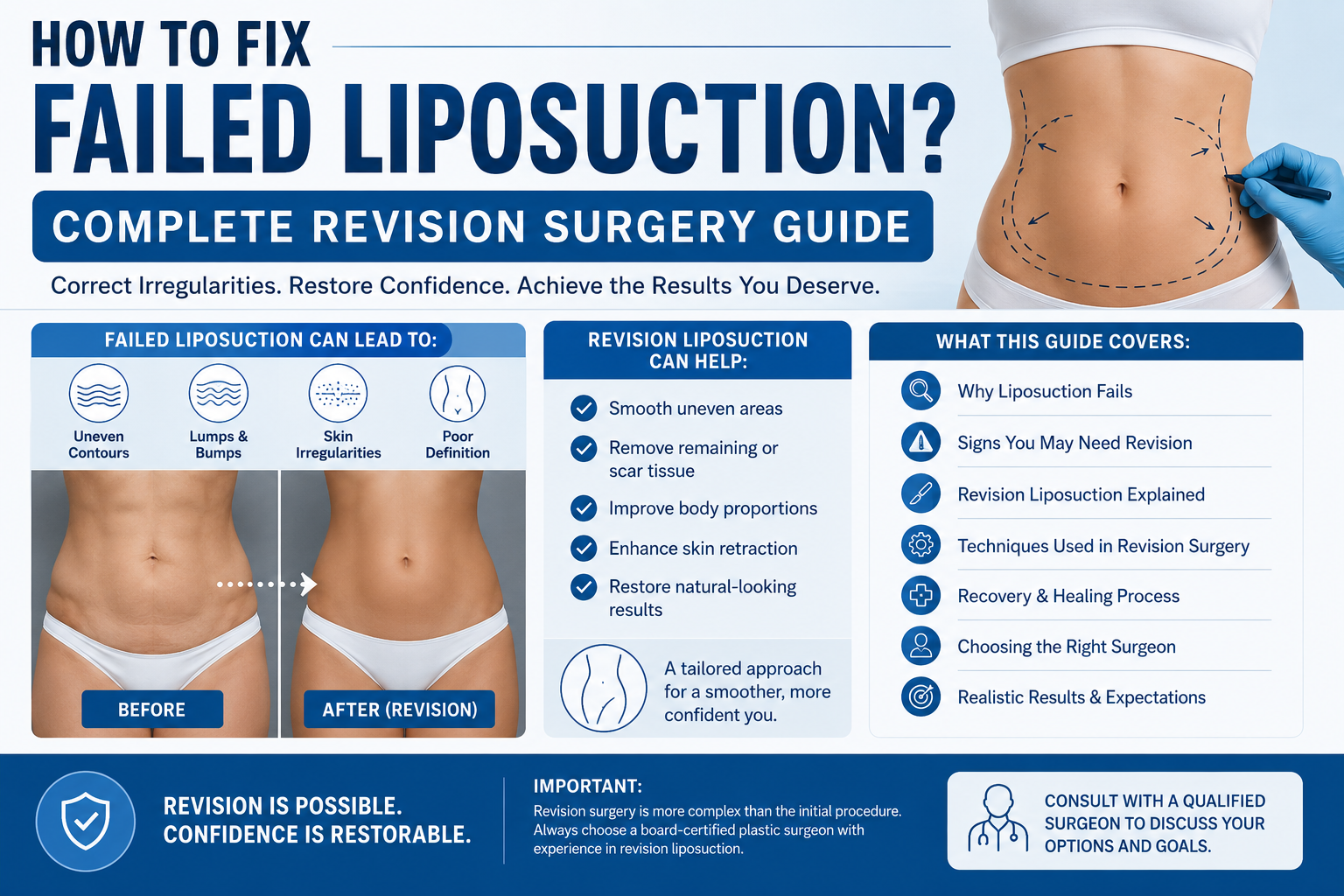
When Patients Come to Us After Liposuction Elsewhere: Assessment and Revision Planning
✔ Medically reviewed by Dr. Ashutosh Shah - M.B., M.S., M.Ch., D.N.B., Board-Certified Plastic & Cosmetic Surgeon, Director of Elegance Clinic, Surat (22+ years’ experience).
When liposuction has already been performed elsewhere, problems such as uneven contours, dents, residual fat or asymmetry may sometimes be improved, but revision is usually planned only after swelling and tissues have sufficiently settled. Liposuction revision after treatment elsewhere starts with identifying whether the problem needs further fat removal, fat grafting, skin treatment or another corrective approach.
Patients seeking revision are often understandably disappointed with their first result. However, an uneven appearance soon after surgery does not automatically mean the first procedure has failed.
Swelling, firmness, scar tissue and tissue contraction can temporarily alter the contour during recovery. This is why revision planning begins with examination and timing rather than immediately scheduling another liposuction procedure.
At Elegance Clinic, Dr. Ashutosh Shah assesses the existing contour, skin quality, previous treatment areas, scars and available fat before discussing whether revision surgery is appropriate and what improvement may realistically be possible.
What Contour Problems Bring Patients Back After Liposuction Elsewhere?
There is no single type of problem seen after previous liposuction.
Patients may seek another opinion because of:
- Uneven contour
- Visible dents or depressions
- Residual pockets of fat
- Difference between the two sides
- Irregular transitions between treated and untreated areas
- Loose skin after fat removal
- Firm or tethered areas
- Over-suctioned areas
- Under-corrected areas
- Concerns about scars
- Persistent dissatisfaction after healing
Each finding needs a different approach.
For example, an area containing excess residual fat may potentially benefit from additional contouring. A depression caused by excessive fat removal may instead need volume restoration.
Performing more suction on every irregularity can make some problems worse.
This distinction is central to liposuction revision after treatment elsewhere because revision surgery is not simply “doing liposuction again.”
Patients considering corrective treatment can read more about revision liposuction and how secondary contour problems are approached.
How Is the Previous Result Assessed at the First Visit?
The first revision consultation should determine what is actually causing the visible problem.
The surgeon may assess the patient while standing because contour irregularities can appear differently when lying down.
The examination may look at:
- Location of depressions
- Residual fat deposits
- Overall symmetry
- Skin laxity
- Skin retraction
- Scar position
- Tissue firmness
- Tethering
- Previous access points
- Relationship between treated and untreated areas
The surgeon also needs to know how long ago the original procedure was performed.
Bring Information From Your First Surgery
If possible, bring:
- Previous operative notes
- Discharge summary
- Details of areas treated
- Approximate date of surgery
- Previous photographs
- Details of postoperative problems
- Information about complications
- Details of any additional procedures
- Current medication list
Not having the original records does not necessarily prevent an assessment, but they may provide useful information about what was previously done.
Before-and-after photographs can also help show whether a particular contour concern developed immediately or became more noticeable during healing.
How Long Must You Wait Before a Revision Is Safe?
One of the most common questions is how long to wait before revision liposuction.
There is no single waiting period appropriate for every patient.
After liposuction, tissues need time to recover. Swelling gradually changes, firmness can soften and skin may continue adapting to the new contour.
Operating too early can make it difficult to distinguish a temporary healing-related irregularity from a persistent contour problem.
The appropriate timing depends on:
- Time since the original procedure
- Amount of residual swelling
- Tissue softness or firmness
- Scar maturation
- Skin condition
- Severity of the deformity
- Whether a complication occurred
- Type of corrective procedure being considered
For many elective revision concerns, the surgeon may prefer to wait until the tissues have sufficiently settled before making a final correction plan.
However, the exact timing should be determined after examination rather than by using an arbitrary date found online.
Revision Decision Table
The following table explains how different findings may lead to different revision strategies. The final plan depends on examination and individual circumstances.
| Finding on examination | Possible cause | Potential corrective approach | Timing consideration |
|---|---|---|---|
| Residual localized fat | Incomplete or conservative initial removal | Additional targeted liposuction may be considered | After adequate healing and reassessment |
| Localized depression or dent | Excessive fat removal | Fat grafting or another volume-restoring approach may be considered | After tissues have sufficiently settled |
| Side-to-side asymmetry | Uneven removal, swelling or anatomical difference | Targeted correction according to the cause | Persistent asymmetry should be reassessed after healing |
| Loose skin | Limited skin retraction or pre-existing laxity | Skin-focused procedure may be more appropriate than additional suction | Depends on skin condition and recovery |
| Firm or irregular tissue | Healing changes or scar tissue | Observation or individualized correction depending on findings | Often requires time for tissue maturation |
| Residual circumferential fullness | Incomplete contouring | Secondary contouring may be considered | After recovery from the first procedure |
The purpose of this table is not to select a procedure yourself. It shows why the visible problem must first be diagnosed correctly.
Which Problems Need Fat Grafting Rather Than More Suction?
This is one of the most important distinctions in revision body contouring.
If the original procedure removed too little fat from a particular area, additional targeted liposuction may sometimes improve the contour.
But if too much fat has been removed and a depression has formed, removing even more fat is unlikely to correct the underlying problem.
A surgeon may instead consider whether volume needs to be restored.
What Is Fat Grafting?
Fat grafting generally involves collecting fat from another suitable area, preparing it and transferring it to a region where additional volume is required.
In revision contouring, it may be considered for selected depressions or over-suctioned areas.
However, not every dent is automatically suitable for fat grafting.
The surgeon needs to assess:
- Depth of the depression
- Condition of the overlying skin
- Scar tissue
- Tissue mobility
- Available donor fat
- Size of the area
- Overall contour
Sometimes the revision plan may involve a combination of techniques rather than one procedure.
This is why correcting over-suctioned areas requires a different strategy from removing residual fat.
Will Loose Skin Improve With More Liposuction?
Not necessarily.
Liposuction removes fat. It does not directly remove substantial excess skin.
If the main problem after the first procedure is loose or hanging skin, performing additional liposuction may not solve it and can sometimes make skin laxity more visible by reducing the volume underneath.
The surgeon therefore needs to distinguish between:
Residual fat: There is still localized fatty fullness.
Loose skin: The volume has reduced, but the skin has not contracted sufficiently.
Combination problem: Both residual fat and skin laxity are present.
Treatment depends on which of these is causing the visible concern.
Patients who want to understand how primary fat removal is planned can read about modern liposuction in Surat.
When Patients Come After Treatment Elsewhere
Patients seeking liposuction revision after treatment elsewhere often arrive with one main question: “Can this be fixed?”
The answer depends on what has actually happened beneath the skin.
A revision consultation should not begin by criticizing the previous surgeon. The goal is to assess the patient's current anatomy and determine what can realistically be improved now.
What Should You Bring From the First Surgeon?
If available, bring your:
- Operative records
- Procedure details
- Hospital discharge documents
- Pre-operative photographs
- Early postoperative photographs
- Recent photographs
- Details of complications
- Previous treatment recommendations
These records can help the revision surgeon understand the sequence of events.
What If You Do Not Have the Previous Records?
You can still be examined.
Explain as accurately as possible:
- When the surgery was performed
- Which areas were treated
- Whether another procedure was performed at the same time
- Whether you experienced infection, fluid collection or delayed healing
- Whether any additional treatment was required
- When you first noticed the contour problem
The physical examination remains essential even when records are available.
Do Not Rush Into Another Procedure
Patients unhappy with their first result may understandably want immediate correction.
But revision surgery performed before the tissues have stabilized can make planning more difficult.
Sometimes the first recommendation after examination is simply to allow more healing time.
That does not mean the concern is being ignored. It means the surgeon wants to assess the final contour rather than operate on a result that is still changing.
What Is Secondary Liposuction?
Secondary liposuction refers to liposuction performed in an area that has previously undergone fat removal.
It can be technically different from a first-time procedure because the tissues may contain scar formation, altered fat distribution or other changes from the original operation.
Patients can learn more about secondary liposuction and why a previously treated area requires fresh assessment.
A second procedure should not simply repeat the original treatment plan.
The surgeon needs to reassess the anatomy as it exists now.
What Result Is Realistic After a Revision?
Revision surgery should be approached as improvement rather than a guarantee of perfect symmetry.
Previous liposuction has already altered the fat layer and surrounding tissues. Scar tissue, skin quality, the severity of the original irregularity and available donor fat can all affect what can be achieved.
The aim may be to:
- Soften a visible depression
- Reduce residual fullness
- Improve side-to-side balance
- Create a smoother transition between areas
- Improve a localized contour irregularity
Complete elimination of every difference may not be possible.
During consultation, ask the surgeon which concern is realistically correctable and which limitations are likely to remain.
This is particularly important when a patient has undergone more than one previous procedure.
Is Revision Liposuction the Same as the First Procedure?
Not necessarily.
Previously treated tissues may behave differently because healing and scar formation have already occurred.
Revision surgery can therefore require:
- More detailed contour assessment
- Careful identification of residual fat
- Evaluation of depressions
- Assessment of scar tissue
- Consideration of fat grafting
- Conservative correction
- Staged treatment in selected cases
The goal is not simply to remove as much fat as possible.
It is to identify the cause of the contour problem and choose a correction appropriate to that finding.
For selected localized fat concerns, patients can also read about small incision fat removal.
Questions to Ask at a Revision Consultation
Before agreeing to another operation, consider asking:
- What is causing the irregularity I can see?
- Is this residual swelling or a permanent contour problem?
- Have my tissues healed enough for revision?
- Does this area need more fat removed or volume added?
- Would fat grafting help?
- Is loose skin contributing to the problem?
- What improvement is realistic?
- Could more than one procedure be required?
- Where would donor fat come from if grafting is needed?
- What limitations will remain after revision?
- How will recovery differ from my first procedure?
- What happens if I choose not to revise the area?
Clear answers can help you understand whether revision is appropriate and what the proposed surgery is intended to accomplish.
Planning Liposuction Revision at Elegance Clinic
A patient who has undergone surgery elsewhere should be assessed according to their current condition rather than simply repeating the first operation.
At Elegance Clinic, Dr. Ashutosh Shah can assess residual fat, contour irregularities, skin quality, depressions, asymmetry and previous scars before discussing whether observation, further liposuction, fat grafting or another corrective approach may be appropriate.
Previous photographs and operative records can be useful, but the current examination is central to planning.
The objective of revision should be a realistic improvement based on the tissues available rather than a promise to erase every sign of the previous procedure.
Conclusion
Liposuction revision after treatment elsewhere requires a different approach from first-time liposuction. The first step is identifying whether the concern comes from residual fat, excessive fat removal, loose skin, asymmetry, scar tissue or a combination of problems.
Timing matters because swelling and tissue changes can continue during recovery. A revision should therefore be planned after appropriate healing and assessment rather than simply because an irregularity is visible soon after surgery.
Some areas may need additional targeted fat removal, while over-suctioned depressions may require fat grafting or another volume-restoring approach. Loose skin may need a different solution altogether.
A careful examination, realistic expectations and an individualized correction plan are the foundation of revision treatment.
Frequently Asked Questions
How long after the first liposuction can a revision be done?
Can over-suctioned dents be filled with fat?
Will loose skin improve with a second liposuction?
Do I need the previous operative notes?
Is revision liposuction more painful?
Can a revision be done on only one side?
About the Author