
Microvascular and Replantation Surgery in Gujarat: When a Severed Part Can Be Saved
✔ Medically reviewed by Dr. Ashutosh Shah - M.B., M.S., M.Ch., D.N.B., Board-Certified Plastic & Cosmetic Surgeon, Director of Elegance Clinic, Surat (22+ years’ experience).
Microvascular surgery in Gujarat can save a severed finger, thumb, hand or limb when the patient reaches a replantation surgeon quickly and the cut part is kept clean and cold. Under an operating microscope, the surgeon rejoins bone, tendons, arteries, veins and nerves. Fingers are often salvageable for several hours if cooled correctly.
Amputation injuries from machines, knives, doors and road accidents are common in an industrial region like South Gujarat. What happens in the first hour often decides whether a part can be reattached. This guide explains what replantation is, when it works, and exactly what to do on the way to hospital.
What is microvascular surgery?
Microvascular surgery is surgery on blood vessels and nerves so small that they can only be repaired under an operating microscope. The vessels in a finger are often around one millimetre wide, and they are stitched with sutures finer than a human hair.
The same skills are used for three main purposes:
- Replantation: reattaching a part of the body that has been completely cut off, such as a finger, thumb, hand or part of the arm.
- Revascularisation: restoring blood flow to a part that is still partly attached but has lost its circulation.
- Free flap reconstruction: moving living tissue with its own blood vessels from one area of the body to cover a wound elsewhere, often after trauma or cancer surgery.
When can a severed part be reattached?
A severed part can usually be considered for reattachment when it is not badly crushed, has been kept cool, and the patient is stable enough for a long operation. The final decision is always made by the surgeon after examining the part and the injury.
Replantation is most often attempted for:
- Thumb injuries, because the thumb provides a large share of hand function
- Several fingers cut at once
- Injuries at the palm, wrist or forearm level
- Any finger injury in a child
- Clean, sharp cuts with little crushing
It may not be advised when the part is severely crushed or torn, heavily contaminated, cut at many levels, or when the patient has other life-threatening injuries that must be treated first.
How quickly must the patient reach a surgeon?
The patient should reach a hospital that offers microvascular replantation as soon as possible, ideally within a few hours. Every hour without blood flow reduces the chance of success, and cooling the part correctly buys valuable time.
Parts with little muscle tolerate delay better than parts with a lot of muscle. The figures below are the ranges generally cited in hand surgery practice. They are a guide only, and every case is different.
| Severed part | Without cooling (warm) | Correctly cooled |
|---|---|---|
| Finger or thumb (little muscle) | Up to about 12 hours | Up to about 24 hours |
| Hand, wrist, forearm or larger limb (more muscle) | About 6 hours | About 12 hours |
Do not wait to see whether the part can be saved. Travel first and let the surgical team decide.
What should you do in the first hour after an amputation injury?
Stay calm, control the bleeding, protect the severed part and head to a replantation centre immediately. These steps follow widely accepted first aid guidance, such as the MedlinePlus guide to traumatic amputation:
- Call for help and arrange transport to a hospital with a plastic or hand surgeon. Call ahead if you can so the team is ready.
- Control the bleeding by pressing firmly on the wound with a clean cloth and raising the injured limb above heart level.
- Avoid a tight tourniquet unless bleeding is life-threatening and cannot be stopped with pressure, because it can damage vessels needed for reattachment.
- Cover the stump with a clean, damp cloth or gauze and bandage it lightly.
- Find every piece, however small, and take all of them with you.
- Rinse the severed part gently with clean water or saline only if it is dirty. Do not scrub it.
- Wrap the part in clean gauze or cloth that is slightly damp, not soaking.
- Seal it in a plastic bag and place the bag in a container of ice and water.
- Never put the part directly on ice, in plain water or in dry ice. Direct freezing destroys the tissue.
- If the part is still hanging on, do not cut it free. Place it in its normal position, support it with a splint and keep it cool from the outside.
- Give nothing to eat or drink, because the patient may need an anaesthetic soon.
What does replantation surgery involve?
Replantation is a long, delicate operation, often taking several hours for a single finger and longer for multiple parts. The surgeon works in a set order so each repaired structure supports the next.
- Cleaning and preparing both the stump and the severed part
- Shortening and fixing the bone with fine wires or plates
- Repairing the tendons that bend and straighten the finger
- Rejoining the arteries under the microscope to restore blood flow
- Repairing the nerves so feeling can return over time
- Rejoining the veins so blood can drain out of the part
- Closing the skin loosely, sometimes with a skin graft
What recovery and function can be expected?
Recovery takes months, and the aim is a useful, sensate part rather than a perfect one. The first few days are the most critical, as the team watches the colour, warmth and blood flow of the replanted part closely.
- Hospital stay: usually several days of close monitoring, warmth and rest.
- Bone healing: generally around six to eight weeks.
- Nerve recovery: feeling returns slowly over many months, and is usually better in children.
- Hand therapy: guided exercises are essential to regain movement and grip.
- Cold sensitivity and stiffness: common for some time after surgery.
- Smoking: should be stopped completely, because nicotine narrows the small vessels and can cause the replant to fail.
Some replants need further surgery later, such as tendon release or scar revision, to improve function.
Where is microvascular surgery available in Gujarat?
Microvascular replantation needs a trained surgeon, an operating microscope and a team available at short notice, so it is offered only at selected centres in Gujarat. In Surat, Dr. Ashutosh Shah trained in microvascular and reconstructive surgery at Ganga Hospital, Coimbatore, and has performed a large number of replantations and microvascular operations during his career.
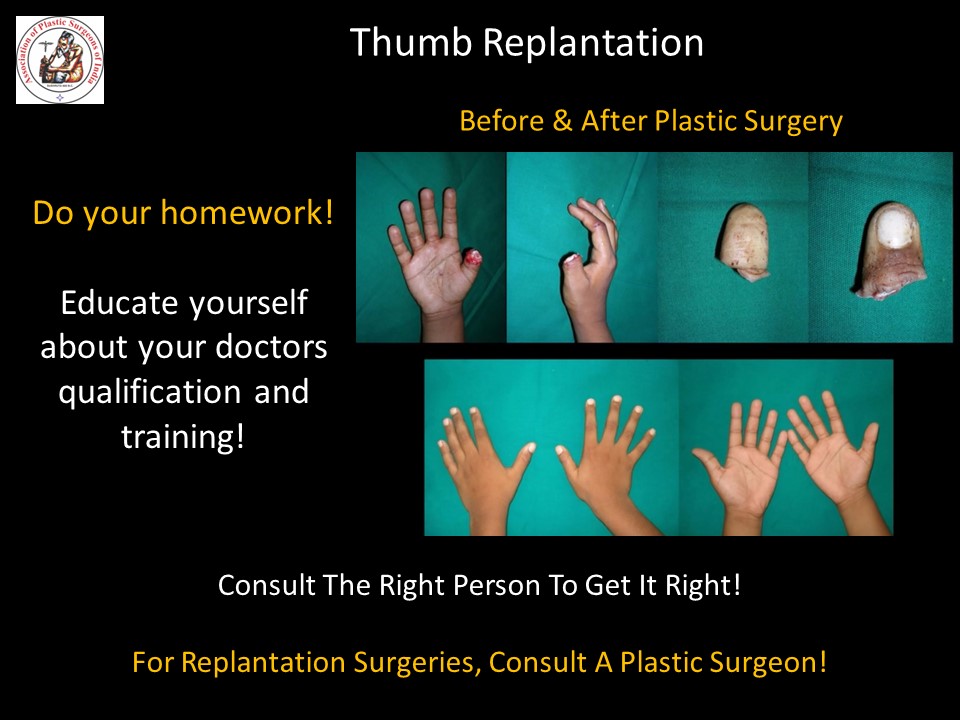
In our practice in Surat, many of the hand injuries we see come from industrial machines and household accidents, and the outcome depends heavily on how the part was handled before the patient arrived. You can read more about Dr. Ashutosh Shah's training and experience, our guide to thumb replantation, and our vascular trauma care.
When should you seek emergency care for a hand injury?
Seek emergency care immediately for any cut-off or partly cut-off finger, thumb or hand, and for any hand injury with heavy bleeding, a pale or cold finger, numbness, or an inability to bend a finger. These signs can mean damage to vessels, nerves or tendons that needs early repair.
Need advice after a hand or finger injury? For emergencies, go to the nearest hospital straight away. For planned reconstruction or follow-up care, you can book a consultation with Dr. Ashutosh Shah at Elegance Clinic, Adajan or Vesu, Surat, or call +91 83205 00350.
Medical disclaimer: This article is for general education and is not a substitute for emergency care or a personal medical assessment. In an emergency, go to the nearest hospital. Consult Dr. Ashutosh Shah or a qualified specialist about your own situation.
Frequently Asked Questions
How long can a severed finger be reattached?
How should a cut finger be stored on the way to hospital?
Does a reattached finger regain feeling?
Is replantation always possible?
Is an amputated finger a medical emergency?
What does microvascular surgery in Gujarat cost?
About the Author