
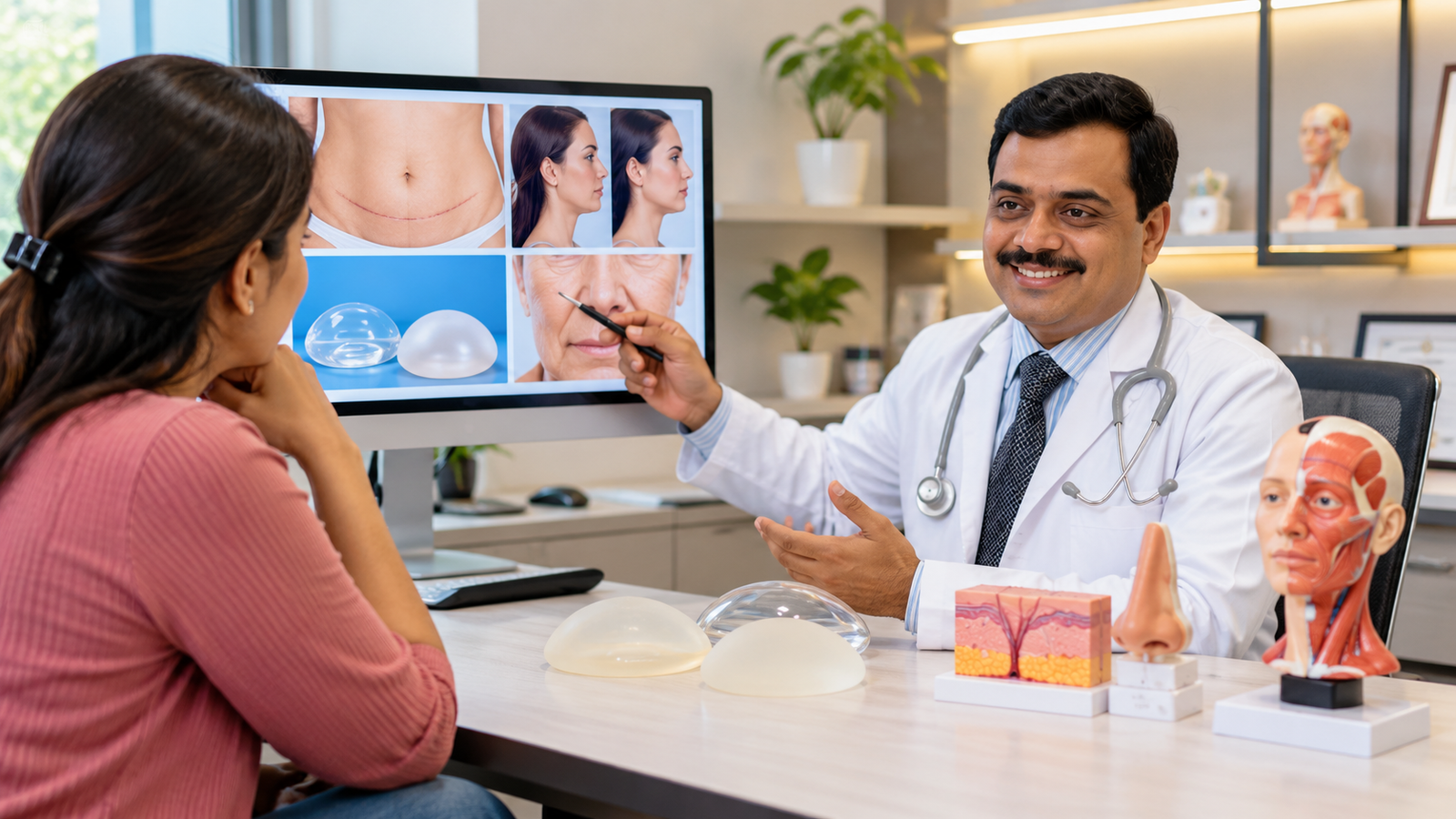
Plastic Surgery Myths a Surgeon Corrects Every Week: Scars, Plastic, Age and 'Permanent' Results
✔ Medically reviewed by Dr. Ashutosh Shah - M.B., M.S., M.Ch., D.N.B., Board-Certified Plastic & Cosmetic Surgeon, Director of Elegance Clinic, Surat (22+ years’ experience).
Can plastic surgery remove scars completely? No. Plastic surgery can improve a scar's width, texture, position and visibility, but it cannot make every scar disappear. Surgery does not necessarily involve synthetic plastic, cosmetic results continue to change with ageing, and plastic surgeons treat injuries, burns and congenital conditions not just appearance concerns.
Many patients arrive at consultations with expectations shaped by social media, advertisements and dramatic transformation photographs.
Some believe plastic surgery leaves no scars. Others think every procedure is cosmetic, that older patients cannot undergo reconstruction or that surgery produces permanent results.
These misunderstandings can create unrealistic expectations and lead to disappointing treatment decisions.
Dr. Ashutosh Shah, reconstructive and cosmetic plastic surgeon, holds MBBS, MS, MCh and DNB qualifications and has practised since 2004. At Elegance Clinic, his reconstructive and aesthetic surgery work involves assessing individual anatomy, treatment goals, healing and possible complications.
This guide explains common plastic surgery myths and the medical facts patients should understand before choosing treatment.
Key Takeaways
-
Plastic surgery can improve scars but cannot guarantee complete removal.
-
The word plastic refers to shaping or moulding, not necessarily synthetic materials.
-
Surgical incisions generally leave scars, although careful techniques can reduce their visibility.
-
Scar appearance often continues changing for 12–18 months or longer.
-
Cosmetic results can change with ageing and weight fluctuations.
-
Age alone does not determine whether someone can undergo surgery.
-
Reconstructive surgery treats injuries, burns, congenital conditions and functional problems.
-
Keloids can return even after surgical removal.
Plastic Surgery Myths vs Facts: What Patients Should Know
| Common myth | What surgeons explain | Why it matters |
|---|---|---|
| Plastic surgery removes scars completely | Scar revision usually improves appearance rather than eliminating the scar | Prevents unrealistic expectations |
| Plastic surgery uses plastic | The name comes from a Greek word associated with shaping or moulding | Clarifies what the specialty involves |
| Plastic surgery is scarless | Incisions generally heal with scars, although surgeons try to minimise their visibility | Helps patients understand surgical trade-offs |
| Cosmetic results last forever | Ageing and body changes continue after treatment | Supports realistic long-term planning |
| Older people cannot undergo surgery | Fitness, medical conditions and procedure risks matter more than age alone | Encourages individual assessment |
| Plastic surgery is only cosmetic | Reconstruction is a major part of the specialty | Explains its medical and functional roles |
| Keloids never return after removal | Keloids have a meaningful recurrence risk | Highlights the need for treatment planning |
| Fillers and surgery are the same | Fillers are injectable treatments, while surgery involves operative techniques | Helps patients compare options |
Myth 1: Can Plastic Surgery Make a Scar Disappear Completely?
One of the most common questions is: Can plastic surgery remove scars completely?
The answer is generally no.
A scar forms when the skin repairs itself after injury, burns or surgery. Scar tissue differs from normal skin in its collagen arrangement, texture and sometimes pigmentation.
Plastic surgery may improve the scar, but the treated area usually retains some visible or detectable evidence of healing.
What Can Scar Revision Actually Improve?
Scar revision may help:
-
Reduce the width of a stretched scar.
-
Improve the position of a poorly placed scar.
-
Release tight scar tissue.
-
Reduce raised or uneven areas.
-
Improve movement when a scar restricts a joint.
-
Make a scar less noticeable within natural skin folds.
For example, a wide scar may be surgically removed and closed carefully to create a narrower scar.
However, the new incision must also heal.
Therefore, permanent scar removal surgery should not be interpreted as a guarantee of completely normal, scar-free skin.
For a detailed explanation of treatment options and realistic results, read our guide to Full scar removal surgery.
How Long Does a Scar Take to Mature?
Scar healing continues long after the skin surface closes.
| Healing stage | Typical changes |
|---|---|
| First 2 weeks | Wound closure, early healing and possible swelling |
| Weeks 3–8 | Scar may appear pink, red, firm or slightly raised |
| Months 3–6 | Scar gradually becomes softer and less prominent |
| Months 6–12 | Colour, thickness and texture may continue improving |
| Months 12–18 | Many scars approach a more mature appearance |
Some scars continue changing beyond 18 months.
Healing depends on skin type, wound tension, location, genetics and aftercare.
Myth 2: Does Plastic Surgery Actually Use Plastic?
Despite its name, plastic surgery does not mean surgeons routinely place plastic material inside the body.
The term comes from the Greek word plastikos, associated with shaping or moulding.
Plastic surgery focuses on restoring, reconstructing or changing the form and function of body tissues.
What Does a Plastic Surgeon Work With?
Depending on the procedure, surgeons may work with:
-
Skin.
-
Fat.
-
Muscle.
-
Tendons.
-
Nerves.
-
Blood vessels.
-
Cartilage.
-
Bone.
Some operations use implants or synthetic materials, but many do not.
For example, repairing a facial cut, reconstructing a damaged hand or releasing a burn contracture may involve the patient's own tissues.
The specialty is defined by surgical techniques and treatment goals, not by the use of plastic.
Myth 3: Does Plastic Surgery Leave Scars?
Another common concern is: Does plastic surgery leave scars?
Yes. Procedures involving skin incisions generally produce scars.
However, surgeons use techniques intended to make them as inconspicuous as reasonably possible.
How Do Plastic Surgeons Reduce Scar Visibility?
Depending on the operation, techniques may include:
-
Placing incisions within natural skin creases.
-
Reducing unnecessary tension during closure.
-
Aligning wound edges accurately.
-
Using appropriate sutures.
-
Protecting the wound during early healing.
-
Recommending suitable scar care after closure.
These measures may improve the final result but cannot guarantee an invisible scar.
Will Stitches Leave Another Scar?
Stitches hold tissues together while a wound heals.
The wound itself forms a scar, and certain sutures can also leave small marks.
The risk depends on suture technique, wound tension, inflammation and healing.
In selected cases, absorbable sutures or carefully timed suture removal can reduce visible stitch marks.
Patients should not remove stitches themselves unless specifically instructed by their treating clinician.
Myth 4: Scarless Plastic Surgery Is Possible
The term scarless surgery is often used in cosmetic advertising.
However, it can be misleading.
Some procedures use small incisions, hidden incisions or access through natural openings.
This may reduce the visibility of scars, but it does not mean tissue healing occurs without scarring.
What Does Scarless Surgery Usually Mean?
It may refer to:
-
Incisions hidden inside the mouth or nose.
-
Small access points.
-
Incisions placed in natural folds.
-
Procedures that do not require a skin incision.
The correct question is not whether a procedure is advertised as scarless.
Instead, ask:
Where will the incision be, how will it heal, and what scar should I realistically expect?
A surgeon should explain these details before treatment.
Myth 5: Plastic Surgery Results Are Permanent
Many procedures produce long-lasting anatomical changes.
However, long-lasting does not mean unchanged forever.
The body continues to age after surgery.
Does a Facelift Last Forever?
A facelift can reposition tissues and improve certain signs of facial ageing.
However, skin and deeper tissues continue changing over time.
The duration of the result depends on individual anatomy, technique and ageing.
Are Liposuction Results Permanent?
Liposuction removes fat cells from treated areas.
However, remaining fat cells can enlarge if body weight increases.
Weight fluctuations and skin changes may alter the appearance achieved through surgery.
Can Reconstructive Results Change?
Yes.
Reconstructed tissues can change because of ageing, scarring, disease progression or additional injury.
Some patients may require further procedures.
A realistic surgical goal is durable improvement, not a promise that the body will never change again.
Myth 6: Plastic Surgery Is Only for Cosmetic Appearance
People sometimes ask: Is plastic surgery only for cosmetic purposes?
No.
Plastic surgery includes both reconstructive and aesthetic procedures.
Reconstructive Plastic Surgery
Reconstructive surgery may treat:
-
Facial injuries.
-
Burns and scar contractures.
-
Hand injuries.
-
Congenital differences.
-
Tissue loss after cancer treatment.
-
Complex wounds.
-
Nerve injuries.
-
Functional problems caused by scars.
The primary aim may be restoring movement, protecting tissues, improving breathing or repairing damage.
Cosmetic Plastic Surgery
Cosmetic procedures primarily aim to change appearance according to the patient's goals.
Examples include selected facial rejuvenation and body-contouring operations.
The same surgeon may perform both reconstructive and cosmetic procedures.
The distinction depends largely on the medical indication and treatment objective.
Myth 7: Older Patients Cannot Undergo Plastic Surgery
There is no universal age at which all plastic surgery becomes unsafe or inappropriate.
A healthy older adult may be suitable for a medically indicated reconstructive procedure.
Likewise, a younger patient may have health problems that increase surgical risk.
What Matters More Than Age?
Surgeons assess:
-
Heart and lung health.
-
Diabetes control.
-
Blood pressure.
-
Current medications.
-
Smoking and nicotine exposure.
-
Nutritional status.
-
Anaesthesia risks.
-
Functional needs.
-
Expected benefits and recovery.
For children, growth and development also influence the timing of certain procedures.
The appropriate decision depends on the individual, not age alone.
Myth 8: Removing a Keloid Means It Will Never Return
A keloid is a raised scar that grows beyond the original wound boundaries.
Keloids can develop after surgery, acne, burns, piercings or minor skin injuries.
Can Surgery Remove a Keloid?
Surgical excision can remove existing keloid tissue.
However, the healing process itself may trigger another keloid.
Therefore, removing a keloid does not guarantee that it will never return.
How Do Surgeons Reduce Recurrence Risk?
Depending on the case, treatment may include:
-
Corticosteroid injections.
-
Silicone-based scar care.
-
Pressure therapy in suitable locations.
-
Selected additional treatments.
-
Careful follow-up.
Combination treatment may be more appropriate than excision alone for some patients.
Patients concerned about recurrence can read Can surgery reduce a keloid for further details about treatment options and limitations.
Myth 9: Fillers and Plastic Surgery Are the Same
Dermal fillers are injectable treatments used to add volume or improve selected contours.
They are not the same as operative plastic surgery.
How Are Fillers Different?
Fillers generally involve injections rather than surgical incisions.
Depending on the material used, their effects may be temporary or long-lasting.
They also carry risks, including infection, lumps and, rarely, serious vascular complications.
How Is Surgery Different?
Surgery may involve removing, repositioning or reconstructing tissues.
It generally requires a different level of planning, recovery and risk assessment.
Neither approach is automatically better.
The appropriate choice depends on the patient's anatomy, treatment goals and medical history.
Plastic Surgeon Consultation in Kadodara: Questions to Ask Before Surgery
A consultation should help patients understand both the expected improvement and the limitations of treatment.
Dr. Ashutosh Shah at Elegance Clinic evaluates individual anatomy, scar characteristics, medical history and treatment goals before discussing appropriate surgical options.
Before deciding on a procedure, patients should ask:
-
What improvement is realistically possible?
-
Will the procedure create a new scar?
-
Where will the incision be placed?
-
What complications are possible?
-
How long will recovery take?
-
Can the problem return?
-
Will further treatment be necessary?
-
Are there non-surgical alternatives?
Patients should also understand the possible risks of surgery, including infection, bleeding, wound-healing problems, anaesthesia complications and the need for revision.
For a detailed discussion of informed consent, read Complications a surgeon must disclose.
A useful consultation explains not only what surgery can achieve but also what it cannot promise.
How to Set Realistic Expectations Before Plastic Surgery
Patients should avoid making decisions based only on edited photographs, advertisements or dramatic transformation claims.
A reliable surgical plan should consider:
-
The actual medical problem.
-
Available treatment options.
-
Expected improvement.
-
Possible scars.
-
Recovery time.
-
Complication risks.
-
Long-term maintenance.
-
The possibility of additional procedures.
Patients should also disclose previous operations, allergies, medications and relevant health conditions.
When expectations are realistic, it becomes easier to judge whether the potential benefits justify the risks.
Conclusion
Plastic surgery is often misunderstood because of unrealistic promises about invisible scars, permanent results and dramatic transformations.
The answer to can plastic surgery remove scars completely remains straightforward: surgery can often improve a scar, but complete disappearance cannot be guaranteed.
Likewise, plastic surgery does not necessarily involve synthetic materials, reconstructive procedures are not simply cosmetic treatments, and age alone does not determine surgical suitability.
Understanding these facts helps patients make informed decisions.
The best surgical plan is one that explains realistic benefits, limitations, recovery and possible complications before treatment begins.
Frequently Asked Questions
What Is Scarless Surgery Really?
Can a Keloid Be Removed Without It Returning?
Will a Facelift or Liposuction Result Last Forever?
Can a 70-Year-Old Have Reconstructive Surgery?
Are Fillers a Form of Plastic Surgery?
Does Insurance Treat All Plastic Surgery as Cosmetic?
About the Author