
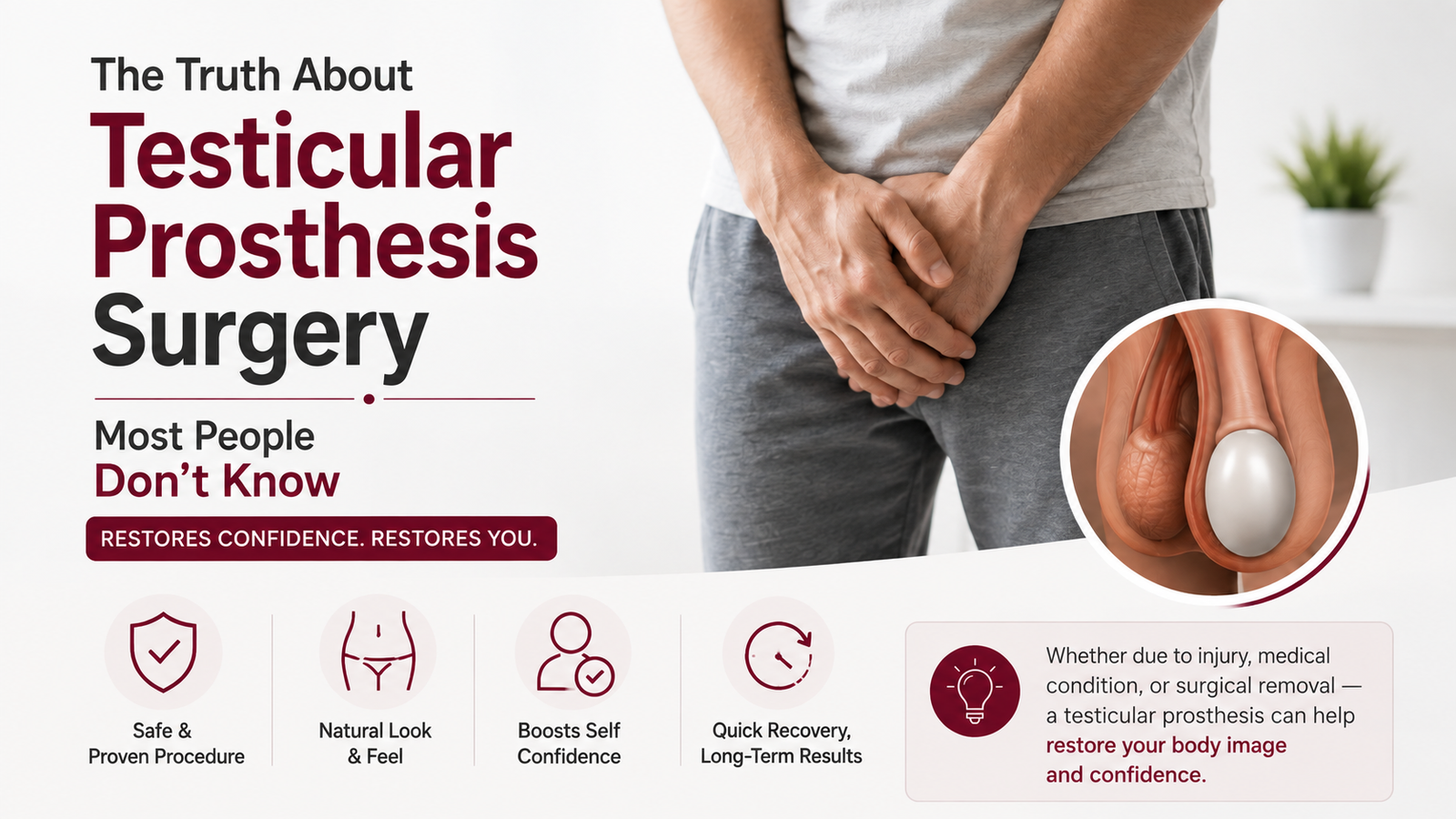
The Truth About Testicular Prosthesis Surgery Most People Don’t Know
✔ Medically reviewed by Dr. Ashutosh Shah - M.B., M.S., M.Ch., D.N.B., Board-Certified Plastic & Cosmetic Surgeon, Director of Elegance Clinic, Surat (22+ years’ experience).
Testicular prosthesis surgery is a procedure in which an artificial testicular implant is placed inside the scrotum to restore a more natural scrotal appearance after the loss or absence of a testicle. It may be considered after orchiectomy, testicular trauma, certain medical conditions, or as part of gender-affirming surgical care.
One important fact many people do not realize is that a testicular prosthesis is primarily intended to restore appearance and body contour. It does not produce sperm or testosterone and does not function like a biological testicle.
For people researching testicular prosthesis surgery in Surat, understanding the procedure, candidacy, implant placement, recovery, risks, and expected appearance can make the consultation much more productive.
What Is Testicular Prosthesis Surgery?
Testicular prosthesis surgery is a surgical procedure that places a prosthetic testicle inside the scrotum when a natural testicle is absent or has been removed.
The prosthesis is designed to provide a shape and feel that can more closely resemble a natural testicle. Modern prostheses are commonly filled with saline and are available in different sizes to help the surgeon select an option appropriate for the individual's anatomy.
In simple terms:
Testicular prosthesis surgery replaces the appearance of a missing testicle with an artificial implant; it does not replace the biological function of a testicle.
This distinction is important when discussing expectations before surgery.
Why Do People Consider a Testicular Prosthesis?
The decision is personal and can involve physical appearance, body image, confidence, or gender-affirming goals.
A prosthesis may be considered by people who have:
- Had one or both testicles removed
- Undergone orchiectomy
- Lost a testicle following trauma
- Had a testicle removed because of a medical condition
- Congenital absence or significant underdevelopment of a testicle
- Scrotal asymmetry following previous surgery
- Gender-affirming surgical goals involving scrotal reconstruction
Research on testicular prostheses has found that patient satisfaction can be high, while common concerns after surgery may involve implant position, size, or weight.
What Most People Don't Know: A Prosthesis Is Not a “Replacement Testicle”
One of the biggest misconceptions about testicular prosthesis surgery is that the implant performs the same biological functions as a natural testicle.
It does not.
A testicular prosthesis is designed primarily for cosmetic and reconstructive purposes. It does not produce sperm and does not naturally produce testosterone.
If both natural testicles have been removed, hormonal management is a separate medical consideration. Bilateral orchiectomy can substantially reduce testosterone production and can affect fertility.
Therefore, patients should discuss both their reconstructive goals and their hormonal or fertility considerations with the appropriate medical professionals.
Is Testicular Prosthesis Surgery the Same as Orchiectomy?
No.
Orchiectomy involves removing one or both testicles. Testicular prosthesis surgery involves placing an artificial implant in the scrotum.
The procedures can sometimes be performed during the same surgical episode, depending on the patient's circumstances and surgical plan. A prosthesis may also be placed later following testicular removal.
Quick comparison
| Procedure | Main purpose |
|---|---|
| Orchiectomy | Removal of one or both testicles |
| Testicular prosthesis surgery | Placement of an artificial testicular implant |
| Scrotoplasty | Creation or reconstruction of the scrotum |
| Testicular prosthesis + scrotoplasty | May be combined in selected gender-affirming or reconstructive procedures |
The appropriate approach depends on anatomy, previous procedures, health status, and the patient's goals.
Can Testicular Prosthesis Surgery Be Part of Gender-Affirming Surgery?
Yes. Testicular prostheses can be incorporated into gender-affirming genital surgery for appropriately selected patients.
Gender-affirming surgical care may include procedures such as scrotoplasty and implantation of testicular prostheses.
For someone considering a gender-affirming testicular prosthesis in Surat, the consultation should address more than the implant itself. The surgeon may need to assess scrotal anatomy, previous surgery, tissue quality, desired size and appearance, and whether other procedures are being performed at the same time.
Who May Be a Candidate for Testicular Prosthesis Surgery?
Candidacy is determined individually after a medical and surgical assessment.
A person may be considered for a testicular prosthesis if they have an absent or removed testicle and want to restore scrotal volume or appearance.
The surgeon may consider:
- Overall health
- Previous scrotal or genital surgery
- Available scrotal tissue
- Existing infection or inflammation
- Healing capacity
- Implant size and desired appearance
- Whether the procedure is being combined with another surgery
- Individual expectations and goals
People with certain conditions, including an existing infection, immune suppression, diabetes, or previous scrotal surgery, may have a higher risk of complications and require careful assessment.
What Happens During Testicular Prosthesis Surgery?
The exact surgical technique varies according to the patient's anatomy and whether other procedures are being performed.
In general, the surgeon:
- Evaluates the scrotum and determines the appropriate implant size.
- Creates an appropriate surgical access point.
- Creates a pocket within the scrotum for the prosthesis.
- Places the prosthesis into the selected position.
- Checks the position and symmetry.
- Closes the surgical incision.
The goal is to position the implant comfortably while creating a natural-looking overall contour.
The final position can change somewhat as swelling decreases and the tissues heal, so the immediate postoperative appearance should not necessarily be considered the final result.
Does a Testicular Prosthesis Look and Feel Natural?
The result can look natural, but expectations should remain realistic.
A prosthesis is an artificial implant, so its size, firmness, movement, and position may differ from a natural testicle. Individual results can also be influenced by scrotal anatomy, previous surgery, scar tissue, implant size, and healing.
Studies have identified implant positioning, size, and weight among the concerns patients may discuss after implantation.
During consultation, patients should therefore discuss what type of appearance and symmetry they want rather than assuming that every implant will produce an identical result.
Is Testicular Prosthesis Surgery Painful?
The surgery itself is performed with anesthesia, so pain is not normally experienced during the procedure.
After surgery, some discomfort, tenderness, swelling, or sensitivity around the scrotum can occur. Cleveland Clinic notes that discomfort or tenderness may be present during the first 24–48 hours after implantation, although individual recovery varies.
Your surgeon will provide personalized instructions regarding pain management, wound care, activity restrictions, and follow-up.
What Is Recovery Like After Testicular Prosthesis Surgery?
Recovery differs from person to person.
During the early recovery period, patients may experience:
- Swelling
- Bruising
- Tenderness
- Mild discomfort
- Temporary sensitivity
- Changes in implant position as swelling decreases
Supportive garments may be recommended during recovery. Strenuous exercise, heavy lifting, cycling, and similar activities may need to be restricted for a period determined by the surgeon.
Sexual activity should also be resumed only when the surgeon considers it appropriate for the individual's healing progress.
Important:
Do not compare your recovery timeline with another patient's experience. Previous surgery, tissue healing, implant placement, and individual health can all affect recovery.
What Are the Risks of Testicular Prosthesis Surgery?
Like any surgical procedure involving an implant, testicular prosthesis surgery carries potential risks.
Possible complications include:
- Infection
- Bleeding or hematoma
- Scarring
- Implant displacement or malposition
- Implant rupture or leakage
- Implant extrusion or expulsion
- Persistent discomfort
- Dissatisfaction with appearance
These complications are not inevitable, but they should be discussed during the preoperative consultation.
Previous scrotal surgery, infection, diabetes, and certain immune-related conditions may increase the risk of complications.
Can the Implant Move After Surgery?
Implant position is an important consideration.
During healing, the tissues surrounding the prosthesis change as swelling decreases. The final position can therefore differ from the immediate postoperative appearance.
A prosthesis can also become displaced or sit differently from the desired position, which is a recognized potential complication.
If a patient notices significant movement, persistent discomfort, marked asymmetry, or a sudden change in appearance after healing, a surgical review is appropriate.
Does a Testicular Prosthesis Affect Sexual Function?
A testicular prosthesis itself is primarily an implant for appearance and does not provide the hormonal or reproductive function of a natural testicle.
Sexual and hormonal outcomes depend largely on the individual's underlying anatomy, whether one or both natural testicles remain, other surgeries performed, and hormone status.
For example, removal of both testicles can significantly reduce testosterone production, while removal of one testicle may have different hormonal consequences if the remaining testicle functions normally.
This is why discussions about testicular implant surgery should include both cosmetic expectations and relevant reproductive or hormonal considerations.
How Is the Right Implant Size Selected?
Implant selection is individualized.
The surgeon considers factors such as:
- Existing testicular size
- Scrotal dimensions
- Available tissue
- Desired symmetry
- Previous surgery
- Overall body proportions
- Whether one or both implants are being placed
The objective is not simply to select the largest possible implant. Proportion, positioning, comfort, and the overall appearance of the scrotum are important considerations.
What Should You Ask Before Testicular Prosthesis Surgery?
A consultation is an opportunity to understand whether the procedure is appropriate for you.
Consider asking:
- Am I a suitable candidate for a testicular prosthesis?
- Which implant size would be appropriate for my anatomy?
- Can the prosthesis be placed during another planned surgery?
- Where will the implant be positioned?
- What should I expect during recovery?
- When can I return to work and exercise?
- What complications should I watch for?
- What happens if the implant moves or becomes infected?
- Will this procedure affect my hormones or fertility?
- What should I realistically expect from the final appearance?
Clear answers to these questions can help you make an informed decision.
Testicular Prosthesis Surgery in Surat
People searching for testicular prosthesis surgery in Surat may have very different reasons for considering the procedure, including reconstruction after testicular removal or gender-affirming surgical goals.
A personalized consultation is important because there is no single implant size, surgical approach, or recovery plan that is appropriate for everyone.
At Elegance Clinic, Dr. Ashutosh Shah can discuss your individual goals, anatomy, previous procedures, and expectations to determine whether testicular prosthesis surgery is an appropriate option for you.
Conclusion: Is Testicular Prosthesis Surgery Right for You?
Testicular prosthesis surgery can restore scrotal volume and improve the appearance of a missing or absent testicle, but it is not a biological replacement.
The most important factors are appropriate patient selection, realistic expectations, careful implant selection, proper positioning, and postoperative follow-up.
If you are considering testicular prosthesis surgery in Surat, the best next step is a personalized surgical consultation rather than choosing an implant based only on photographs or online information.
Book a Consultation in Surat
If you are considering a testicular prosthesis after orchiectomy, trauma, previous surgery, or as part of gender-affirming care, discuss your goals with a qualified surgeon.
Contact Dr. Ashutosh Shah at Elegance Clinic to discuss your suitability, surgical options, implant selection, expected recovery, and personalized treatment plan.
Frequently Asked Questions
What is testicular prosthesis surgery?
Who can get a testicular prosthesis?
Is a testicular prosthesis a real testicle?
Can a testicular prosthesis be placed after orchiectomy?
Can transgender patients have testicular prosthesis surgery?
How long does testicular prosthesis surgery take?
About the Author