
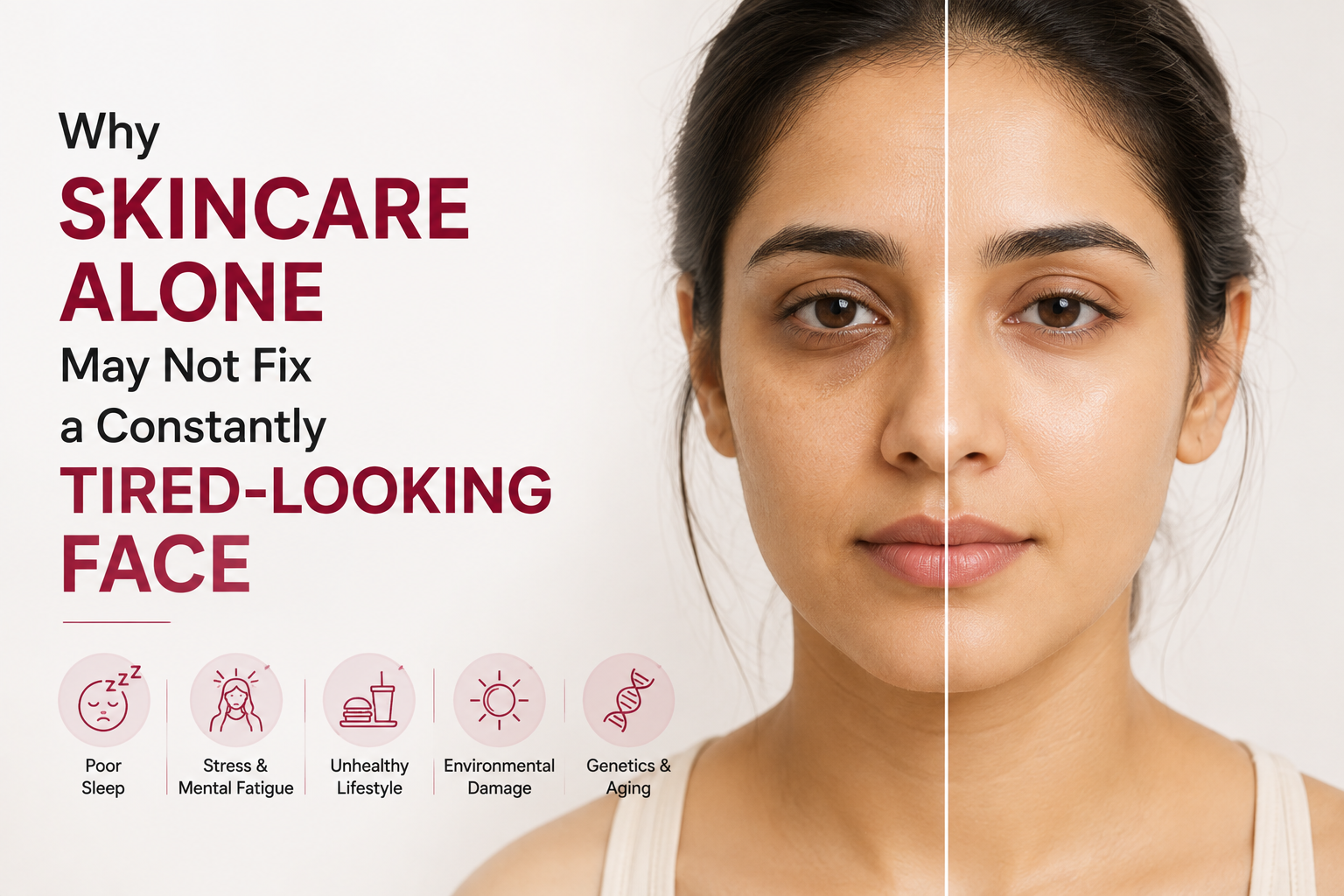
Why Skincare Alone May Not Fix a Constantly Tired-Looking Face
✔ Medically reviewed by Dr. Ashutosh Shah - M.B., M.S., M.Ch., D.N.B., Board-Certified Plastic & Cosmetic Surgeon, Director of Elegance Clinic, Surat (22+ years’ experience).
If your face looks tired even after adequate sleep, the problem may not be your skincare routine alone. A tired-looking face can be influenced by changes in facial volume, fine lines, skin texture, elasticity and the way light reflects from the skin. As the face ages, loss of facial volume can occur alongside changes in the skin, muscles and underlying structures, which can contribute to a less refreshed appearance.
This is why someone can follow a good skincare routine and still feel that their face looks dull, fatigued or older than they feel.
For people searching for a Tired Skin Look Solution, treatments that address deeper changes in facial skin quality and structure may be worth discussing with a qualified aesthetic or plastic surgeon.
Why Does Your Face Look Tired Even When You Are Not Tired?
A tired appearance is not always caused by dehydration or lack of sleep.
Several changes can contribute to the appearance of facial fatigue:
- Loss of facial volume with age
- Fine lines and wrinkles
- Reduced skin elasticity
- Uneven skin texture
- Changes around the cheeks and under-eye area
- Reduced facial definition
- Sun-related skin changes
- Natural changes in collagen and elastin
Facial ageing is a combination of several structural changes rather than a single skin problem. Research has also found that facial volume decreases with age along with changes in skin, muscle and bone.
This explains why applying another cream may not completely change the way the face looks.
Why Skincare May Not Be Enough
Skincare can be useful for maintaining hydration, supporting the skin barrier and addressing certain surface-level concerns. However, topical products cannot recreate lost facial volume or directly replace changes in deeper facial tissues.
If the main concern is skin quality, fine wrinkles or a fatigued facial appearance associated with ageing, a consultation can help determine whether a procedure such as nanofat grafting is appropriate.
The important point is that treatment should be based on why the face looks tired, rather than simply treating the word “tired.”
What Is Nanofat Grafting?
Nanofat grafting is a type of fat-transfer procedure in which a small amount of fat is collected from another area of the patient's body and processed into a fine preparation before being placed into selected facial areas. The technique is designed to address aspects of facial rejuvenation, including skin quality and fine lines.
Unlike conventional volumising fat grafting, nanofat is processed into very small particles and is primarily discussed in the literature for potential skin-quality and regenerative effects rather than significant volume replacement.
This distinction is important when choosing a Tired Skin Look Solution.
If someone has substantial volume loss, a surgeon may consider a different or combined fat-grafting approach. If the concern is primarily skin quality and fine lines, nanofat may be considered as part of an individualized rejuvenation plan.
How Can Nanofat Help a Tired-Looking Face?
The interest in nanofat comes from its potential effect on skin quality rather than simply adding volume.
Clinical research has reported improvements in areas such as skin quality, fine wrinkles and certain signs of photoageing following nanofat treatments. A systematic review found potential benefits for skin rejuvenation, including improvements in wrinkles, pigmentation and discoloration, although the authors noted that much of the available evidence remains limited in quality.
Another clinical study reported improvements in skin quality after subcutaneous nanofat injections, with histological findings involving dermal cellularity and collagen and elastic-fibre density. The researchers also emphasized that additional studies are needed.
So, rather than promising to “erase tiredness,” nanofat grafting may be considered when the goal is to improve specific signs associated with facial ageing.
Nanofat Grafting Is Not Simply a Facial Filler
One misconception is that nanofat and traditional dermal fillers work in exactly the same way.
They do not.
Traditional fillers are generally selected for specific purposes such as adding volume, defining contours or filling particular depressions. Nanofat grafting uses the patient's own processed fat and is primarily explored for skin-quality and rejuvenation effects.
The nanofat procedure offered at Elegance Clinic in Surat involves harvesting a small quantity of the patient's own fat, processing it and introducing the prepared material into selected facial areas using a fine cannula.
The appropriate technique depends on facial anatomy, skin condition, volume loss and the patient's desired outcome.
Who May Consider Nanofat as a Tired Skin Look Solution?
Nanofat grafting may be considered by people who are concerned about:
- Fine facial wrinkles
- Early signs of facial ageing
- Dull or less youthful-looking skin
- Changes in skin quality
- Certain areas that appear chronically fatigued
- Facial ageing where skin quality is an important concern
However, not every tired-looking face needs nanofat.
For example, prominent under-eye hollows, significant cheek-volume loss, pigmentation, severe skin laxity or a medical skin condition may require a different approach. A proper assessment is therefore more useful than choosing a treatment based only on an online symptom.
What Happens During Nanofat Grafting?
The general process involves several stages.
1. Facial assessment
The surgeon first evaluates facial proportions, skin quality, wrinkles, volume distribution and the areas responsible for the tired appearance.
2. Fat harvesting
A small amount of the patient's own fat is collected from a suitable donor area. The clinic's nanofat information describes common donor areas such as the hips, thighs or lower abdomen.
3. Fat processing
The harvested fat is processed to create a fine nanofat preparation.
4. Precise placement
The prepared material is introduced into selected facial areas using a fine cannula or needle, depending on the treatment plan.
5. Recovery and follow-up
The recovery experience varies according to the amount treated and the technique used. Follow-up allows the surgeon to evaluate healing and the development of the aesthetic result.
Does Nanofat Grafting Give Instant Results?
Not necessarily.
The appearance can change progressively as swelling settles and the treated tissues respond. In one clinical study, improvements became apparent within several weeks and continued to be observed during follow-up.
Patients should therefore avoid judging the final outcome immediately after treatment.
The expected result also varies between individuals. The clinic itself notes that treatment results differ from patient to patient and that expectations should be discussed with the treating doctor.
Can Nanofat Improve Fine Wrinkles?
Potentially, yes.
A clinical trial evaluating nanofat for facial wrinkles reported significant reductions in several measured wrinkle parameters at seven months. However, the researchers also noted that larger studies are needed to confirm the findings.
This makes nanofat an interesting option for selected patients, but it should not be presented as a guaranteed wrinkle-removal treatment.
Is Nanofat the Right Solution for Every Tired Face?
No.
The phrase Tired Skin Look Solution can describe very different concerns. One person may have dehydrated skin, while another may have facial volume loss, fine wrinkles or reduced elasticity.
Possible treatment approaches can therefore differ.
A consultation may identify whether the main concern is:
Surface skin quality: skincare, chemical peels, lasers or other skin treatments may be considered.
Fine lines and wrinkles: injectable or energy-based treatments may sometimes be appropriate.
Facial volume loss: fat grafting or another volumising approach may be considered.
Skin-quality concerns: nanofat may be discussed in selected patients.
Significant skin laxity: surgical facial rejuvenation may be more appropriate in some cases.
The goal should be to match the treatment to the underlying cause rather than choosing a procedure simply because it is popular.
Why Individualized Treatment Matters in Surat
Facial rejuvenation should be planned around the individual's facial structure rather than applying the same treatment to every patient.
At Elegance Clinic, Surat, nanofat grafting is presented as a facial rejuvenation option involving the patient's own fat.
Dr. Ashutosh Shah, a board-certified plastic and cosmetic surgeon listed by the clinic, can assess whether nanofat grafting or another rejuvenation approach is more appropriate for the patient's facial concerns.
Key Takeaways
- A tired-looking face is not always caused by poor sleep or inadequate skincare.
- Facial volume loss, wrinkles and changes in skin quality can contribute to a fatigued appearance.
- Skincare can support the skin but may not address deeper structural changes.
- Nanofat grafting uses the patient's own processed fat and is being studied for facial skin rejuvenation.
- Research suggests potential improvements in skin quality and fine wrinkles, but evidence is still developing.
- Nanofat is not appropriate for everyone, and the correct treatment depends on the cause of the tired appearance.
- A professional assessment in Surat can help determine whether nanofat grafting is suitable.
Conclusion: Finding the Right Tired Skin Look Solution
If your face consistently looks tired despite good sleep and a carefully chosen skincare routine, the underlying issue may involve more than the skin's surface. Age-related changes in facial volume, wrinkles, elasticity and tissue quality can all influence facial appearance.
Nanofat grafting may be considered as a Tired Skin Look Solution for selected patients who want to address certain signs of facial ageing and skin-quality changes using their own processed fat. Current research is promising but still evolving, so realistic expectations and professional assessment are essential.
Concerned that your face looks tired even when you feel well-rested?
Schedule a consultation at Elegance Clinic in Surat to discuss your facial concerns and learn whether nanofat grafting or another personalized rejuvenation treatment may be suitable for you.
Frequently Asked Questions
Why does my face look tired even after sleeping well?
What is the best tired skin look solution?
Can nanofat grafting improve tired-looking skin?
Is nanofat better than skincare for tired-looking skin?
Does nanofat grafting make the face look fuller?
Can nanofat reduce fine lines on the face?
About the Author