
Breast Reconstruction After Mastectomy: Immediate or Delayed, and How Radiation Changes the Plan
✔ Medically reviewed by Dr. Ashutosh Shah - M.B., M.S., M.Ch., D.N.B., Board-Certified Plastic & Cosmetic Surgeon, Director of Elegance Clinic, Surat (22+ years’ experience).
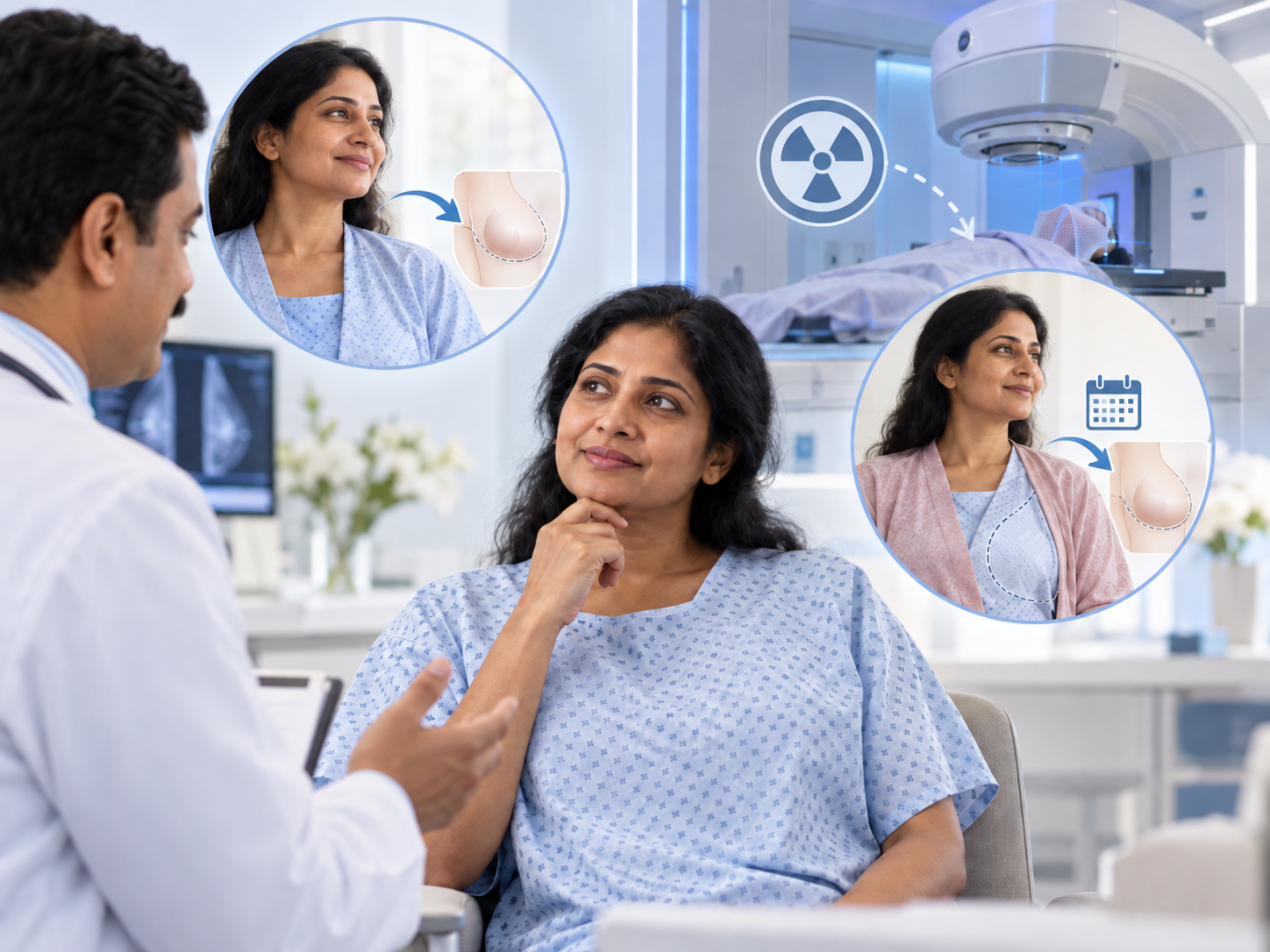
Breast reconstruction after mastectomy can be done in the same operation (immediate) or months to years later (delayed). The choice depends mainly on whether radiation is planned, the cancer stage and your own tissue. Implants suit many immediate cases; own-tissue flaps are often preferred after radiation. The oncologist and plastic surgeon should agree the plan before mastectomy.
For many patients, the difficult question is not simply whether to reconstruct the breast, but when and how to do it without interfering with cancer treatment.
The right plan depends on the mastectomy, whether radiation or chemotherapy is expected, previous operations, available abdominal or thigh tissue, general health and personal preference.
That is why breast reconstruction after mastectomy should ideally be discussed before cancer surgery whenever circumstances allow. A plastic surgeon and treating cancer team can then coordinate the mastectomy and reconstruction rather than treating them as unrelated procedures.
Learn more about breast reconstruction after cancer.
What Is the Difference Between Immediate and Delayed Breast Reconstruction?
Immediate breast reconstruction is started during the same operation as the mastectomy.
Once the breast surgeon removes the breast tissue, the plastic surgeon begins reconstruction during the same anaesthetic. Depending on the treatment plan, reconstruction may involve an implant, a tissue expander or the patient's own tissue.
The major advantage is that the reconstructive process starts at the time of cancer surgery. In suitable patients, much of the breast skin can sometimes be preserved, which can help with the final shape.
However, immediate reconstruction is not automatically the best option for everyone.
Delayed breast reconstruction is performed after mastectomy, sometimes months or even years later.
It may be chosen when:
-
Radiation is expected.
-
Cancer treatment needs to take priority.
-
The patient is not ready to decide about reconstruction.
-
Health conditions make a longer combined operation unsuitable.
-
Previous treatment has affected the chest skin.
-
A patient initially chose mastectomy without reconstruction and later changes her mind.
Delayed reconstruction remains an option for many patients who had mastectomy years earlier.
There is also a staged approach in which temporary reconstruction is started at mastectomy and the definitive reconstruction is completed later.
The key point is that immediate vs delayed breast reconstruction is a treatment-planning decision, not a contest between a “better” and “worse” method.
How Does Planned Radiation Change the Choice and Timing?
Radiation is one of the most important factors in reconstruction planning.
Radiotherapy can change the treated skin and deeper tissues. Over time, the tissues may become firmer, less elastic or more scarred. These changes can affect both implant-based and tissue-based reconstruction.
If Radiation Is Not Expected
When post-mastectomy radiation is unlikely, immediate reconstruction may be an attractive option for an appropriate patient.
An implant-based reconstruction can sometimes be performed at the same operation, either directly with an implant or through a staged tissue-expander approach.
Own-tissue reconstruction can also be immediate when suitable.
If Radiation Is Planned
The decision becomes more complex.
Radiation can increase the risk of problems around an implant, including firmness from capsular contracture, changes in breast shape and the possibility of further corrective procedures.
This does not mean an implant can never be used when radiation is expected. It means the patient needs to understand that radiation may affect the reconstructed breast and potentially change the long-term result.
In some situations, the team may use a staged approach and postpone the final reconstruction until radiation is completed.
If Radiation Has Already Been Completed
For a previously irradiated chest, reconstruction using the patient's own well-vascularised tissue is often an important option.
A flap brings tissue from another part of the body to reconstruct the breast and can be particularly useful when the chest skin has become tight or scarred after radiation.
The exact timing after radiation is individual. The cancer team and plastic surgeon consider tissue recovery, ongoing cancer treatment, general health and the reconstructive method before scheduling surgery.
Breast Reconstruction Surgeon in Gujarat: Implant, Own-Tissue Flap or Fat Transfer—Who Suits Which?
There is no single reconstruction method that suits every patient. When consulting a breast reconstruction surgeon in gujarat, the discussion should include cancer treatment, chest skin quality, body build, previous surgery, recovery expectations and the patient's priorities.
The three broad reconstructive tools are implants, the patient's own tissue and fat transfer.
Implant Reconstruction
Implant reconstruction avoids taking a large flap from another part of the body.
It can be performed as a direct-to-implant procedure in selected cases or as a staged procedure using a tissue expander followed by a permanent implant.
Potential advantages include a shorter operation than many free-flap procedures and no large tissue-donor site.
However, an implant is a medical device. Some patients may require future surgery for implant-related problems or changes in the reconstructed breast.
Radiation history is particularly important when considering this approach.
Own-Tissue or Flap Reconstruction
Flap reconstruction uses the patient's own skin and fat, sometimes with muscle depending on the technique.
Common donor areas can include the abdomen, back or thigh.
The tissue is shaped to create the breast mound. Some modern microsurgical procedures transfer skin and fat while preserving as much donor-site muscle as possible.
Flap surgery is generally a longer operation and creates a second surgical site. Recovery is therefore often longer than with a straightforward implant reconstruction.
The advantage is that the reconstructed breast is made largely from the patient's own living tissue.
For patients who have undergone radiation, an own-tissue reconstruction may be particularly valuable because it introduces healthy vascularised tissue into the treated area.
See the available breast reconstruction options.
Breast Reconstruction With Fat Transfer
Fat transfer uses liposuction to collect fat from another body area. The fat is processed and carefully transferred to the breast.
It can be extremely useful for:
-
Correcting small contour irregularities.
-
Softening transitions around an implant or flap.
-
Improving selected areas after reconstruction.
-
Adding volume in stages in carefully selected patients.
However, breast reconstruction with fat transfer may require more than one session because not all transferred fat survives permanently.
For a complete breast after mastectomy, fat transfer alone is not suitable for every patient and may require multiple staged procedures.
Read more about breast fat transfer.
Breast Reconstruction Decision Table
| Situation | Immediate or delayed? | Implant, flap or fat? | Possible stages | General recovery considerations |
|---|---|---|---|---|
| No radiation expected | Immediate reconstruction may be suitable | Implant or own-tissue flap depending on patient | One or multiple stages | Depends greatly on implant vs flap |
| Radiation planned | Individualised; staged or delayed definitive reconstruction may be considered | Implant may still be possible; flap may form part of later definitive reconstruction | Often staged | Must coordinate with cancer treatment |
| Radiation completed | Delayed reconstruction is possible | Own-tissue flap is an important option; fat may assist contour correction | May require more than one stage | Usually longer for flap procedures |
| Thin build | Either, depending on cancer plan | Implant may be considered if donor tissue is limited; alternative flap sites may be assessed | Variable | Depends on technique |
| Larger build with suitable donor tissue | Immediate or delayed | Own-tissue flap may provide adequate volume | One major reconstruction plus refinements if needed | Donor site and breast both need recovery |
This table is a planning guide rather than a rule. The final recommendation depends on the individual cancer and reconstructive situation.
Does Reconstruction Delay Chemotherapy or Radiation?
This is an important concern because cancer treatment must remain the priority.
Breast reconstruction is planned so that it fits into the overall cancer-treatment pathway. However, complications from any major operation can potentially affect the timing of subsequent treatment.
For example, a wound-healing problem or infection may require additional care before the next stage of treatment can begin.
This is why reconstruction planning should involve communication between the cancer surgeon, medical oncologist, radiation oncologist when required, and plastic surgeon.
The plan should answer several questions before surgery:
Is chemotherapy expected?
Is radiation likely after mastectomy?
Is immediate reconstruction oncologically appropriate?
Would a long flap operation be suitable for this patient?
Should reconstruction be staged?
Would delaying definitive reconstruction simplify cancer treatment?
A patient should not choose a reconstructive technique simply because it produces the shortest theoretical timeline.
The goal is to integrate reconstruction safely with cancer treatment.
In our practice, the reconstruction plan is agreed with the treating oncologist before the mastectomy date whenever preoperative reconstruction planning is possible.
How Many Stages Does Reconstruction Usually Take, Including the Nipple?
Patients often imagine breast reconstruction as one operation.
In reality, it may be a process with one major operation followed by smaller refinement procedures.
Stage 1: Creating the Breast Mound
This is the main reconstruction.
It may involve:
-
An implant.
-
A tissue expander.
-
An abdominal or other tissue flap.
-
Another reconstruction selected for the patient's anatomy and treatment history.
For immediate reconstruction, this stage starts during the mastectomy.
For delayed reconstruction, it happens at a later operation.
Stage 2: Refining Shape or Symmetry
After healing, some patients choose further surgery to improve contour or symmetry.
This might involve fat transfer, scar refinement or an operation on the opposite breast to improve balance.
Not everyone needs or wants these procedures.
Stage 3: Nipple-Areola Reconstruction
When the nipple cannot be preserved during mastectomy, reconstruction of the nipple-areola complex can be considered later.
This is generally performed after the reconstructed breast has settled sufficiently.
Options may include local tissue reconstruction and medical tattooing.
For patients wondering why the breast mound can still look unfinished, see when a reconstructed breast looks incomplete without a nipple.
The number of stages therefore varies considerably. One patient may be satisfied after a major reconstruction, while another may choose several refinements.
What Is Breast Reconstruction After Mastectomy Recovery Time?
Breast reconstruction after mastectomy recovery time depends strongly on the procedure performed.
An implant reconstruction generally involves a different recovery pathway from a microsurgical flap.
With an implant, there is primarily the chest surgical site to recover from. With a flap, both the reconstructed breast and the donor area need to heal.
Early recovery commonly focuses on:
-
Pain and swelling control.
-
Drain management when drains are used.
-
Wound care.
-
Gradually increasing walking.
-
Protecting the reconstructed breast.
-
Caring for the donor site after flap surgery.
-
Avoiding heavy lifting until cleared.
-
Monitoring for infection or wound problems.
Patients undergoing flap reconstruction generally need a longer initial recovery because surgery involves another part of the body.
Returning to work also depends on the type of work. Someone with a desk-based role may return earlier than a person whose job involves lifting or strenuous physical activity.
Most importantly, recovery should be measured by healing and function rather than a fixed calendar date.
What Should Be Decided Before the Mastectomy?
Whenever possible, reconstruction planning should begin before the mastectomy rather than after it.
The consultation should clarify:
-
Whether immediate reconstruction is oncologically appropriate.
-
Whether radiation is likely.
-
Whether an implant or own tissue is more suitable.
-
Whether adequate donor tissue is available.
-
Whether previous abdominal or other surgery affects flap options.
-
Whether reconstruction should be completed immediately or staged.
-
What scars and donor sites to expect.
-
How reconstruction fits around chemotherapy or radiation.
-
Whether nipple preservation is possible in the cancer operation.
-
What additional procedures may be required later.
This allows the patient to make a decision based on the entire cancer-treatment pathway, not only the appearance immediately after mastectomy.
Key Takeaways
Breast reconstruction after mastectomy can be immediate or delayed. Immediate reconstruction begins during the mastectomy, while delayed reconstruction can be performed months or even years later.
Radiation is one of the biggest factors influencing the plan. When radiation is expected, the timing and choice between an implant, staged reconstruction and an own-tissue flap require careful discussion.
Implants can provide reconstruction without a major tissue donor site, while flap reconstruction uses the patient's own living tissue and can be especially valuable when chest tissues have been affected by radiation.
Breast reconstruction with fat transfer is useful for selected reconstruction and refinement, but it may require several sessions and is not the sole solution for every complete mastectomy defect.
Reconstruction also does not necessarily end after creation of the breast mound. Fat transfer, symmetry procedures and nipple-areola reconstruction may form later stages.
Most importantly, the cancer treatment and reconstruction plans should be coordinated. When reconstruction is being considered before mastectomy, the oncologist, cancer surgeon and plastic surgeon should agree on a pathway that accounts for radiation, chemotherapy and the patient's reconstructive goals.
Frequently Asked Questions
Can I have reconstruction years after my mastectomy?
Is breast reconstruction safe after radiation?
Will a reconstructed breast have sensation?
Can fat transfer alone rebuild a breast?
How long is recovery after flap reconstruction?
Is breast reconstruction covered by insurance in India?
About the Author