
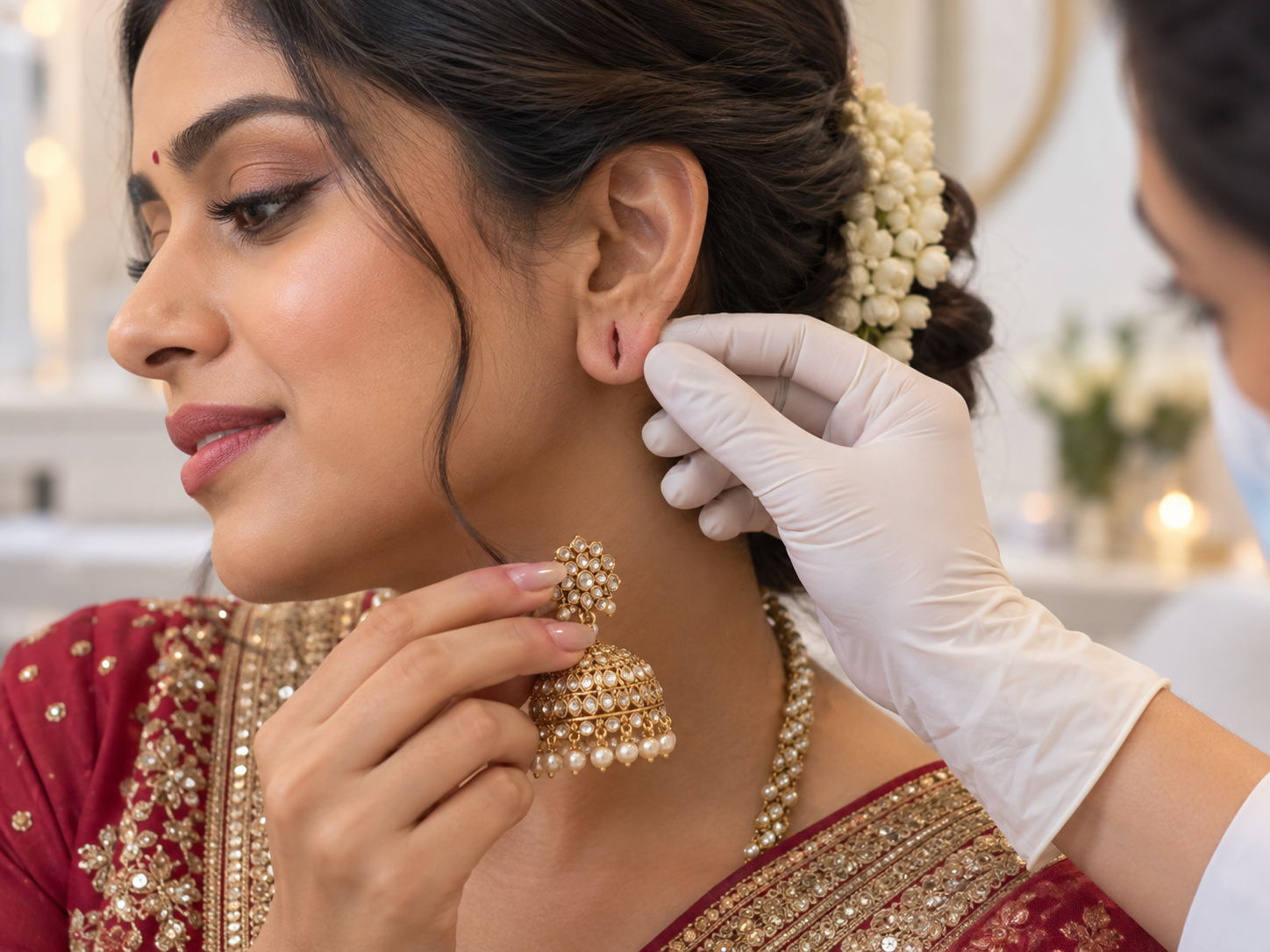
Torn Earlobe From Heavy Jhumkas: What Can Be Repaired Before Karwa Chauth, Diwali and the Wedding Season
✔ Medically reviewed by Dr. Ashutosh Shah - M.B., M.S., M.Ch., D.N.B., Board-Certified Plastic & Cosmetic Surgeon, Director of Elegance Clinic, Surat (22+ years’ experience).
A torn or split earlobe is repaired under local anaesthesia in about 30 to 45 minutes by excising the torn edges and stitching the lobe in layers. Stitches come out in 1 to 2 weeks, clip-on earrings may be allowed after that, and re-piercing is usually delayed 6 to 12 weeks, so wedding-season jhumkas need planning now.
Heavy jhumkas, bridal earrings and repeated pulling on an old piercing can gradually stretch the piercing hole until only a thin strip of tissue remains. A sudden pull can also convert an already weak piercing into a complete split.
Earlobe reconstruction after heavy earring tear is therefore not only about closing the visible gap. The surgeon also has to consider the shape of the lobe, the position of the old piercing, scar quality and whether the patient wants to wear earrings again.
At Elegance Clinic, Dr. Ashutosh Shah, Plastic Surgeon, assesses the type of tear before recommending repair. Patients planning treatment before Karwa Chauth, Diwali or wedding season should also discuss their event date and the type of jewellery they hope to wear.
How is a completely split earlobe different from a stretched or partly torn one?
Earlobe damage from earrings can occur at different stages.
A stretched piercing usually looks like an elongated hole. The earring begins sitting lower than it used to, but there is still a reasonable bridge of tissue beneath the piercing.
A partly torn earlobe has a much longer opening with only a thin strip of skin remaining at the lower edge. At this stage, another pull from a heavy earring can complete the tear.
A completely split earlobe occurs when the piercing has torn through the lower border of the lobe, leaving two separated sections.
This distinction matters because simply stopping heavy earrings will not normally restore a completely split lobe. Once the edges have healed with skin covering them, surgical repair is usually needed to join the tissue again.
An assessment is also useful before a partial tear becomes complete. The exact repair depends on how much healthy tissue remains and whether previous piercing or scarring has changed the natural shape of the lobe.
How is the repair done and how long does it take?
Earlobe repair is generally performed as a minor procedure under local anaesthesia.
The area is numbed first. The healed skin lining the tear is carefully refreshed so that healthy tissue surfaces can be brought together. The surgeon then aligns the earlobe and closes it with fine stitches.
The aim is to restore a smooth lower border and a natural lobe shape rather than simply stitching the two visible ends together.
Depending on the type of tear and whether one or both ears are being treated, the procedure may take approximately 30–45 minutes.
Patients can generally return home the same day.
Stitches are commonly removed after approximately 1–2 weeks, depending on healing and the technique used. During this period, the ear should be protected from pulling, rubbing and unnecessary pressure.
Mild swelling, tenderness or redness may occur during early healing. The external wound can settle relatively quickly, but the scar underneath continues gaining strength for much longer.
At Elegance Clinic, Dr. Ashutosh Shah evaluates the old piercing, scar tissue and remaining earlobe before planning the reconstruction. This becomes particularly important when a long-standing tear has left an irregular or notched lower edge.
When can you wear earrings again, and which ones? Earlobe repair near Ghod Dod Road Surat
Patients considering earlobe repair near ghod dod road surat before a festival or wedding should distinguish between wound healing and being ready to wear jewellery.
They are not the same milestone.
After the repair, no earring should be pushed through the healing wound unless specifically advised by the surgeon. Even after the stitches are removed, the newly repaired tissue is still developing strength.
If an important function occurs during the healing period, a surgeon may sometimes discuss whether a lightweight clip-on earring can be used after adequate healing. It should not place significant pressure on the repaired area.
A pierced stud requires a new piercing, so it usually comes later.
Heavy jhumkas, chandelier earrings and bridal jewellery require even more caution because their weight produces downward traction on the lobe.
A practical planning timeline may look like this:
| Stage | Approximate planning point |
|---|---|
| Earlobe repair | Day 0 |
| Early wound healing | First 1–2 weeks |
| Stitch removal | Commonly around 1–2 weeks |
| Clip-on earrings | Only after adequate healing and surgeon approval |
| Re-piercing | Commonly considered after about 6–12 weeks or as advised |
| Heavy earrings | Only after the repaired lobe and new piercing are sufficiently stable |
These are general planning ranges, not guaranteed dates. Healing differs between patients.
If you are undergoing repair specifically because you want to wear jewellery at a wedding, tell your surgeon what kind of earrings you intend to wear. A tiny stud and a heavy bridal jhumka place very different loads on the earlobe.
How long must you wait before re-piercing, and where should the new hole go?
Re-piercing should not be rushed simply because the outer skin appears healed.
The repaired tissue needs time to strengthen. Depending on healing and the surgeon's assessment, re-piercing may commonly be considered after approximately 6–12 weeks or longer.
The position of the new piercing also matters.
Placing the new hole directly through a weak scar can increase stress on the repaired area. The surgeon may therefore recommend positioning the piercing away from the previous scar while maintaining a natural appearance.
Enough healthy tissue should remain beneath the new piercing to support an earring.
This is especially important for patients who regularly wear traditional jewellery. If the new piercing is too low or too close to the repaired scar, repeated downward traction may contribute to stretching again.
Re-piercing should therefore be treated as part of the reconstruction plan rather than as an unrelated cosmetic step.
If your wedding is approaching, work backwards from the event date:
earlobe repair → wound healing → scar strengthening → re-piercing → piercing healing → heavier jewellery
Trying to compress these stages into a few days can put unnecessary stress on the repaired tissue.
How do you stop the lobe tearing again with heavy bridal earrings?
Repairing the tear does not make the earlobe permanently resistant to heavy jewellery.
Repeated traction can gradually stretch even a successfully reconstructed lobe. Preventing another tear therefore requires changing how heavy earrings are supported.
Use ear chains or sahara
Traditional ear chains can transfer part of the jewellery's weight toward the hair or upper ear rather than allowing the entire load to pull on the piercing.
Consider earlobe support patches
Support patches placed behind the lobe can help distribute the pressure over a wider surface instead of concentrating it around the piercing hole.
Choose lightweight bridal jewellery
Large earrings do not necessarily need to be extremely heavy. Hollow or lightweight designs can provide the appearance of traditional jhumkas while reducing downward force.
Avoid wearing heavy earrings for long periods
Very heavy earrings are better reserved for limited periods rather than worn continuously throughout multiple wedding functions.
Watch for early stretching
If the piercing begins becoming elongated or the tissue underneath it looks thin, stop using heavy earrings and seek advice. Waiting until the last strip of skin tears completely can create a larger defect.
Plan the new piercing carefully
A correctly positioned piercing with adequate healthy tissue beneath it gives the lobe better support. This is particularly important after previous reconstruction.
Wedding and Festival Planning Checklist
If you are considering earlobe repair before Karwa Chauth, Diwali or a wedding, use this checklist:
-
Check whether the piercing is stretched, partly torn or completely split.
-
Tell your surgeon the exact date of your important function.
-
Explain whether you want to wear studs, clip-ons or heavy bridal jhumkas.
-
Allow time for stitch removal and scar healing.
-
Do not re-pierce the lobe simply because the skin looks healed.
-
Ask where the new piercing should be positioned.
-
Allow the new piercing to settle before using heavy earrings.
-
Use ear chains or other support for heavier bridal jewellery.
-
Stop wearing heavy earrings if the new hole begins stretching.
For patients planning around a wedding, the safest schedule should be based on actual healing rather than the event date alone.
About Dr. Ashutosh Shah and Elegance Clinic
Dr. Ashutosh Shah is a Plastic Surgeon at Elegance Clinic with experience in cosmetic and reconstructive procedures. Earlobe repair is planned after evaluating the extent of the tear, remaining tissue, scar pattern, previous piercing position and the patient's future jewellery requirements.
The consultation is also an opportunity to discuss the timing of stitch removal, scar care, re-piercing and when heavier earrings may be considered.
Learn more about Ear repair and treatment options for damaged or deformed ears.
You can also read about Otoplasty and earlobe repair for more information about cosmetic ear correction.
Patients who have previously developed thick or raised ear scars can learn about Keloid prevention after ear surgery.
For consultation information and addresses, see Clinic locations in Adajan and Vesu.
Key Takeaways
A stretched piercing, partial tear and completely split earlobe are different problems and should be assessed accordingly.
Earlobe reconstruction after heavy earring tear is usually a minor procedure performed under local anaesthesia, but the tissue needs more time to regain strength than the visible wound needs to close.
Stitch removal does not mean the ear is immediately ready for a new piercing or heavy jewellery. Re-piercing may commonly be delayed for around 6–12 weeks or longer depending on healing.
For brides and patients who regularly wear jhumkas, planning the new piercing carefully and using ear chains, support patches or lighter jewellery can help reduce repeated stress on the repaired lobe.
Frequently Asked Questions
Can a torn earlobe be repaired without stitches?
Can I wear a light stud for Diwali after repair?
Will the ear look notched after repair?
Can both ears be repaired in one sitting?
Is earlobe repair possible for a lobe torn years ago?
Can a keloid form after earlobe repair?
About the Author