
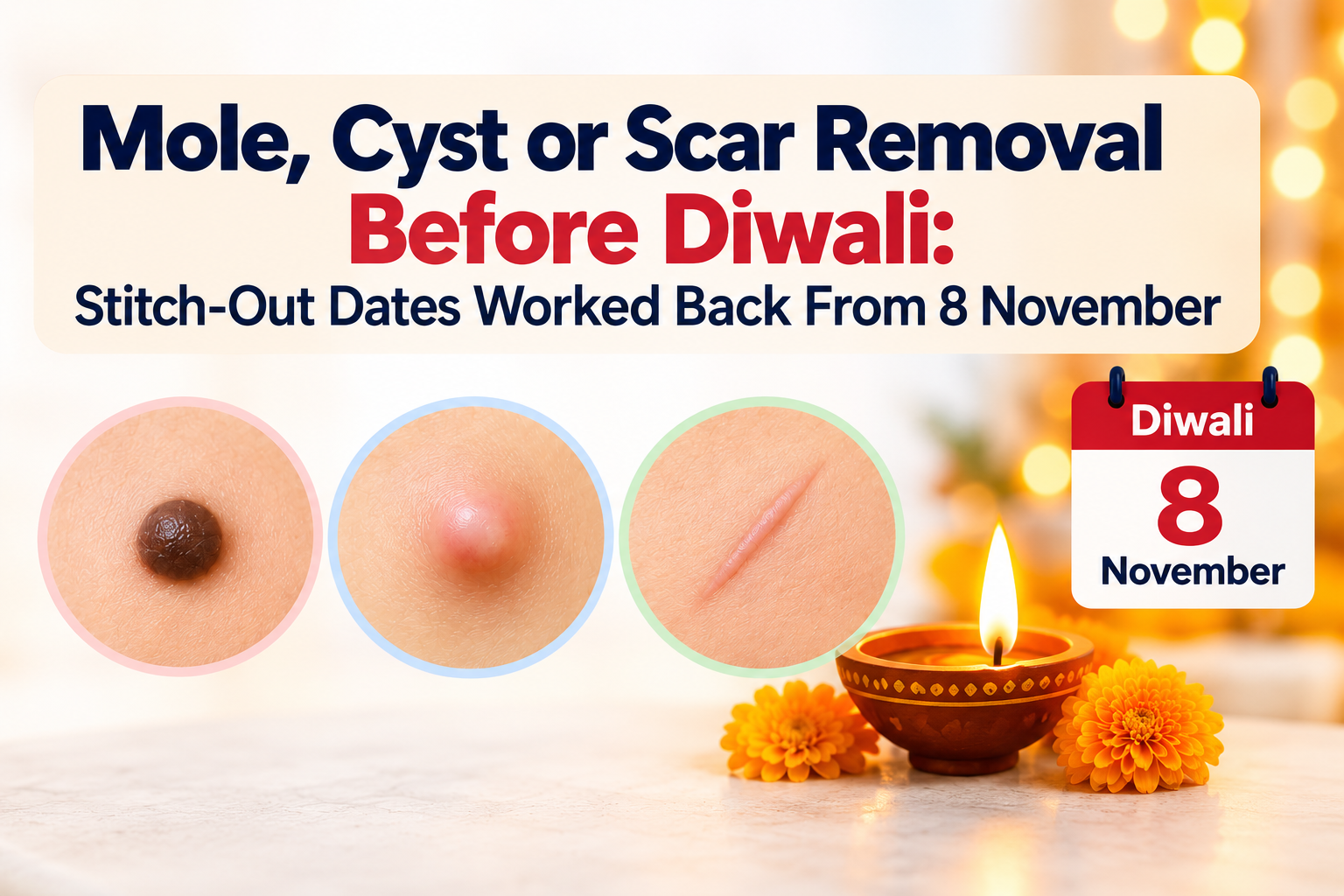
Mole, Cyst or Scar Removal Before Diwali: Stitch-Out Dates Worked Back From 8 November
✔ Medically reviewed by Dr. Ashutosh Shah - M.B., M.S., M.Ch., D.N.B., Board-Certified Plastic & Cosmetic Surgeon, Director of Elegance Clinic, Surat (22+ years’ experience).
For a small mole, cyst or scar excised under local anaesthesia, face stitches usually come out in 5 to 7 days and body stitches in 10 to 14 days, while pinkness fades over weeks. For a clean look at Diwali on 8 November, face procedures are best done by about 20 October and body or back procedures by early October.
Festival season often creates a very practical question: “If I remove this mole, cyst or scar now, will it look healed by Diwali?”
The answer depends on where the lesion is, how large it is, how the wound is closed, your individual healing, and whether the lesion first needs diagnostic assessment.
For anyone researching scar removal surgery recovery time, it is important to separate three different milestones: wound closure, stitch removal and scar maturation. They do not happen on the same day.
How Long Do Stitches Stay In After Mole, Cyst or Scar Removal on Each Body Area?
After a small surgical excision, the wound edges may be closed with removable stitches, dissolvable stitches, skin adhesive or another closure technique. The exact choice depends on the location and procedure.
As a general guide, stitches on the face are often removed earlier than those on the body. NHS patient guidance describes facial stitch removal at around 5–7 days, while stitches elsewhere may remain for roughly 7–14 days depending on the location and wound.
That makes the body area an important part of planning your procedure around a festival.
| Procedure and area | Approx. stitch-out time* | Makeup around healed area | Visible redness | Planning for 8 November |
|---|---|---|---|---|
| Small facial mole excision | About 5–7 days | Only after the wound is closed and the surgeon permits it | May remain pink for weeks | Preferably allow several weeks |
| Facial cyst excision | Often around 5–7 days | After adequate wound closure and medical approval | Depends on cyst size and inflammation | Avoid leaving it to the final week |
| Neck/scalp lesion | Often around 7–10 days | Depends on exact site | May remain visible after stitch removal | Allow extra healing time |
| Arm/trunk lesion | Around 10–14 days in many cases | After wound healing | Often persists beyond stitch removal | Preferably several weeks beforehand |
| Back/shoulder cyst | Often around 10–14 days | Usually not relevant | Tension can prolong settling | Earlier planning is preferable |
| Scar/keloid excision | Procedure-dependent | Surgeon-specific | Can take weeks or longer to settle | Requires individual planning |
*These are planning ranges, not guaranteed stitch-removal dates. Your surgeon decides the actual timing based on wound location, tension and healing.
If you are specifically comparing mole removal healing time or cyst removal on face recovery, do not use the stitch-out date as the date of your final cosmetic result. A newly healed scar can remain pink, firm or noticeable for considerably longer.
When Does the Redness Settle Enough for Makeup and Festive Photos?
Removing the stitches is only one stage of healing.
A facial wound may be structurally closed when the stitches come out, but the new scar can still look pink or slightly raised. Mild bruising or swelling can also occur after facial skin surgery.
For that reason, avoid scheduling a minor cosmetic excision just a few days before an important celebration if your main goal is to look completely healed in photographs.
Makeup should not be used to hide a wound that is still open, moist, crusted, bleeding or showing signs of infection. Ask your surgeon when makeup can safely be applied to or around your particular wound.
Sun protection also matters once the wound has healed because a fresh scar can remain visually noticeable while it matures.
Sebaceous Cyst Removal in Bardoli: How Early Should You Plan Before Diwali?
If you are considering sebaceous cyst removal in bardoli before Diwali, work backwards from the event rather than choosing the procedure date first.
For a straightforward facial procedure, allowing a few weeks provides more flexibility than relying only on the typical 5–7-day stitch period. For the back, shoulder or another high-tension body area, allowing even more time is sensible because stitches may remain longer and physical movement can put tension on the healing wound.
At Elegance Clinic, Dr. Ashutosh Shah assesses the lesion, its location, wound tension and expected scar before advising whether removal immediately before an important event is reasonable.
Learn more about scar, cyst and mole removal.
What Is the Last Sensible Date to Book Before Diwali, Karwa Chauth or a Wedding?
There is no medically guaranteed “last date” because two apparently similar wounds can heal differently.
For Diwali on 8 November, a practical planning approach is to leave a buffer after the expected stitch-removal date rather than arranging the procedure immediately before the celebration.
As a conservative clinic-planning rule, a surgeon may aim for approximately:
Face: stitch-out date + about 7 additional days before the important event.
Back/shoulder/body: stitch-out date + about 14 additional days when possible.
This is a scheduling buffer, not a biological guarantee that redness will disappear within that period.
Therefore, if appearance in photographs is especially important, earlier is usually more convenient. A consultation also needs to happen before the procedure because what looks like a simple mole or cyst may require a different approach.
For more information about scars, see can full scar removal make an old scar less visible?.
Which Lesions Should Be Sent for Biopsy Instead of Just Removed for Looks?
A mole should not automatically be treated as a cosmetic spot.
A lesion that is changing in size, shape or colour, looks different from your other moles, itches, or bleeds needs proper medical assessment. The American Academy of Dermatology specifically advises medical evaluation for new or changing spots and lesions that itch or bleed.
The familiar ABCDE warning signs include:
A – Asymmetry: one side looks different from the other.
B – Border: irregular or poorly defined edges.
C – Colour: more than one colour or an unusual change in colour.
D – Diameter: size can be relevant, although melanoma can also be small.
E – Evolving: the lesion is changing in size, shape, colour or appearance.
A festival deadline should never override the need to investigate a suspicious lesion.
When clinically appropriate, an excised lesion may be sent for histopathology so the tissue can be examined. The decision depends on the lesion and the surgeon's assessment.
If you have a suspicious or changing spot, read more about when a skin spot needs checking before removal.
Is Laser or Surgical Removal Better When You Have Limited Time?
The method should be selected according to the lesion—not simply according to which option sounds faster.
Some superficial benign lesions may be suitable for a non-excisional technique. Other moles, deeper cysts or scars may require surgical treatment.
A true cyst also has a capsule or wall. Simply treating the visible bump without adequately addressing the underlying lesion may not provide the desired result.
Similarly, a suspicious pigmented lesion should be assessed before choosing a purely cosmetic destructive treatment because diagnosis and tissue examination may be important.
The safest approach is therefore:
diagnosis first → appropriate procedure second → festival timing third.
What Should You Avoid During the Festive Week After Minor Skin Surgery?
Even a small skin procedure creates a healing wound.
Follow the dressing instructions given by your surgeon. Do not pick scabs or repeatedly touch the wound. Friction from tight clothing, jewellery or costumes may also irritate a healing area.
Strenuous exercise, repeated bending, stretching and heavy lifting can put tension on a fresh surgical wound. Cambridge University Hospitals advises avoiding strenuous exercise, swimming, bending, straining and heavy lifting for 14 days after certain skin excisions. Your own restrictions may be shorter or longer depending on the procedure.
This is particularly relevant during Navratri and festival season. Dancing, gym workouts or long celebrations can involve sweating and repeated movement.
Contact your treating doctor if you develop worsening pain, spreading redness, pus, significant swelling, fever, wound separation or bleeding that does not settle.
Scar Removal Surgery Recovery Time: What Does “Healed” Actually Mean?
A scar does not become mature when the stitches are removed.
There are several stages:
Early wound healing: The skin edges join and the wound starts gaining strength.
Stitch removal: External sutures are removed when the clinician believes the wound has enough support.
Early scar phase: The line may remain pink, red, firm or slightly raised.
Scar maturation: The scar gradually changes in colour, texture and firmness over subsequent months.
This distinction is especially important when patients ask about scar removal surgery recovery time before a wedding or festival.
A wound can be medically healed enough to have stitches removed while still being cosmetically visible.
A Practical Diwali Countdown
If 8 November is your target date, do not plan solely around “How soon can my stitches come out?”
Instead, ask:
How long will stitches remain?
How much swelling or bruising is expected?
Will the area be under tension?
When can makeup be safely used?
Is tissue testing necessary?
How visible is the early scar likely to be?
If your event is important, earlier assessment gives you more options. It also gives your surgeon the freedom to advise postponing treatment when rushing would compromise diagnosis, healing or scar quality.
You can book a consultation to have the lesion assessed before deciding on timing.
Frequently Asked Questions
Can I apply makeup on a mole removal wound before Diwali?
Will a cyst come back if it is only drained?
Is laser or surgical mole removal better when there is little time?
Can I attend garba a few days after cyst removal?
Does every removed mole need a lab test?
Can a keloid be removed just before a festival?
About the Author