Do Plastic Surgeons Treat Burns, Cancer Defects and Birth Differences? What Reconstructive Work Actually Covers
✔ Medically reviewed by Dr. Ashutosh Shah - M.B., M.S., M.Ch., D.N.B., Board-Certified Plastic & Cosmetic Surgeon, Director of Elegance Clinic, Surat (22+ years’ experience).
Yes. A plastic surgeon with MCh or DNB training treats burn scars and contractures, defects left after skin or breast cancer removal, facial fractures and nerve injuries, cleft lip and nose, and severed fingers. Cosmetic work is one part of the specialty; reconstruction of form and function after injury, cancer or birth differences is the core of the training.
Patients searching do plastic surgeons treat burns are often surprised by how broad plastic surgery actually is. Plastic surgeons do not only perform cosmetic procedures such as rhinoplasty, liposuction, breast augmentation or facelifts. Their training also covers reconstruction after burns, accidents, cancer surgery and congenital conditions.
Reconstructive surgery may be needed when skin, soft tissue, muscle, tendon, nerve, blood vessel or another structure has been damaged or lost. The goal can be to restore movement, cover exposed structures, close a difficult wound, reconstruct a missing body part or improve both function and appearance.
Is Plastic Surgery Only Cosmetic, or Is Reconstruction the Main Training?
Plastic surgery includes both reconstructive and cosmetic surgery.
A reconstructive plastic surgeon deals with conditions in which normal anatomy has been damaged, lost or altered because of injury, burns, cancer, infection, previous surgery or a condition present from birth.
Plastic-surgery training can include:
-
Burns and post-burn deformities
-
Burn scar and contracture reconstruction
-
Hand and upper-limb surgery
-
Tendon repair
-
Peripheral nerve surgery
-
Microsurgery
-
Replantation of amputated parts
-
Cleft lip and palate surgery
-
Craniofacial reconstruction
-
Head and neck reconstruction
-
Breast reconstruction
-
Lower-limb reconstruction
-
Difficult wound coverage
-
Trauma reconstruction
-
Cancer defect reconstruction
-
Aesthetic and cosmetic surgery
This explains why the same specialty can manage a facial cosmetic concern as well as a severe hand injury, post-burn contracture or defect following cancer surgery.
Which Burn Problems Does a Plastic Surgeon Treat, and at What Stage?
The answer to do plastic surgeons treat burns is yes, but treatment depends heavily on the stage and severity of the injury.
Plastic surgeons can become involved during the initial burn treatment as well as months or years later when a healed burn has caused problematic scarring or restricted movement.
Fresh Burns
Fresh burns vary considerably in depth and severity.
A superficial burn may heal with appropriate wound care. Deeper burns can damage the full thickness of the skin and sometimes the tissues beneath it.
Depending on the injury, treatment may involve:
-
Assessment of burn depth
-
Wound care
-
Removal of non-viable tissue
-
Infection management where required
-
Skin grafting
-
Soft-tissue reconstruction
-
Flap coverage for complex defects
Burns involving the face, hands, feet, major joints or extensive areas generally require particularly careful assessment because functional and cosmetic consequences can be significant.
Burns That Do Not Heal Properly
Some deeper burn wounds do not close adequately with routine wound care.
Once damaged tissue has been removed and the wound is suitable for reconstruction, a plastic surgeon may use a skin graft or flap to provide stable coverage.
The appropriate technique depends on wound depth, location, size and whether important structures such as tendons or bone are exposed.
Burn Scars
Healing does not always mark the end of burn treatment.
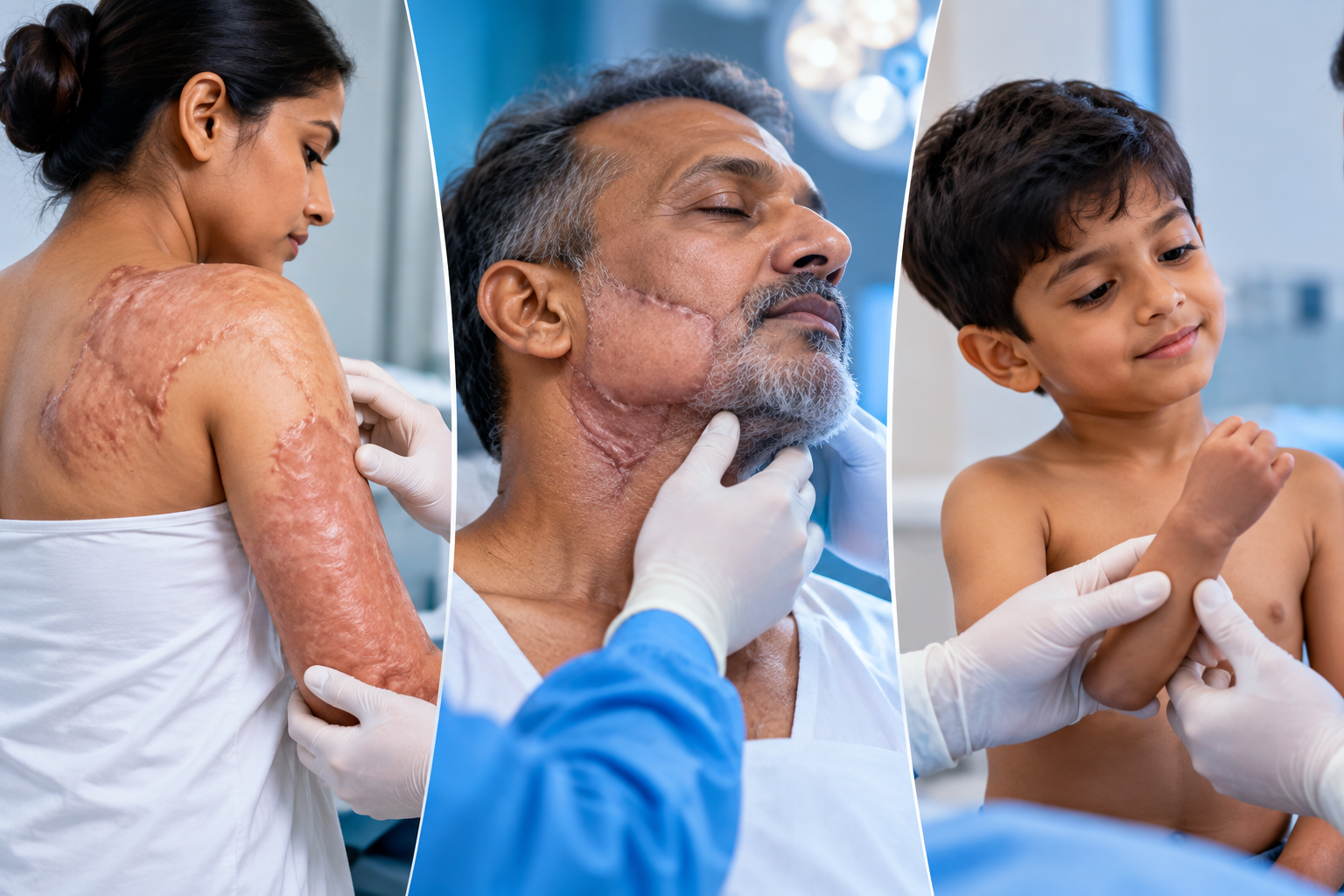
Some patients develop scars that become:
-
Thick
-
Raised
-
Itchy
-
Painful
-
Tight
-
Discoloured
-
Cosmetically noticeable
-
Restrictive during movement
Treatment depends on the type and maturity of the scar.
Scar-management options can include silicone therapy, pressure treatment in selected cases, injections, laser treatment, physiotherapy or surgical scar revision.
Post-Burn Contractures
A burn contracture occurs when scar tissue tightens enough to restrict normal movement or distort surrounding structures.
Common areas include the:
-
Neck
-
Fingers
-
Hand
-
Elbow
-
Shoulder
-
Armpit
-
Knee
-
Ankle
For example, a severe neck contracture can pull the chin downward. A contracture across a finger or elbow can prevent full extension.
Surgical treatment may involve releasing the tight scar and covering the resulting defect using a skin graft, local tissue rearrangement such as Z-plasty, or flap reconstruction.
When Should You See a Burn Treatment Doctor Near Vesu?
A burn treatment doctor near vesu should be consulted when a burn appears deep, involves the face or hand, crosses an important joint, is not healing normally, or has resulted in a painful or restrictive scar.
Fresh significant burns should be assessed promptly rather than waiting to see whether a contracture develops.
For an old burn, specialist assessment becomes particularly important when the scar:
-
Restricts neck movement
-
Prevents a joint from straightening
-
Interferes with hand function
-
Pulls the eyelid or lip
-
Frequently breaks down
-
Causes persistent pain or itching
-
Produces significant facial or body deformity
The surgeon can determine whether continued scar management, physiotherapy or reconstructive surgery is appropriate.
What Does a Plastic Surgeon Do After Skin or Breast Cancer Surgery?
Plastic surgeons can also reconstruct defects created during cancer treatment.
Removing cancer sometimes requires removal of surrounding skin, soft tissue, breast tissue, muscle or other structures. Cancer removal remains the priority, but reconstruction can help restore the resulting defect.
Reconstruction After Skin Cancer
Removing skin cancer from areas such as the nose, cheek, eyelid, lip, ear or scalp can leave a defect that cannot always be closed simply by bringing the wound edges together.
Depending on its size and location, reconstruction may involve:
-
Direct closure
-
Local skin flap
-
Skin graft
-
Regional flap
-
Free-tissue transfer for selected large defects
The aim is to achieve safe wound closure while preserving important structures and obtaining the best practical functional and aesthetic result.
Breast Reconstruction After Cancer
A plastic surgeon may reconstruct the breast following mastectomy or selected breast cancer procedures.
Options can include:
-
Implant-based reconstruction
-
Tissue-expander reconstruction
-
Reconstruction using the patient's own tissue
-
Combination techniques
-
Nipple-areola reconstruction in appropriate cases
-
Revision procedures following previous reconstruction
Breast reconstruction can sometimes be performed at the time of mastectomy. In other circumstances, delayed reconstruction may be recommended.
Read more about Breast Reconstruction After Mastectomy.
Head and Neck Cancer Reconstruction
Cancer involving the face, mouth, jaw or surrounding tissues can produce much more complex defects.
Reconstruction may require tissue transferred from another part of the patient's body. Microsurgical free-flap reconstruction allows the surgeon to transfer tissue together with its blood vessels and reconnect those vessels at the reconstructed site.
Which Injuries to the Face, Hand and Nerves Need a Plastic Surgeon Rather Than a General Surgeon?
Plastic surgeons frequently become involved when trauma damages several structures simultaneously or requires specialised reconstruction.
Facial Fractures
Road accidents, falls, sports injuries and other trauma can fracture the:
-
Nose
-
Cheekbone
-
Orbit
-
Upper jaw
-
Lower jaw
-
Multiple facial bones
Treatment is not solely about joining broken bones. Facial reconstruction may also need to restore facial symmetry, eye position, chewing and mouth opening.
Read more about Facial Fracture Repair.
Hand Injuries
The hand contains bones, tendons, nerves, arteries and veins within a relatively small anatomical area.
A deep cut or crush injury may therefore damage several structures simultaneously.
Plastic and hand surgery can include treatment of:
-
Fingertip injuries
-
Nail-bed injuries
-
Tendon injuries
-
Digital nerve injuries
-
Blood-vessel injuries
-
Soft-tissue loss
-
Crush injuries
-
Complex hand wounds
Restoring hand function often requires both surgical reconstruction and rehabilitation.
Cut Nerves
Peripheral nerves carry signals between the brain, spinal cord and different parts of the body.
A significant nerve injury can cause numbness, weakness or loss of movement.
Depending on the injury, treatment may involve:
-
Direct nerve repair
-
Nerve grafting
-
Nerve transfer
-
Neuroma surgery
-
Tendon transfer for selected established nerve palsies
Recovery varies according to the nerve involved, level of injury, patient's circumstances and distance over which the nerve must regenerate.
Severed Fingers and Hands
Plastic surgeons trained in microsurgery may perform replantation in selected amputations.
Replantation can involve repairing:
-
Bone
-
Tendons
-
Arteries
-
Veins
-
Nerves
-
Skin and soft tissue
Not every amputated finger or limb can or should be replanted. The mechanism of injury, condition of the amputated part, level of amputation, patient factors and time since injury all influence the decision.
Read more about When a Severed Finger or Hand Can Be Saved.
Do Plastic Surgeons Treat Birth Differences?
Yes. Reconstructive plastic surgery also includes treatment of several congenital conditions.
Examples include:
-
Cleft lip
-
Cleft palate
-
Cleft nose deformity
-
Congenital ear differences
-
Microtia
-
Craniofacial differences
-
Congenital hand differences
-
Syndactyly in selected cases
-
Other congenital soft-tissue differences
Treatment frequently involves more than one specialist.
For example, children with cleft lip and palate may need coordinated care involving plastic surgery, paediatrics, ENT, speech therapy, dentistry and orthodontics.
Treatment is planned according to the child's age, development and individual condition rather than using one operation for every patient.
What Problems Does a Reconstructive Plastic Surgeon Treat?
| Problem | Typical Referring Doctor/Team | What the Plastic Surgeon Does | Usual Timing | Related Service |
|---|---|---|---|---|
| Deep burn | Emergency/burn team | Wound treatment, grafting or flap reconstruction when required | Emergency to weeks | Burn reconstruction |
| Burn contracture | Physician/surgeon/self-referral | Scar release and reconstruction | Usually after healing | Burn scar surgery |
| Skin cancer defect | Dermatologist/oncologist | Closure, graft or flap reconstruction | During or after cancer removal | Cancer reconstruction |
| Breast after mastectomy | Breast/onco surgeon | Implant or autologous reconstruction | Immediate or delayed | Breast reconstruction |
| Facial fracture | Emergency/trauma team | Reduction and fixation where indicated | Usually acute | Facial fracture repair |
| Tendon injury | Emergency/orthopaedic team | Tendon repair/reconstruction | Often acute | Hand surgery |
| Peripheral nerve injury | Emergency/orthopaedic team | Nerve repair, graft or reconstruction | Acute or planned | Nerve reconstruction |
| Severed finger | Emergency/trauma team | Replantation when appropriate | Emergency | Microvascular replantation |
| Complex traumatic wound | Trauma/orthopaedic team | Graft, local flap or free flap | Acute or staged | Trauma reconstruction |
| Cleft lip or palate | Paediatric/cleft team | Staged cleft reconstruction | Age-dependent planning | Cleft surgery |
| Congenital facial difference | Paediatric/craniofacial team | Individualised reconstruction | Planned | Craniofacial surgery |
| Difficult lower-limb defect | Orthopaedic/trauma team | Soft-tissue or microsurgical coverage | Acute or staged | Limb reconstruction |
The exact timing varies considerably between conditions. A severed finger may require immediate assessment, whereas an established burn contracture or delayed breast reconstruction can usually be planned.
How Do You Get Referred, and What Should the First Reconstructive Visit Cover?
Some patients are referred directly from an emergency department, oncologist, orthopaedic surgeon, breast surgeon or another specialist.
Others seek a plastic surgeon themselves because they have an old scar, deformity, chronic wound or functional problem.
A reconstructive consultation should establish:
-
What happened?
The surgeon needs to understand the injury, disease, previous operation or congenital condition. -
Which structures are affected?
Skin alone may be involved, or there may also be damage to muscle, tendon, nerve, bone or blood vessels. -
Has function been lost?
Movement, sensation, facial expression, hand function or other activities may be affected. -
Is the condition stable?
An active wound requires a different approach from a mature scar. -
What treatment has already been performed?
Previous surgery, radiation, chemotherapy, grafting or scar treatment can influence reconstruction. -
Is treatment urgent?
Replantation and certain traumatic injuries require immediate decisions. Old scars generally allow more planning. -
Which reconstructive options are available?
Options may range from simple scar revision to grafting, local flaps or microsurgical free-tissue transfer. -
What will recovery involve?
Rehabilitation, physiotherapy, dressings and follow-up may be as important as the operation itself.
Dr. Ashutosh Shah and Reconstructive Plastic Surgery
Dr. Ashutosh A Shah, MS, MCh (Plastic Surgery), D.N.B., is a Board Certified Plastic & Reconstructive Surgeon at Elegance Clinic with more than 22 years of experience.
His work includes plastic, reconstructive and microvascular surgical procedures. Patients requiring reconstruction after trauma, burns, cancer surgery or complex tissue loss need an individual assessment because the appropriate technique depends on the structures involved and the functional problem.
Read more about Dr Ashutosh Shah's training in reconstructive and microvascular surgery.
Citable Proof: What Does Reconstructive Plastic Surgery Actually Cover?
A useful way to understand the specialty is to look at formal plastic-surgery training rather than assuming that “plastic surgery” means cosmetic procedures.
The scope of plastic and reconstructive surgery includes areas such as:
-
Burns and post-burn deformities
-
Hand surgery
-
Peripheral nerve surgery
-
Microvascular surgery
-
Replantation
-
Cleft and craniofacial surgery
-
Head and neck reconstruction
-
Breast reconstruction
-
Trunk reconstruction
-
Lower-limb reconstruction
-
Trauma reconstruction
-
Aesthetic surgery
Therefore, do plastic surgeons treat burns? Yes. Burns and post-burn reconstruction sit within the broader reconstructive scope of plastic surgery, alongside trauma, microsurgery, congenital conditions and reconstruction following cancer treatment.
Conclusion
The question “do plastic surgeons treat burns?” highlights a common misunderstanding about the specialty. Plastic surgery extends well beyond cosmetic procedures and includes burn care and contracture reconstruction, cancer-defect reconstruction, facial trauma, hand injuries, nerve and tendon repair, microsurgery, replantation and treatment of selected congenital differences.
At Elegance Clinic, Dr. Ashutosh A Shah assesses reconstructive problems according to the tissue involved, loss of function, previous treatment and the timing of reconstruction. The aim of reconstructive surgery is not simply to alter appearance but, wherever possible, to restore useful form and function after injury, disease or a congenital condition.
Frequently Asked Questions
Do plastic surgeons treat fresh burns or only old burn scars?
Is a reconstructive surgeon different from a cosmetic surgeon?
Can a plastic surgeon rebuild a nose or breast after cancer?
Do plastic surgeons repair cut nerves and tendons?
Does health insurance cover reconstructive plastic surgery in India?
Who decides whether a problem is cosmetic or reconstructive?
About the Author