
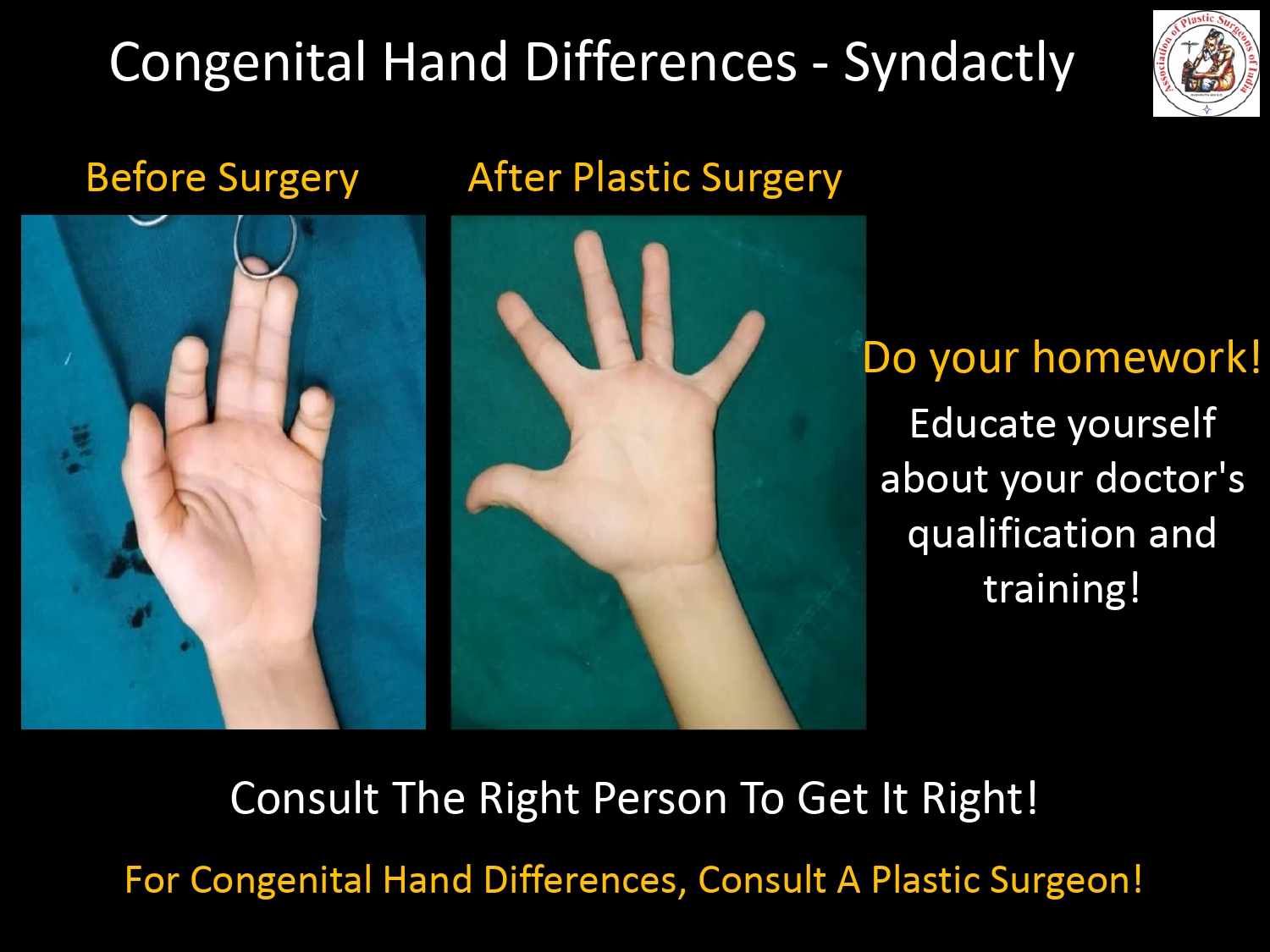
Syndactyly Correction Surgery
Congenital hand differences are conditions in which a baby is born with variations in the shape, structure, or function of the hand and fingers. One of the most common congenital hand anomalies is Syndactyly, a condition where two or more fingers are joined together.
Syndactyly may affect only the skin between the fingers or may involve deeper structures such as soft tissue, nails, bones, or tendons. The condition can vary from mild webbing between fingers to complete fusion of digits. Modern plastic and reconstructive surgery offers effective treatment options to improve both hand appearance and function.
What is Syndactyly?
Syndactyly is a congenital condition in which adjacent fingers remain connected instead of separating normally during fetal development. The term comes from the Greek words meaning “joined digits.”
Normally, fingers separate during early pregnancy while the baby develops in the womb. In syndactyly, this separation process remains incomplete, resulting in fused fingers.
The condition may affect:
- One hand or both hands
- Only two fingers
- Multiple fingers
- Hands alone or along with foot involvement
The most commonly involved fingers are:
- Middle and ring finger
- Ring and little finger
Types of Syndactyly
Syndactyly can be classified into different types depending on severity and tissue involvement.
Simple Syndactyly
Only the skin and soft tissues are joined between the fingers.
Complex Syndactyly
The bones, nails, tendons, or joints may also be fused together.
Complete Syndactyly
The fingers are joined throughout their entire length.
Incomplete Syndactyly
The fingers are connected only partially.
The severity varies from person to person, and proper evaluation helps determine the most suitable treatment plan.
What Causes Syndactyly?
Syndactyly occurs during fetal development before birth. In most cases, the exact cause is not clearly known.
Possible factors may include:
- Genetic influence
- Family history
- Developmental abnormalities during pregnancy
- Certain congenital syndromes
In many children, syndactyly occurs as an isolated condition without any other health problem.
Symptoms and Appearance
The most obvious sign of syndactyly is joined fingers. Depending on the severity, the condition may affect hand function and finger movement.
Common Features Include:
- Webbed fingers
- Fused skin between fingers
- Limited finger separation
- Difference in finger appearance
- Difficulty with fine hand movements in severe cases
Mild cases may mainly affect appearance, while complex syndactyly can interfere with normal hand function and growth.
Psychological and Functional Impact
Children with visible hand differences may experience emotional and social challenges as they grow older. Some children may become self-conscious about hand appearance, especially during school years.
Functional difficulties may include:
- Trouble gripping objects
- Difficulty with writing or fine movements
- Limited finger independence
- Reduced hand flexibility
Early surgical correction can improve both hand function and cosmetic appearance.
Diagnosis of Syndactyly
Syndactyly is usually diagnosed at birth during physical examination.
Doctors may recommend:
- Clinical examination
- X-rays to evaluate bone involvement
- Assessment of finger movement and function
Imaging helps determine whether the condition is simple or complex and assists in surgical planning.
Treatment for Syndactyly
The primary treatment for syndactyly is surgical correction performed by a qualified plastic and reconstructive surgeon or hand surgeon.
The goal of surgery is to:
- Separate the fused fingers
- Improve hand function
- Allow normal finger growth
- Improve cosmetic appearance
When is Surgery Performed?
Surgery is commonly performed during early childhood, often between 6 months to 2 years of age depending on:
- Severity of fusion
- Fingers involved
- Growth concerns
- Functional limitations
Early treatment is important because joined fingers can affect normal growth patterns if left untreated.
How is Syndactyly Surgery Performed?
The surgical procedure involves carefully separating the fused fingers while preserving blood supply, nerves, and hand function.
During surgery:
- The joined skin is separated
- New skin coverage is created between fingers
- Skin grafts may sometimes be required
- Finger shape and movement are improved
The exact surgical technique depends on the complexity of the condition.
Plastic surgeons plan the reconstruction carefully to achieve both functional and aesthetically balanced results.
Recovery After Surgery
After surgery:
- A dressing or splint may be applied
- Healing is monitored regularly
- Hand exercises may sometimes be recommended
- Follow-up visits are important
Children generally recover well after surgery, especially when treatment is done early.
Parents are advised to protect the operated hand during healing and follow all post-operative instructions carefully.
Benefits of Surgical Correction
Syndactyly surgery can provide major long-term benefits for both function and appearance.
Common Benefits Include:
- Improved finger movement
- Better hand function
- More natural finger separation
- Improved ability to grip and hold objects
- Better cosmetic appearance
- Increased confidence as the child grows
Most children adapt very well after successful reconstruction.
Are There Risks Involved?
Like any surgical procedure, syndactyly correction may have some risks such as:
- Infection
- Scarring
- Skin graft healing issues
- Finger stiffness
- Recurrence of webbing
However, with experienced surgical care and proper follow-up, outcomes are usually very good.
Importance of Early Treatment
Early evaluation by a plastic surgeon is very important in congenital hand differences. Delayed treatment may affect:
- Finger growth
- Hand function
- Joint development
- Fine motor skills
Timely surgery helps improve overall hand development and long-term function.
Living with Congenital Hand Differences
Many children born with syndactyly lead completely normal and active lives after proper treatment. Emotional support from family and early medical care play a major role in helping children develop confidence and independence.
Modern reconstructive surgery techniques continue to improve both functional and cosmetic outcomes for congenital hand conditions.
Final Words
Syndactyly is one of the most common congenital hand differences where two or more fingers are fused together. The condition may vary from simple skin webbing to complex fusion involving deeper structures.
Although syndactyly is present from birth, modern plastic and reconstructive surgery can successfully separate the fingers and improve both hand function and appearance. Early diagnosis and timely surgical correction are important for proper hand development and long-term results.
Consultation with a qualified plastic surgeon helps parents understand the condition, treatment options, recovery process, and expected outcomes for their child.