
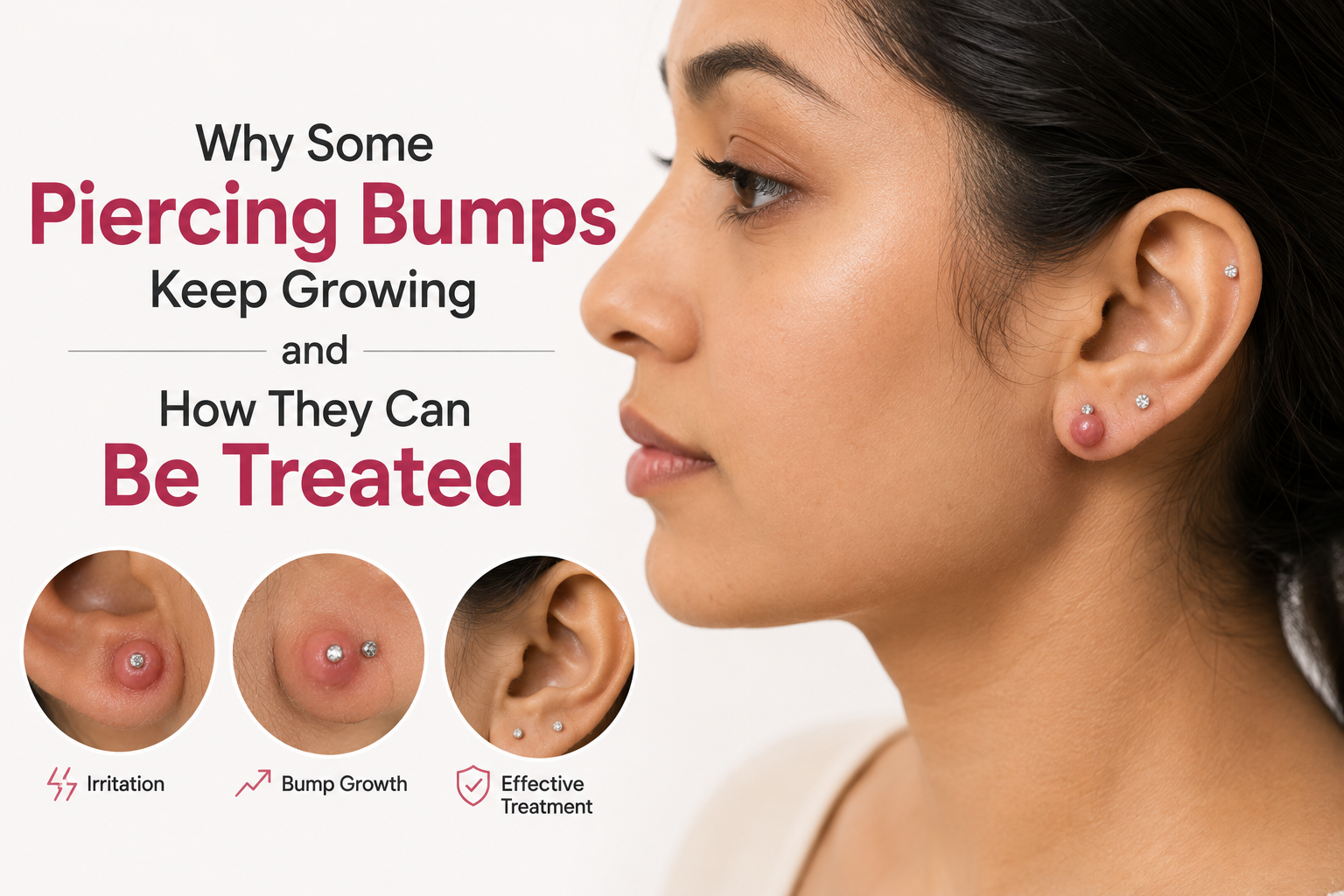
Why Some Piercing Bumps Keep Growing and How They Can Be Treated
✔ Medically reviewed by Dr. Ashutosh Shah - M.B., M.S., M.Ch., D.N.B., Board-Certified Plastic & Cosmetic Surgeon, Director of Elegance Clinic, Surat (22+ years’ experience).
A small bump after piercing is easy to dismiss as irritation. But when that bump becomes firm, raised, itchy, painful, or gradually larger, it may be more than an ordinary piercing reaction. In some people, the skin responds to the piercing injury by producing excessive scar tissue, resulting in a keloid.
This is especially important with ear piercings because keloids can continue growing beyond the original piercing site and may become noticeable from both sides of the earlobe.
For people searching for Skin Lump After Piercing Treatment in Surat, understanding the difference between a temporary piercing bump and a keloid is the first step toward choosing appropriate treatment.
Key Takeaways
- A persistent lump after piercing can sometimes be a keloid or hypertrophic scar, rather than a simple infection.
- Keloids can continue growing because of abnormal scar formation and prolonged inflammatory activity.
- Ear piercing is a recognised trigger for auricular keloids.
- Treatment depends on the lump's size, location, growth pattern, symptoms, and whether it has returned after previous treatment.
- Keloids often require a combination approach rather than removal alone because recurrence is possible after surgery.
- Professional assessment is important before attempting to squeeze, cut, pierce, or otherwise manipulate the lump.
Why Does a Piercing Bump Keep Growing?
When skin is pierced, the body begins a wound-healing process. Normally, scar tissue gradually becomes less prominent as the wound heals.
A keloid behaves differently.
Instead of stopping once the wound has healed, scar-forming activity can remain excessive. Fibroblasts and other components involved in wound healing can contribute to an overproduction of connective tissue. The resulting scar can become thick, firm and raised.
This explains why a bump that initially looks insignificant can slowly become larger months after the piercing.
Common factors associated with a growing piercing lump include:
- Repeated irritation from earrings
- Trauma to the piercing site
- Previous inflammation or infection
- Individual tendency to develop keloid scars
- Repeated injury to an existing scar
- Continued pressure or friction around the piercing
A growing lump should therefore not automatically be treated as an infection.
Piercing Bump vs Keloid: What's the Difference?
Not every bump after piercing is a keloid.
A temporary irritation bump may settle as the piercing heals. A keloid, on the other hand, tends to remain firm and can progressively enlarge.
| Feature | Temporary Piercing Bump | Possible Keloid |
|---|---|---|
| Growth | Usually settles | May progressively enlarge |
| Texture | May be soft or inflamed | Often firm or rubbery |
| Location | Usually close to irritation | Can extend beyond the original piercing |
| Symptoms | Irritation or tenderness | Itching, tenderness or pain may occur |
| Duration | Often improves with healing | Can persist for months or longer |
| Scar behaviour | Usually limited | Can continue producing excess scar tissue |
A clinical examination is needed to determine what type of lesion is actually present.
Why Do Some Keloids Continue Growing?
One of the most important things people often overlook is that keloids are not simply extra skin sitting over an old piercing.
They represent abnormal scar formation.
Keloids can extend beyond the boundaries of the original wound and generally do not spontaneously disappear. Their growth can be influenced by ongoing inflammation and mechanical factors affecting the scar.
This is why repeatedly irritating the area or trying to remove the lump at home may make the situation more complicated.
Can a Skin Lump After Piercing Be Treated?
Yes, a skin lump after piercing can often be treated, but the appropriate treatment depends on whether it is a keloid, hypertrophic scar, infection, cyst, or another type of lesion.
If the diagnosis is a keloid, treatment options may include:
1. Intralesional Corticosteroid Injections
Medication can be injected directly into the scar to help flatten and soften a keloid.
Intralesional corticosteroid treatment is widely used as a first-line treatment option for keloids, although the number and timing of injections vary according to the individual lesion and clinical response.
2. Surgical Excision
For larger or more prominent keloids, surgical removal may be considered.
However, excision alone does not guarantee that the keloid will not return. The American Academy of Dermatology notes that recurrence after keloid surgery can be very high, which is why additional treatment is commonly considered after removal.
3. Excision Combined With Additional Treatment
Combining removal with postoperative or perioperative corticosteroid treatment has been studied for ear keloids. Research suggests that combination approaches can help reduce recurrence compared with relying on excision alone.
Other adjunctive options may include pressure therapy or silicone-based scar management depending on the case.
What Is Intralesional Excision?
Intralesional techniques are designed around the principle of removing or reducing problematic keloid tissue while considering the surrounding skin and the possibility of recurrence.
The exact surgical approach should be selected after examining the size, depth, location and characteristics of the keloid.
The Intralesional Excision service at Elegance Clinic in Surat is specifically focused on keloid management, with treatment planning based on the individual scar. The clinic page also highlights that keloid healing is challenging and that long-term outcomes need to be considered when choosing an approach.
Why Treating a Keloid Is Different From Removing a Normal Lump
This distinction is important.
If a person simply thinks, “There is a lump, so I need to remove the lump,” they may underestimate the biology of keloid formation.
A keloid can recur after treatment because the skin may again respond to the surgical injury by producing excessive scar tissue.
Therefore, treatment planning may involve:
Diagnosis → Assessment of scar → Selection of treatment → Recurrence prevention → Follow-up
This is one reason why a specialist evaluation is more useful than attempting home remedies or repeatedly traumatising the piercing site.
Can You Prevent a Piercing Keloid From Getting Bigger?
If you already notice a persistent or enlarging lump, avoid repeatedly irritating it.
Depending on the diagnosis, a specialist may recommend measures such as:
- Avoiding unnecessary trauma to the area
- Avoiding repeated piercing through or around the scar
- Following prescribed scar-care instructions
- Using silicone-based scar products when appropriate
- Considering pressure therapy for suitable ear lesions
- Attending follow-up appointments if injections or surgery are performed
Pressure earrings, for example, may be recommended after treatment of suitable earlobe keloids to help reduce recurrence.
When Should You See a Specialist?
Consider an evaluation if the lump:
- Keeps getting larger
- Becomes hard or raised
- Extends beyond the original piercing
- Causes persistent itching or discomfort
- Bleeds or becomes repeatedly irritated
- Has not settled despite allowing the piercing to heal
- Has returned after previous treatment
A rapidly changing, painful, red or draining lesion should also be evaluated because not every post-piercing lump is a keloid.
Skin Lump After Piercing Treatment in Surat
If you are looking for Skin Lump After Piercing Treatment in Surat, the first priority should be identifying the cause of the lump rather than choosing a treatment based only on its appearance.
At Elegance Clinic, Surat, patients can undergo specialist assessment for suspected keloid scars and discuss treatment options based on the size, location and behaviour of the lesion. Dr. Ashutosh Shah, a board-certified plastic surgeon and Director of Elegance Clinic, provides evaluation and treatment planning for keloid-related concerns.
The goal is not simply to make the lump smaller. Treatment planning should also consider scar quality, wound healing, cosmetic appearance and the possibility of recurrence.
Conclusion
A piercing bump that keeps growing should not always be dismissed as a normal part of healing. In some cases, it may be a keloid, particularly when the lump becomes firm, raised and progressively larger.
The right Skin Lump After Piercing Treatment in Surat depends on identifying the underlying cause and assessing the scar before selecting treatment. Because keloids can recur, successful management may require more than simply removing the visible growth.
Looking for Keloid Treatment in Surat?
If you have a persistent or growing lump after piercing, consider a specialist consultation to determine whether it is a keloid and which treatment approach is appropriate for you.
Book a consultation at Elegance Clinic, Surat, for an expert evaluation and personalised keloid treatment plan.
Frequently Asked Questions
What causes a skin lump after piercing?
Is every piercing bump a keloid?
Why does my ear piercing bump keep getting bigger?
Can an ear-piercing keloid be removed permanently?
Is surgery alone enough for a piercing keloid?
About the Author