
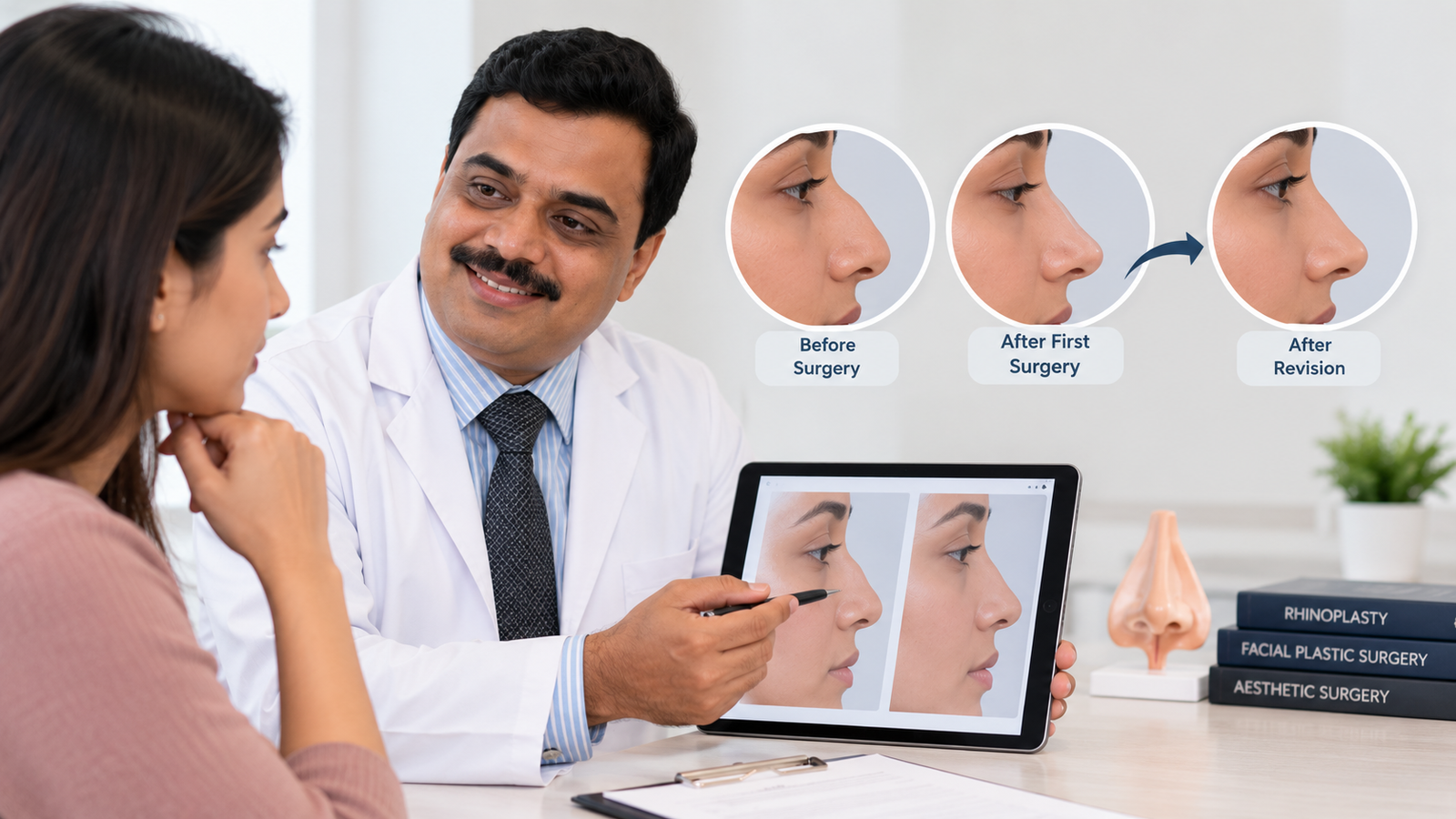
Revision Rhinoplasty: What Can Be Fixed After Someone Else's Nose Surgery
✔ Medically reviewed by Dr. Ashutosh Shah - M.B., M.S., M.Ch., D.N.B., Board-Certified Plastic & Cosmetic Surgeon, Director of Elegance Clinic, Surat (22+ years’ experience).
Revision rhinoplasty after failed nose surgery is usually considered only after the nose has had enough time to heal from the first operation. In many cases, surgeons prefer to wait around 9–12 months, because swelling and scar tissue continue changing during this period. Earlier intervention may be considered when there is an urgent functional problem, but timing must be individualised.
A second nose surgery can address problems such as an uneven bridge, pinched or collapsed nasal tip, persistent asymmetry, excessive or insufficient tissue removal, and some breathing difficulties. However, revision surgery is generally more complex because the surgeon is working with scar tissue and anatomy that has already been altered.
What Actually Goes Wrong in a Primary Rhinoplasty?
A rhinoplasty can change both the appearance and function of the nose. When the final result does not meet the surgical goal, there may be a cosmetic concern, a functional problem, or both.
Not every concern after surgery means that the rhinoplasty has failed. Swelling can make the nose look uneven or larger during the early healing period.
A true revision concern is generally evaluated after the nose has sufficiently healed.
Too Much Cartilage May Have Been Removed
Cartilage provides important structural support to the nose.
If too much supporting cartilage is removed, certain areas may become weak. Depending on the structures affected, this can contribute to problems such as tip pinching, loss of projection or nasal collapse.
Too Little Correction May Have Been Made
Sometimes the original concern remains partly visible.
For example, a patient may still notice:
- A residual bridge hump
- A wide nasal base
- Tip asymmetry
- An under-projected or drooping tip
- Persistent deviation
Revision surgery may be considered when the remaining concern is significant and surgically correctable.
Scar Tissue Can Affect the Result
Scar formation is a normal part of healing.
However, scar tissue can sometimes influence nasal contour, particularly in a nose that has already undergone extensive surgery.
This is one reason revision rhinoplasty after failed nose surgery requires careful assessment rather than simply repeating the original procedure.
Breathing May Be Affected
Structural changes can sometimes narrow the nasal airway.
Patients may report difficulty breathing through one or both sides of the nose following surgery. A revision assessment should therefore consider nasal function as well as appearance.
Healing Can Create Asymmetry
No surgeon can completely control how every tissue heals.
Differences in swelling, scar formation, skin thickness and tissue response can affect the final appearance even when the original operation was carefully planned.
The first step is therefore determining why the result is unsatisfactory before deciding how to correct it.
Why Does Revision Usually Wait Nine to Twelve Months?
Patients unhappy with their rhinoplasty often want the problem corrected quickly.
However, operating too early can make it difficult to distinguish a permanent deformity from temporary postoperative swelling.
Swelling Takes Time to Settle
Major swelling usually decreases during the earlier stages of recovery, but subtle swelling—particularly around the nasal tip—can persist much longer.
The nose may continue changing for many months.
A result that looks disappointing at three months may look different at nine or twelve months.
Scar Tissue Is Still Maturing
Internal scar tissue also changes over time.
Operating while tissues are still actively healing can make revision more difficult and may expose the nose to unnecessary additional trauma.
The Final Problem Must Be Clearly Defined
Waiting allows the surgeon to assess:
- What has healed satisfactorily
- What remains asymmetric
- Whether the tip has adequate support
- Whether the bridge requires correction
- Whether breathing is affected
- How much usable cartilage remains
This makes revision planning more precise.
Can Revision Ever Be Done Earlier?
Occasionally, an earlier intervention may be considered for a specific complication or significant functional problem.
However, this is not the usual approach for purely cosmetic concerns.
Patients wondering how long to wait before revision rhinoplasty should therefore have their nose assessed rather than choosing a revision date based on a fixed online timeline.
Which Deformities Are Correctable and Which Are Not?
Many problems following rhinoplasty can potentially be improved, but revision surgery does not mean that every aspect of the nose can be made perfect.
The amount of improvement depends on the remaining anatomy, scar tissue, skin characteristics, available cartilage and previous surgical changes.
Correctable vs Non-Correctable or Limited-Correction Concerns
| Deformity/Concern | Likely Cause | Possible Revision Technique | Realistic Improvement |
|---|---|---|---|
| Pinched nasal tip | Excess cartilage removal or weak support | Structural cartilage grafting and tip reconstruction | Tip support and contour may be improved |
| Collapsed tip | Loss of structural support | Support grafts and reconstruction | Projection and support may be restored to varying degrees |
| Residual bridge hump | Incomplete correction or healing pattern | Careful bridge refinement | Smoother profile may be achievable |
| Bridge depression | Excessive tissue removal | Cartilage graft or other reconstruction | Bridge height and contour may be improved |
| Persistent deviation | Remaining structural asymmetry or healing | Osteotomy, cartilage correction or grafting when appropriate | Alignment may improve, but perfect symmetry cannot be guaranteed |
| Nasal valve weakness | Loss of structural support | Structural grafting | Airflow may improve when obstruction is caused by correctable structural weakness |
| Tip asymmetry | Cartilage imbalance, scar tissue or healing | Tip suturing, grafting or scar management | Improved balance may be possible |
| Very thick scarred skin | Individual tissue response and previous surgery | Limited surgical/scar-management options | Improvement may be limited by skin and scar characteristics |
| Extensive tissue loss | Previous aggressive surgery or multiple operations | Complex reconstruction | Improvement may be possible, but complete restoration may not be achievable |
The purpose of this table is not to predict an individual outcome. A physical examination is needed to determine which structures are responsible.
Can a Collapsed Nose Tip Be Corrected?
A collapsed nose tip may sometimes be reconstructed if adequate structural support can be restored.
Cartilage grafts may be used to rebuild areas that have become weak after previous surgery.
However, the exact technique depends on what cartilage remains and how much scar tissue is present.
What About Persistent Breathing Problems?
If breathing difficulty results from a correctable structural problem, revision surgery may be able to improve airflow.
The surgeon needs to identify whether the problem involves the septum, nasal valves or another part of the airway.
Aesthetic correction alone should not replace a proper functional assessment.
Patients can learn more about nose injury surgery explained when structural nasal problems are also a concern.
Where Does the Surgeon Take Cartilage From in a Revision?
Cartilage is especially important in revision rhinoplasty because the nose may need structural support rather than additional tissue removal.
During the first rhinoplasty, some of the patient's septal cartilage may already have been removed or reshaped.
If additional cartilage is required, the surgeon has several possible donor sites.
Septal Cartilage
If enough suitable septal cartilage remains, it may be used for reconstruction.
Septal cartilage is useful because it is already located within the nose and can provide structural graft material.
However, previous surgery may mean there is not enough remaining.
Ear Cartilage
Cartilage can sometimes be obtained from the ear.
Its natural curvature can make it useful for selected areas of nasal reconstruction.
The donor site and expected effect on the ear should be discussed during surgical planning.
Rib Cartilage
More complex revision cases may require a larger or stronger source of cartilage.
In these situations, rib cartilage may be considered.
This does not mean that everyone undergoing revision rhinoplasty needs a rib graft.
A cartilage graft for revision nose surgery is selected according to how much structural material is required and what suitable cartilage remains elsewhere.
Why Is Grafting Needed?
A primary rhinoplasty may sometimes focus on reducing or reshaping existing structures.
Revision surgery often requires the opposite approach.
Instead of removing more tissue, the surgeon may need to rebuild support.
Grafts can potentially be used to:
- Support a weak tip
- Improve projection
- Reconstruct a depressed bridge
- Support the nasal valve
- Correct selected asymmetries
- Replace structural support lost during previous surgery
At Elegance Clinic, Dr. Ashutosh Shah assesses the previous surgical changes, nasal support, breathing function, scar tissue and available graft material before planning revision rhinoplasty.
For an overview of the procedure, see Rhinoplasty at Elegance Clinic.
What Results Are Realistic the Second Time?
A successful revision should not be defined as creating a mathematically perfect nose.
The objective is usually to improve the specific correctable problems while preserving or restoring function.
Revision Rhinoplasty Is More Complex
The surgeon may be dealing with:
- Scar tissue
- Altered anatomy
- Missing cartilage
- Weakened structural support
- Previous implants or grafts
- Changes in blood supply
- Less predictable tissue behaviour
Because of these factors, revision rhinoplasty after failed nose surgery can be technically more demanding than primary rhinoplasty.
Improvement Is More Realistic Than Perfection
A realistic goal might be:
- Better tip support
- Improved nasal balance
- Reduced visible asymmetry
- Improved bridge contour
- Correction of a pinched appearance
- Better airflow when a correctable structural obstruction exists
Perfect symmetry cannot be guaranteed.
Every human nose has some degree of natural asymmetry, and previous surgery may limit what can safely be changed.
Photographs Help Define the Problem
If possible, bring photographs from before the first surgery.
These can help the revision surgeon understand the original anatomy and how it changed after the procedure.
Also bring:
- Previous operative records, if available
- Implant or graft details
- Earlier consultation notes
- Recent photographs
- A clear list of current concerns
Avoid Asking for Every Detail to Be Changed
A second operation should generally focus on meaningful problems that can be safely improved.
Repeatedly operating on minor irregularities can increase scar tissue and make future procedures more complicated.
Patients concerned specifically about nasal width can also read about alar reduction surgery, while those concerned about tip position can review nose tip lift surgery.
Conclusion
Revision rhinoplasty after failed nose surgery can improve selected cosmetic and functional problems, but the second operation requires particularly careful planning.
In most non-urgent cases, waiting approximately 9–12 months allows swelling to settle and scar tissue to mature before the final result is assessed. The surgeon can then determine whether concerns such as a pinched tip, collapsed support, bridge irregularity, persistent asymmetry or breathing difficulty are surgically correctable.
Revision surgery may also require cartilage grafting from the septum, ear or rib when the nose no longer has enough structural support.
The most important goal is not perfection. It is a realistic improvement that respects the remaining anatomy, preserves nasal function and avoids unnecessary additional surgery.
Frequently Asked Questions
Can a pinched or collapsed nose tip be rebuilt?
Do I need rib cartilage for a revision rhinoplasty?
Is revision rhinoplasty more painful than the first surgery?
Will breathing improve after a revision?
Can a revision be done if the first surgeon used an implant?
How many revisions are safe on one nose?
About the Author