
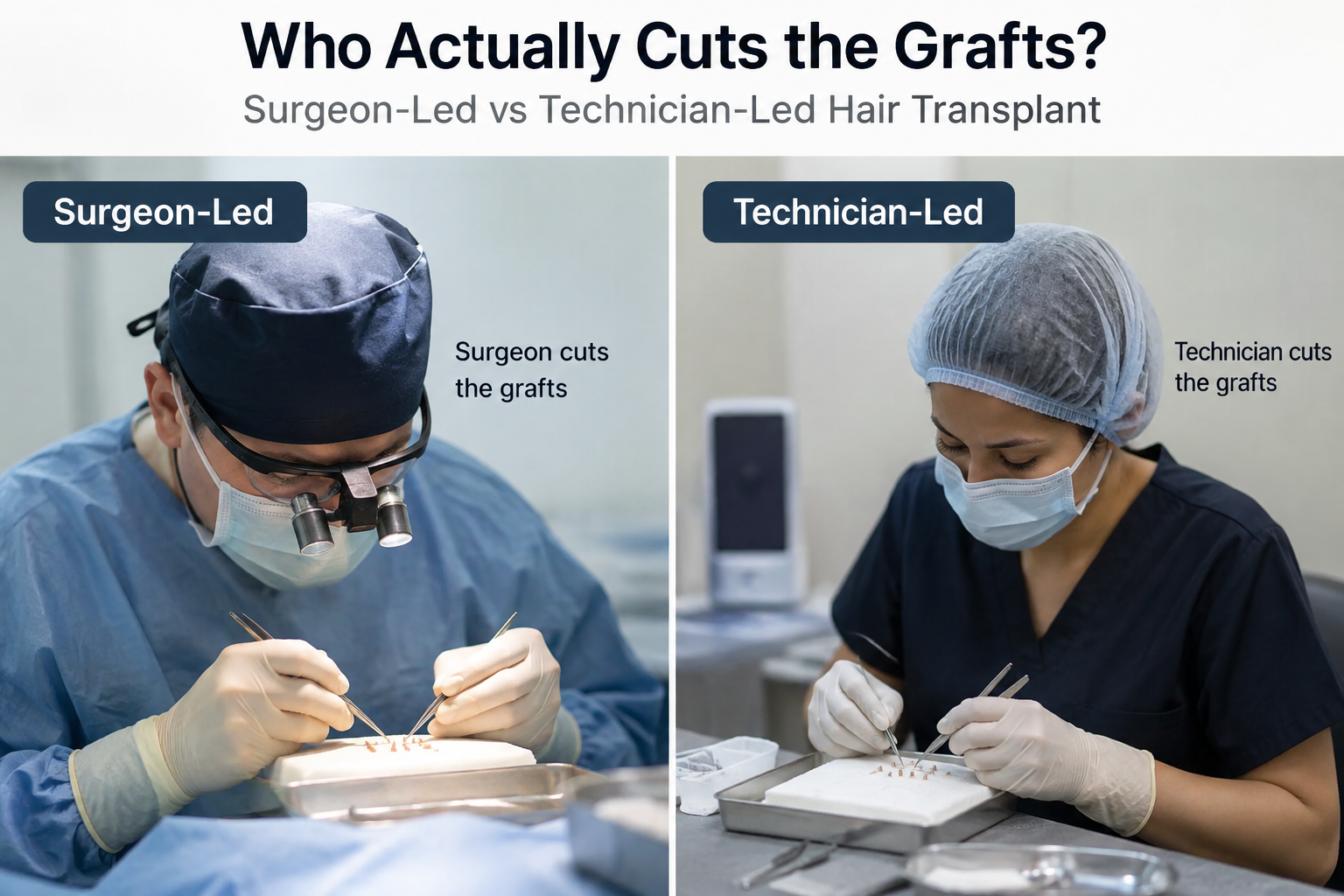
Who Actually Cuts the Grafts? Surgeon-Led vs Technician-Led Hair Transplant
✔ Medically reviewed by Dr. Ashutosh Shah - M.B., M.S., M.Ch., D.N.B., Board-Certified Plastic & Cosmetic Surgeon, Director of Elegance Clinic, Surat (22+ years’ experience).
Is a hair transplant performed by the surgeon or by technicians? A hair transplant involves several distinct stages, and the operating doctor should have direct responsibility for the surgical plan and critical surgical steps. Assistants may support appropriate parts of the procedure within their training and permitted role, but patients should know exactly who will perform each step before giving consent.
This matters because a hair transplant is not simply a process of moving a fixed number of hairs. Decisions about donor harvesting, hairline position, graft direction, density and recipient-site planning influence how natural the result can look and how safely the donor area is managed.
Before booking, ask one straightforward question: Who performs my hair transplant the surgeon or technician and what exactly will each person do?
What are the steps of a transplant and who may legally perform each one?
A hair transplant is a surgical process involving assessment, planning, donor harvesting, preparation of grafts, creation of recipient sites and implantation.
The exact professional responsibilities depend on applicable medical regulations, scope of practice and the procedure being performed. Patients should not assume that every person wearing scrubs in a procedure room is a doctor.
A typical FUE procedure involves:
- Medical and scalp assessment
- Donor-area evaluation
- Hairline planning
- Local anaesthesia
- Follicular unit extraction
- Graft handling and preparation
- Recipient-site planning
- Creation of recipient sites/slits
- Graft placement
- Post-procedure assessment and instructions
The operating surgeon should remain responsible for the patient's surgical assessment, procedure plan, management of complications and clinical outcome.
Trained assistants may support appropriate non-independent tasks according to local rules and the surgeon's supervision.
Who does what during a hair transplant?
| Procedure Step | Responsibility | Why It Matters |
|---|---|---|
| Hairline design | Surgeon-led | Requires assessment of facial proportions, existing hair loss and future recession |
| Donor assessment | Surgeon | Determines safe harvesting strategy and donor limitations |
| Anaesthesia planning | Qualified medical professional | Requires medical assessment and safe medication use |
| Graft extraction | Should follow applicable surgical scope and surgeon responsibility | Poor extraction can damage follicles and overharvest the donor area |
| Graft preparation | Appropriately trained team under supervision | Grafts require careful handling and hydration |
| Recipient slit/site making | Surgeon-led surgical planning | Determines direction, angle, distribution and density |
| Graft placement | Appropriately trained team as permitted and supervised | Correct handling and orientation help protect grafts |
| Complication management | Surgeon/medical team | Bleeding, drug reactions or other problems require medical assessment |
Patients should confirm the division of responsibility before the procedure, rather than discovering it after entering the operating room.
For more information on the extraction technique, see Follicular unit extraction (FUE).
Which parts must the surgeon personally perform?
A hair transplant contains both technical and medical decisions.
The surgeon's direct involvement is particularly important wherever a decision changes the surgical plan or affects patient safety.
This begins before the first graft is removed.
Medical assessment
The surgeon needs to determine whether transplantation is appropriate in the first place.
Hair loss may be influenced by:
- Pattern hair loss
- Alopecia areata
- Scarring alopecia
- Previous transplantation
- Medical conditions
- Medicines
- An unstable pattern of ongoing hair loss
Transplanting hair without understanding the underlying pattern can produce a poor long-term plan even when the transplanted grafts themselves grow.
Donor-area planning
The donor area is limited.
Removing too many follicular units or concentrating extraction too heavily in one location can leave visible thinning or an irregular donor appearance.
The surgeon therefore needs to determine:
- Donor density
- Hair calibre
- Distribution
- Safe extraction pattern
- Approximate graft requirement
- Existing donor scarring
- Future transplant needs
A large advertised graft number is not automatically better.
Surgical planning
The surgeon should determine the intended recipient pattern, hairline strategy and distribution of grafts.
These decisions influence how the transplanted hair integrates with the patient's existing hair and how the result may age if further hair loss occurs.
At Elegance Clinic, Dr. Ashutosh Shah evaluates the donor area, hair-loss pattern, hairline and realistic graft requirement before planning a hair transplant.
Why can hairline design never be delegated?
Hairline design is not simply drawing a curved line across the forehead.
It is one of the most important aesthetic and long-term planning decisions in hair transplantation.
The hairline must be considered in relation to:
- Facial proportions
- Forehead height
- Existing hairline
- Degree of baldness
- Age
- Donor supply
- Hair direction
- Future hair loss
- Temple recession
- Desired density
A lower hairline is not always better
Creating an unnecessarily low hairline can consume a large number of grafts.
That matters because donor hair is finite.
If native hair continues to thin behind a very low transplanted hairline, the patient may later require additional procedures while having fewer donor grafts available.
A conservative, age-appropriate plan may therefore be more sustainable than trying to recreate a teenage hairline.
Direction matters as much as position
Hair does not emerge from the scalp at one uniform angle.
Natural direction changes across the frontal hairline, temples and other scalp regions. Recipient sites need to account for these variations.
Poorly planned direction can make transplanted hair look unnatural even when graft survival is good.
Irregularity can look more natural
Natural hairlines are not perfectly straight or mechanically symmetrical.
The surgeon may plan subtle irregularity and different follicular-unit distribution near the front to avoid an artificial appearance.
Read more about this stage on the Hairline creation page.
What signs at consultation suggest the surgeon will not be in the room?
Patients should know the identity of the doctor responsible for their operation before paying an advance or arriving for surgery.
Certain consultation experiences should prompt additional questions.
You never meet the operating surgeon
If every discussion happens with a salesperson, coordinator or counsellor and you cannot meet the doctor who will operate, ask why.
A coordinator can help with scheduling and administrative information, but should not replace a surgical assessment.
Nobody clearly names the surgeon
Be cautious if the clinic repeatedly refers to:
- "Our team"
- "Our experts"
- "The transplant team"
- "Our technicians"
without clearly identifying the doctor responsible for your operation.
Ask for the operating surgeon's full name and qualifications.
The consultation focuses almost entirely on graft packages
Statements such as "3,000 graft package" or "unlimited grafts" do not replace assessment of donor density, hair calibre, recipient area and future hair loss.
The graft requirement should follow the surgical plan not the other way around.
The hairline is designed by a salesperson or coordinator
Administrative staff can discuss appointments and logistics, but the actual surgical hairline requires clinical and aesthetic planning by the responsible surgeon.
The answer changes when you ask who performs extraction
Ask specifically: Who performs the extraction, who creates the recipient sites, and who places the grafts?
A clear clinic should be able to explain the roles of the surgeon and assistants without ambiguity.
The surgeon appears only briefly
Patients should also ask whether the named surgeon will remain appropriately involved throughout the procedure rather than appearing only for a photograph, initial marking or short portion of the case.
Understanding why transplant plans differ between patients can help when comparing clinics. See Why every hair transplant is different.
What should the consent form say about the operating surgeon?
Consent should tell you what procedure you are agreeing to and who is responsible for providing it.
Before signing, check whether the documentation clearly identifies the operating surgeon and accurately reflects the procedure discussed during consultation.
Before giving consent, confirm:
- Name of the operating surgeon
- Planned transplant technique
- Donor area
- Approximate treatment plan
- Who performs the surgical stages
- Role of assistants or technicians
- Anaesthesia plan
- Important risks and limitations
- Alternatives to surgery
- Postoperative follow-up
- Who manages complications
- Whether photographs will be taken and how they may be used
Patients should have an opportunity to ask questions before signing.
Consent is more than a signature
A signed form does not replace a meaningful discussion.
You should understand what will happen, who will perform the procedure, important risks, reasonable alternatives and what postoperative care will involve.
If the surgeon or planned procedure changes unexpectedly, you should be informed rather than discovering the change after the procedure has started.
Ask before paying an advance
Questions about the operating surgeon are best resolved before paying a non-refundable deposit.
Useful questions include:
- Will the doctor I met perform my procedure?
- Will that doctor be present during the surgical stages?
- Who performs graft extraction?
- Who creates recipient sites?
- Who places the grafts?
- Who handles a medical problem if one occurs?
- Who reviews me after surgery?
A clinic should be able to answer these questions clearly.
Patients comparing transplantation with other approaches can also review Hair restoration options for bald men.
Conclusion
When asking who performs a hair transplant surgeon or technician, the answer should not be hidden behind the phrase "our team."
Hair transplantation contains multiple stages, and different trained team members may appropriately contribute to parts of the procedure. However, the operating surgeon remains central to medical assessment, donor planning, hairline design, surgical decision-making and management of complications.
Before booking, ask who designs the hairline, who performs extraction, who creates recipient sites, who places grafts and which doctor will actually be present on your surgery date.
A clear answer before consent is far more useful than discovering the division of responsibilities after the procedure begins.
Frequently Asked Questions
Can I ask which doctor will be in the operating room on my date?
Is it normal for assistants to place grafts?
Why do some clinics never name the operating surgeon?
Does technician-led surgery affect graft survival?
Who designs the hairline in a large clinic chain?
How does graft damage from untrained extraction show up later?
About the Author